
Indoor humidification,
does it really help with Prevention of upper respiratory tract infection incidence in humans?
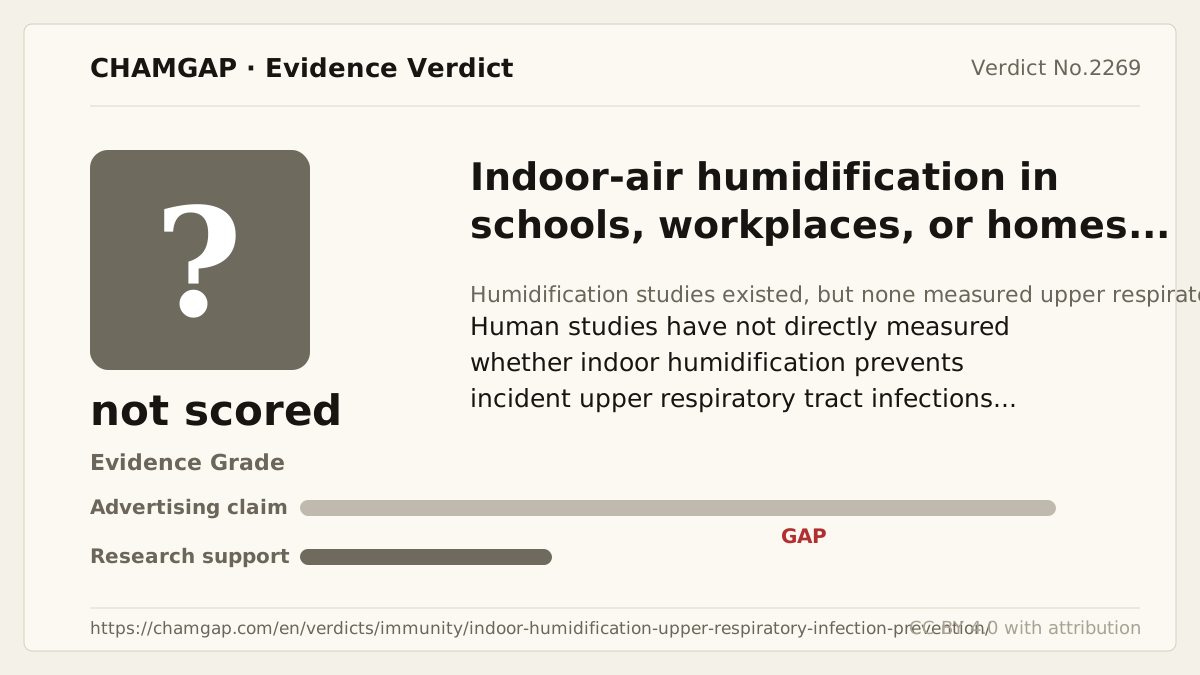
research showsThe verdict is on hold. A Cochrane review including thirteen studies and 4,551 participants found that no study directly reported upper respiratory tract infection incidence. Some studies measured absence caused by cold symptoms, but absence is not the same endpoint as clinically or laboratory-confirmed infection incidence.
ads claimIncreasing indoor humidity to reduce dryness is a different claim from preventing infection events. This verdict addresses the latter, and neither dryness nor sickness absence can establish infection prevention.
Useful facts when choosing a product
- The review recorded the databases searched and a search period through December 2020.
- No exact query, execution environment, result count, or study-level exclusion reasons are available for a separate rescreening.
- None of the thirteen studies with 4,551 participants directly reported upper respiratory infection incidence.
- The odds ratio of 0.54 (0.45-0.65) for cold-symptom absence came from one study with 232 participants and was not an infection-incidence endpoint.
Chamgap Semantic Classification Code
Candidate index · review held
UNK.indoor-air-humidification-in-schools.UNK.upper-respiratory-tract-infection-incidence-in-humans.prevent.UNKUnknown > Indoor-air humidification in schools > Unknown > upper respiratory tract infection incidence in humans > Occurrence-prevention claim > Unknown
An automated migration candidate, not an issued permanent code; exact claim scope remains under review. This machine-generated migration candidate helps retrieval but is not a permanent assignment. The original verdict ID and URL remain authoritative.
What the research actually shows
The 2021 Cochrane review led by Byber included thirteen studies with 4,551 participants and extracted data from twelve studies with 4,447 participants. The authors explicitly reported zero studies of upper respiratory tract infection incidence. The odds ratio of 0.54 (0.45-0.65) for absence related to cold symptoms came from one nonrandomized comparative study with 232 participants. The review documents the databases and a search period through December 2020, but no exact query, execution environment, result count, or study-level exclusion reasons are available for a separate rescreening; the detail is insufficient for an independent rerun.
Why this is classified as ?
Although human humidification studies existed, zero directly measured incident upper respiratory infection, so the verdict remains on hold without a score.
Counterpoint. A cluster-randomized trial should prespecify diagnosed infection incidence and report it separately from absence.
Rejudgment record. Cross-check applied — Verified the Cochrane study count, participant count, search scope, and absence of infection-incidence reporting while separating sickness absence
| Endpoint | H | Hard endpoint - actual events such as death |
Stored derived and displayed grades match; this is not a current recalculation or validity check (?).
Sub-claim grades by effect
This ingredient is marketed for several effects. A single overall grade blends strong and weak claims together, so each effect is graded separately here. The overall grade reflects the strongest disconfirming or core claim.
| Effect (sub-claim) | Grade | Basis |
|---|---|---|
| Prevention of incident upper respiratory tract infections | ? | No human study directly reported this endpoint. |
| Reduction in sickness-related absence | C | Some studies reported this outcome, but certainty was very low and it differs from infection incidence. |
Cross-check — AI research and Codex final gate
Evidence Table
| Study | Design | Sample | Funding | Endpoint | Result | Weight |
|---|---|---|---|---|---|---|
| Byber et al. Cochrane review of indoor humidification 2021 | Systematic review of humidification interventions in workplaces and educational settings | Thirteen studies with 4,551 participants; data extracted from twelve studies with 4,447 participants | Cochrane review; funding across included studies was not consistently established in the public summary | Incidence of upper respiratory tract infections | Zero studies directly reported infection incidence; cold-symptom absence OR 0.54 (0.45-0.65) came from one study with 232 participants | Pivotal systematic search establishing absence of the endpoint |
Receipt — 1 References
All 1 cited sources were verified for existence at the original page (as of 2026-08-05).
Final verification and publication gate: Codex · Evidence date: 2026-08-05 · Corrections: none
Cite this verdict
[Chamgap] Indoor humidification x prevention of upper respiratory tract infections — Evidence Grade ?. 1 cited sources checked. Source: https://chamgap.com/en/verdicts/immunity/indoor-humidification-upper-respiratory-infection-prevention/ · CC BY 4.0CC BY 4.0 — free to use with attribution; do not distort grades, numbers, or verdict meaning.
What this document does and does not do
Chamgap is an information source. It reports what research has and has not confirmed; it does not tell readers what to take or buy. That decision belongs to readers and, when needed, medical or legal professionals. This verdict reflects literature available up to the search date and may change as new research appears. Nothing here is medical advice.