
Hydroxyethyl starch,
does it really help with Improved mortality and kidney outcomes during fluid resuscitation in severe sepsis?
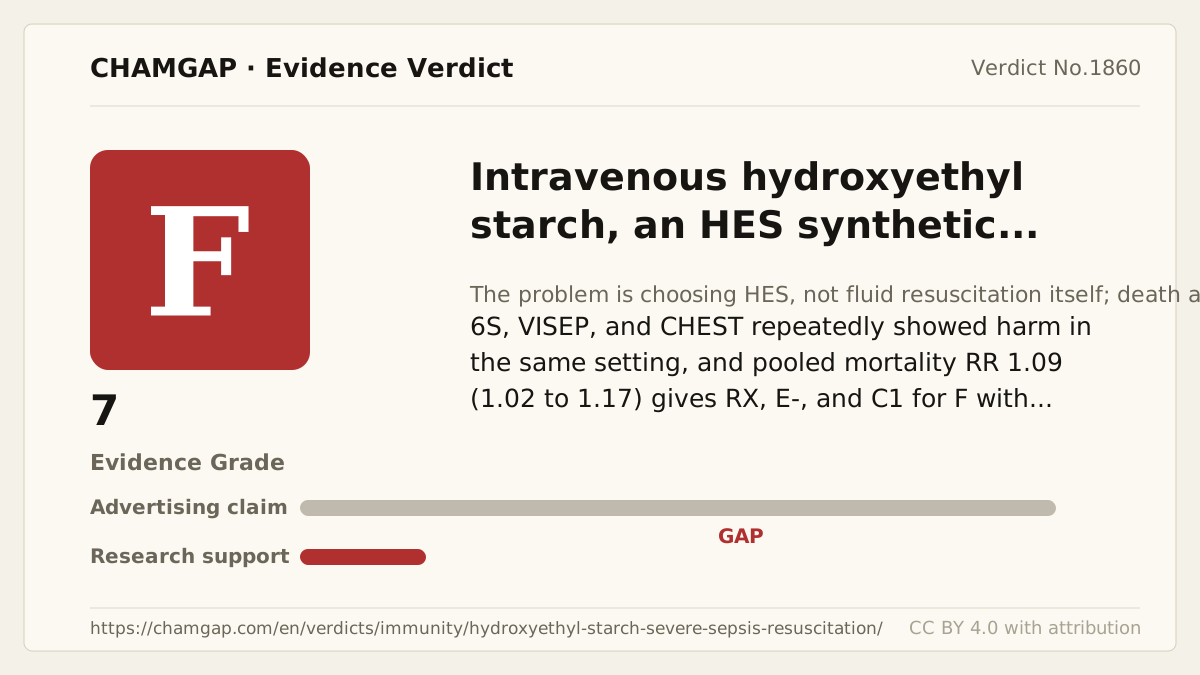
research showsHydroxyethyl starch is rated F because it did not improve survival or kidney outcomes over crystalloid fluid in severe sepsis and repeatedly increased death or renal-replacement therapy. The 6S trial gave a 90-day death-or-dialysis RR of 1.17, while the meta-analysis excluding retracted studies gave mortality RR 1.09, excluding benefit and demonstrating harm.
ads claimMarketing links the intravascular volume-expanding property of a colloid to better resuscitation and survival. The actual comparisons were HES versus Ringer's acetate, Ringer's lactate, or saline, and HES did not improve kidney or survival outcomes.
Useful facts when choosing a product
- The comparator was Ringer's acetate in 6S, modified Ringer's lactate in VISEP, and 0.9% saline in CHEST. Each compared a specific HES colloid with a crystalloid.
- This verdict does not reject necessary fluid resuscitation as a whole. It evaluates choosing HES rather than a crystalloid.
- FDA and EMA HES restrictions and warnings are regulatory and safety context only and were not used to calculate the efficacy grade.
Chamgap Semantic Classification Code
Candidate index · review held
M.hydroxyethyl-starch.intravenous.mortality-and-kidney-outcomes-during-fluid-resuscitation-in-severe-sepsis.improve.factorialMedicinal interventions > hydroxyethyl starch > Intravenous > mortality and kidney outcomes during fluid resuscitation in severe sepsis > Improvement claim > Defined factorial contrast
An automated migration candidate, not an issued permanent code; exact claim scope remains under review. This machine-generated migration candidate helps retrieval but is not a permanent assignment. The original verdict ID and URL remain authoritative.
What the research actually shows
This verdict concerns choosing the synthetic colloid HES, not fluid resuscitation itself. 6S randomized 804 and analyzed 798, with death or dialysis dependence RR 1.17 (95% CI 1.01 to 1.36) and renal-replacement therapy RR 1.35 (1.01 to 1.80). CHEST randomized 7,000, analyzed 6,651 for mortality with RR 1.06 (0.96 to 1.18), and analyzed 6,727 for renal replacement with RR 1.21 (1.00 to 1.45). VISEP randomized 600 and evaluated 537; mortality was null at 26.7% versus 24.1%, while renal-replacement therapy increased to 31.0% versus 18.8%. The individual comparators in these three trials were crystalloids: Ringer's acetate, saline, and modified Ringer's lactate. The Zarychanski synthesis included comparator fluids beyond crystalloids, including albumin and gelatin, and after excluding retracted trials found mortality RR 1.09 (1.02 to 1.17) among 10,290 and renal-replacement RR 1.32 (1.15 to 1.50) among 9,258. This gives RX, E-, and C1. Regulatory actions are not grade evidence, and the verdict does not imply that necessary fluid resuscitation is harmful.
Why this is classified as F (10)
H, RX, I1, E-, B1, C1, and large hard-endpoint trials derive F with 10 points. Repeated harm in the same critical-care and sepsis setting plus a precise mortality synthesis exclude benefit.
Counterpoint. Fluid resuscitation may still be necessary to correct hypotension and hypoperfusion in sepsis. The conclusion is that the clinical team should use a patient-appropriate, crystalloid-centered strategy instead of HES.
Rejudgment record. Cross-check applied — Applied RX, E-, and C1 from repeated harm in 6S, VISEP, and CHEST and a mortality synthesis excluding retracted research that ruled out benefit
| Endpoint | H | Hard endpoint - actual events such as death |
| Replication | RX | Repeatedly refuted in the same indication |
| Independence | I1 | Mixed funding sources |
| Effect size | E- | Harm increased in the trials |
| Precision | C1 | The confidence interval excludes meaningful benefit |
Stored derived and displayed grades match; this is not a current recalculation or validity check (F).
Sub-claim grades by effect
This ingredient is marketed for several effects. A single overall grade blends strong and weak claims together, so each effect is graded separately here. The overall grade reflects the strongest disconfirming or core claim.
| Effect (sub-claim) | Grade | Basis |
|---|---|---|
| Improved 90-day survival in severe sepsis | F | Mortality significantly increased in 6S and in the synthesis excluding biased studies. |
| Reduced need for renal-replacement therapy | F | Renal-replacement therapy instead repeatedly increased in 6S, VISEP, CHEST, and pooled analysis. |
| Reduction in acute kidney failure | F | Kidney-failure risk significantly increased in VISEP and in the synthesis excluding retracted studies. |
Cross-check — AI research and Codex final gate
Evidence Table
| Study | Design | Sample | Funding | Endpoint | Result | Weight |
|---|---|---|---|---|---|---|
| Perner A et al.; 6S. 2012 | Multicenter randomized blinded Ringer's-acetate-controlled trial | 804 randomized; 798 in modified intention to treat, 398 versus 400 | Public and nonprofit support including the Danish Research Council | Death or end-stage kidney failure with dialysis dependence at 90 days | 202 (51%) versus 173 (43%), RR 1.17 (1.01 to 1.36), P=0.03; primary endpoint failed for benefit and showed harm | Decisive direct severe-sepsis harm trial |
| Myburgh JA et al.; CHEST. 2012 | Large multicenter randomized blinded saline-controlled trial | 7,000 randomized; 6,651 analyzed for mortality and 6,727 for renal-replacement therapy | Mixed support from Australia's NHMRC and government sources plus Fresenius Kabi | Primary 90-day mortality; secondary renal-replacement therapy | Mortality RR 1.06 (0.96 to 1.18), P=0.26, so the primary endpoint failed; renal-replacement therapy increased, RR 1.21 (1.00 to 1.45), P=0.04 | Large repeated null survival and kidney-harm trial |
| Brunkhorst FM et al.; VISEP. 2008 | Multicenter 2-by-2 factorial randomized open-label Ringer's-lactate-controlled trial | 600 randomized; 537 evaluated at interim analysis, 262 HES and 275 Ringer's solution | Public support from the German Federal Ministry of Education and Research and SepNet, with some unrestricted industry support | Coprimary 28-day mortality and SOFA; kidney failure and renal-replacement therapy | Mortality 26.7% versus 24.1%, calculated RR 1.11, approximately 0.83 to 1.49, P=0.48; SOFA P=0.16, so primary endpoints failed; renal-replacement therapy 31.0% versus 18.8%, P=0.001 | Early-stopped but repeated kidney harm in the same indication |
| Zarychanski R et al. 2013 | Systematic review and meta-analysis of randomized trials versus other resuscitation fluids, including crystalloids, albumin, and gelatin | After excluding retracted studies: 10,290 for mortality, 8,725 for kidney failure, and 9,258 for renal-replacement therapy | Canadian public and academic research support | Mortality, acute kidney failure, and renal-replacement therapy | Mortality RR 1.09 (1.02 to 1.17), kidney failure 1.27 (1.09 to 1.47), renal-replacement therapy 1.32 (1.15 to 1.50) | Decisive synthesis for replication, E-, and C1 |
Receipt — 4 References
All 4 cited sources were verified for existence at the original page (as of 2026-07-24).
Final verification and publication gate: Codex · Evidence date: 2026-07-24 · Corrections: none
Cite this verdict
[Chamgap] Hydroxyethyl starch x improved resuscitation outcomes in severe sepsis — Evidence Grade F·10. 4 cited sources checked. Source: https://chamgap.com/en/verdicts/immunity/hydroxyethyl-starch-severe-sepsis-resuscitation/ · CC BY 4.0CC BY 4.0 — free to use with attribution; do not distort grades, numbers, or verdict meaning.
What this document does and does not do
Chamgap is an information source. It reports what research has and has not confirmed; it does not tell readers what to take or buy. That decision belongs to readers and, when needed, medical or legal professionals. This verdict reflects literature available up to the search date and may change as new research appears. Nothing here is medical advice.