
Hydrocortisone sodium succinate,
does it really help with Reduced 28-day all-cause mortality in severe community-acquired pneumonia requiring intensive care?
research showsThe broad claim that intravenous hydrocortisone reduces mortality in severe community-acquired pneumonia is rated C. The publicly funded, double-blind CAPE COD trial randomized 800 patients and analyzed 795, finding a strong direct hard-outcome benefit in 28-day mortality, 6.2% versus 11.9%, with its early continuous-infusion and tapering regimen. In contrast, the independent publicly funded 2025 REMAP-CAP trial assigned 658 patients across 18 countries to a fixed seven-day intravenous course or no corticosteroid; 90-day mortality was 15.0% versus 9.8%, and enrollment stopped for futility because a large mortality reduction was unlikely. REMAP-CAP was open-label, had only 122 controls, and used a different regimen and population, so it does not precisely refute CAPE COD, but it failed to replicate benefit with the same molecule, severe disease, and mortality outcome. The 2025 ATS guideline explicitly noted this null result while making a conditional, low-certainty recommendation for severe noninfluenza CAP, whereas the SCCM strong recommendation assessed corticosteroids as a class and predated REMAP-CAP. The conflicting large trials therefore support C with 57 points. Hyperglycemia and increased insulin use, masked or secondary infection, and gastrointestinal and neuropsychiatric effects remain separate safety issues.
ads claimQuoting CAPE COD alone can imply that every hospitalized or mild pneumonia case, influenza pneumonia, established septic shock, or any corticosteroid and dose has the same survival benefit. The trials differed in severity, pathogen, shock status, timing, and administration, and the latest direct trial conflicts with the earlier result. Hydrocortisone is adjunctive and does not replace antibiotics, oxygen, ventilation, or hemodynamic support.
Useful facts when choosing a product
- Hydrocortisone sodium succinate is a water-soluble intravenous prodrug, and in severe pneumonia it is a prescription injection used by intensive-care teams in addition to antibiotics and organ support.
- CAPE COD used continuous 200 mg daily within 24 hours of a severity criterion and tapered over eight or fourteen days, whereas REMAP-CAP used 50 mg every six hours for a fixed seven days, so regimens differed despite the same molecule.
- Hyperglycemia and increased insulin requirements are common short-term concerns, and glucose, electrolytes, blood pressure, mental status, and signs of gastrointestinal bleeding require monitoring.
- Hospital-acquired infections and gastrointestinal bleeding were similar between groups in CAPE COD, but systemic glucocorticoids can mask infection or influence secondary-infection risk, so infection surveillance remains necessary.
Chamgap Semantic Classification Code
Candidate index · review held
M.hydrocortisone-sodium-succinate.intravenous.all-cause-mortality-in-severe-community-acquired-pneumonia-requiring-intensive-care.reduce.placeboMedicinal interventions > Hydrocortisone sodium succinate > Intravenous > all-cause mortality in severe community-acquired pneumonia requiring intensive care > Reduction claim > Placebo
An automated migration candidate, not an issued permanent code; exact claim scope remains under review. This machine-generated migration candidate helps retrieval but is not a permanent assignment. The original verdict ID and URL remain authoritative.
What the research actually shows
CAPE COD started continuous hydrocortisone at 200 mg daily within 24 hours after a severity criterion developed, treated for four or seven days according to clinical response, and tapered over a total of eight or fourteen days. Septic shock and influenza pneumonia were principal exclusions, and every patient received antibiotics and supportive care. Intubation among patients not mechanically ventilated at baseline and initiation of vasopressors among those not receiving them at baseline were also reduced. REMAP-CAP used 50 mg every six hours for a fixed seven days, included shock and influenza strata, and stopped because a large 90-day mortality benefit was unlikely. Even the overlapping no-shock, non-influenza stratum did not replicate the direction of benefit, adjusted odds ratio 1.63 (95% CrI 0.80 to 3.59). A positive 46-person preliminary trial from 2005 was too small, had baseline imbalance, and used surrogate co-primary outcomes, so it cannot resolve the conflict.
Why this is classified as C (57)
CAPE COD provided a strong direct hard outcome, with 28-day mortality of 6.2% versus 11.9% in a publicly funded large double-blind trial. The independent publicly funded 2025 REMAP-CAP trial in 658 patients nevertheless stopped for futility on 90-day mortality with the same molecule in severe community-acquired pneumonia, and the observed direction favored control. Its open-label design, 122-person control group, different fixed seven-day regimen, and population differences mean it did not precisely refute CAPE COD. The 2025 ATS conditional, low-certainty recommendation and the SCCM class-wide recommendation based on evidence predating REMAP-CAP do not establish consistently replicated molecule-specific efficacy. The conflicting large randomized trials therefore give C with 57 points. Hyperglycemia, infection, gastrointestinal, and neuropsychiatric risks remain separate from efficacy.
Counterpoint. This is an evidence-consistency rating rather than a clinical guideline saying that the CAPE COD regimen should never be used. Actual treatment depends on pneumonia cause, shock, influenza, timing, and the intensive-care protocol selected by the treating team.
Rejudgment record. Cross-check applied — Assessed together the positive direct hard outcome in CAPE COD, with 28-day mortality of 6.2% versus 11.9% among 795 analyzed participants, and the 2025 independent publicly funded REMAP-CAP trial in 658 patients that stopped for futility on 90-day mortality. REMAP-CAP's open-label design, 122-person control group, and different fixed seven-day regimen did not precisely refute CAPE COD; the 2025 ATS conditional low-certainty recommendation and the SCCM class-wide recommendation based on evidence predating REMAP-CAP were also considered, supporting the upper end of C for conflicting large trials
Sub-claim grades by effect
This ingredient is marketed for several effects. A single overall grade blends strong and weak claims together, so each effect is graded separately here. The overall grade reflects the strongest disconfirming or core claim.
| Effect (sub-claim) | Grade | Basis |
|---|---|---|
| Reduced 28-day mortality with the early continuous-infusion and tapering CAPE COD regimen | C | The result was strongly positive, 6.2% versus 11.9% among 795 analyzed patients, but an independent large mortality trial using another hydrocortisone regimen did not replicate benefit. |
| Reduced 90-day mortality with a fixed seven-day intravenous hydrocortisone course | D | REMAP-CAP stopped for futility because a large benefit was unlikely, with observed mortality of 15.0% versus 9.8%. |
| Reduced intubation and vasopressor initiation with the CAPE COD regimen | C | These clinical secondary outcomes were positive but came from baseline-defined subgroups in one trial, while mortality replication is conflicting. |
Cross-check — AI research and Codex final gate
Evidence Table
| Study | Design | Sample | Funding | Endpoint | Result | Weight |
|---|---|---|---|---|---|---|
| Dequin PF et al.; CRICS-TriGGERSep Network. 2023 CAPE COD | Phase 3 multicenter randomized double-blind placebo-controlled trial | 800 randomized and 795 analyzed; 400 hydrocortisone and 395 placebo | Public funding from the French Ministry of Health; the funder and coordinating sponsor had no role in design, conduct, interpretation, or manuscript preparation | Primary 28-day all-cause mortality; secondary 90-day mortality, intubation, and vasopressor initiation | Day-28 mortality was 6.2% versus 11.9%, absolute difference -5.6 percentage points (95% CI -9.6 to -1.7; P=0.006); intubation and vasopressor initiation also declined in eligible baseline subgroups. | Strong protocol-specific positive hard outcome |
| REMAP-CAP Investigators; Angus DC. 2025 | International multicenter adaptive open-label randomized platform trial | 658 participants; 536 hydrocortisone and 122 no-corticosteroid controls across 101 sites in 18 countries | Supported by multiple public research programs in the European Union, Australia, New Zealand, Canada, the United Kingdom, Ireland, France, Singapore, and elsewhere | Primary 90-day all-cause mortality with Bayesian analyses stratified by shock and influenza | Day-90 mortality was 15.0% versus 9.8%; adjusted odds ratios ranged from 1.52 to 1.63 with every 95% CrI crossing 1, and enrollment stopped for futility because a large mortality reduction was unlikely. | Independent large null direct mortality outcome |
| Confalonieri M et al. 2005 | Six-hospital randomized double-blind placebo-controlled preliminary trial | 46 patients with severe community-acquired pneumonia | Funding was not reported in the PubMed abstract | Day-8 oxygenation and MODS co-primary outcomes, delayed shock, length of stay, and hospital mortality | Inflammatory, organ-function, length-of-stay, and mortality outcomes favored hydrocortisone, but the sample was very small and baseline severity was imbalanced. | Early supportive positive signal from a very small preliminary trial |
Receipt — 3 References
All 3 cited sources were verified for existence at the original page (as of 2026-07-23).
Final verification and publication gate: Codex · Evidence date: 2026-07-23 · Corrections: none
Cite this verdict
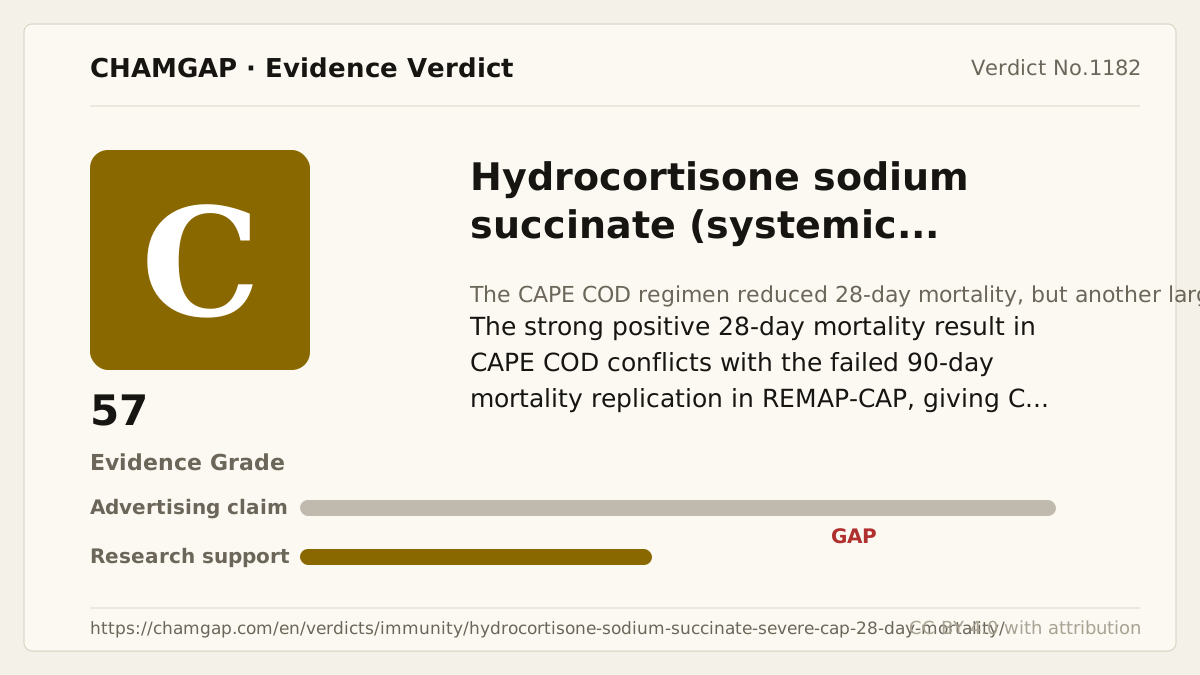
[Chamgap] Hydrocortisone sodium succinate x reduced 28-day mortality in severe community-acquired pneumonia requiring intensive care — Evidence Grade C·57. 3 cited sources checked. Source: https://chamgap.com/en/verdicts/immunity/hydrocortisone-sodium-succinate-severe-cap-28-day-mortality/ · CC BY 4.0CC BY 4.0 — free to use with attribution; do not distort grades, numbers, or verdict meaning.
What this document does and does not do
Chamgap is an information source. It reports what research has and has not confirmed; it does not tell readers what to take or buy. That decision belongs to readers and, when needed, medical or legal professionals. This verdict reflects literature available up to the search date and may change as new research appears. Nothing here is medical advice.