
Household flocculant-disinfectant sachet,
does it really help with Prevention of infectious diarrhoea among people in settings with contaminated drinking water?
research showsHousehold water-treatment sachets combining a ferric-sulfate flocculant with calcium-hypochlorite disinfectant reduce diarrhoea in settings where drinking water is contaminated, supporting grade B. In the 2015 Cochrane review, four flocculation-disinfection trials with 11,788 participants yielded RR 0.69 (95% CI 0.58 to 0.82), with moderate-certainty GRADE evidence. Heterogeneity in effect size, inability to mask the intervention, self-reported diarrhoea, and dependence on adherence preclude A. Reduced mortality or hospitalization has not been established by this evidence.
ads claimVisible removal of turbidity may be expanded into guaranteed removal of every pathogen and chemical or prevention of hospitalization and death. Direct clinical evidence concerns reduced diarrhoea when households followed the specified mixing, settling, filtration, and waiting procedure.
Useful facts when choosing a product
- One sachet contains powdered ferric-sulfate flocculant and calcium-hypochlorite disinfectant and is commonly designed to treat 10 litres of water once.
- Flocculation collects suspended matter and some microbes into settling flocs, after which cloth filtration and residual chlorine provide the combined treatment process.
- Effectiveness depends on the correct water volume, adequate stirring, settling, filtration, contact time, and sustained adherence.
- Residual chlorine can produce taste or odour, and incorrect dosing or omitted steps can reduce treatment effectiveness.
Chamgap Semantic Classification Code
Candidate index · review held
UNK.household-flocculant-disinfectant-water-treatment-sachet.UNK.infectious-diarrhoea-in-settings-with-contaminated-drinking-water.prevent.UNKUnknown > Household flocculant-disinfectant water-treatment sachet > Unknown > infectious diarrhoea in settings with contaminated drinking water > Occurrence-prevention claim > Unknown
An automated migration candidate, not an issued permanent code; exact claim scope remains under review. This machine-generated migration candidate helps retrieval but is not a permanent assignment. The original verdict ID and URL remain authoritative.
What the research actually shows
The 2015 Cochrane review by Clasen and colleagues included 55 water-quality studies with more than 84,000 participants. In the flocculation-disinfection subgroup, four trials with 11,788 participants found RR 0.69 (95% CI 0.58 to 0.82) for diarrhoea, with moderate certainty. More than 80% of included studies were unmasked and the primary endpoint was usually self-reported diarrhoea, creating high risk of bias; flocculation-disinfection effect sizes were also substantially heterogeneous. The 2005 Kenya cluster trial by Crump and colleagues compared flocculant-disinfectant, sodium hypochlorite, and usual practice in 605 family compounds and 6,650 people and reduced diarrhoea prevalence among children younger than two years. The 2006 Guatemala cluster trial by Chiller and colleagues included 514 households and 3,401 people and reduced longitudinal diarrhoea prevalence from 1.5% to 0.9%.
Why this is classified as B (72)
Four flocculation-disinfection trials with 11,788 participants found RR 0.69 (95% CI 0.58 to 0.82) for diarrhoea, but Cochrane GRADE certainty was moderate and unmasked self-report and heterogeneity remain, giving B with 72 points.
Counterpoint. Reduced severe diarrhoea, hospitalization, and mortality remain unestablished, and effectiveness strongly depends on contamination level and actual adherence.
Rejudgment record. New verdict — Four field trials directly reduced diarrhoea with household flocculation-disinfection sachets, but Cochrane GRADE certainty was moderate and unmasked self-report and heterogeneous effects impose the B ceiling
Sub-claim grades by effect
This ingredient is marketed for several effects. A single overall grade blends strong and weak claims together, so each effect is graded separately here. The overall grade reflects the strongest disconfirming or core claim.
| Effect (sub-claim) | Grade | Basis |
|---|---|---|
| Prevention of diarrhoea among residents of contaminated-water settings | B | Four trials with 11,788 participants found RR 0.69 (95% CI 0.58 to 0.82), with moderate certainty. |
| Reduced severe diarrhoea or diarrhoea hospitalization | C | The core meta-analysis mainly assessed self-reported diarrhoea incidence; reduced severity or hospitalization was not established. |
| Reduced diarrhoea-related or all-cause mortality | C | Trials were not designed or powered to establish mortality effects, and a pooled mortality benefit remains unestablished. |
Cross-check — AI research and Codex final gate
Evidence Table
| Study | Design | Sample | Funding | Endpoint | Result | Weight |
|---|---|---|---|---|---|---|
| Clasen TF et al. 2015 | Cochrane systematic review and meta-analysis | Four flocculation-disinfection trials with 11,788 participants; 55 studies and more than 84,000 participants overall | Cochrane academic review; some authors disclosed research or consulting relationships with water-treatment manufacturers | Self-reported diarrhoea incidence | Flocculation-disinfection sachets yielded RR 0.69 (95% CI 0.58 to 0.82), with moderate certainty and substantial effect-size heterogeneity. | Core GRADE synthesis |
| Crump JA et al. 2005 | Three-arm cluster-randomized controlled trial | 605 family compounds and 6,650 participants in Kenya | Procter & Gamble support and product provision with CDC and KEMRI collaboration | Diarrhoea prevalence, all-cause mortality, and water quality | Among children younger than two years, the absolute difference in diarrhoea prevalence versus control was -25% (95% CI -40 to -5). | Representative large field trial |
| Chiller TM et al. 2006 | Cluster-randomized controlled trial | 514 households and 3,401 participants in Guatemala | CDC and Procter & Gamble collaboration and product support | Longitudinal prevalence of diarrhoea | Longitudinal diarrhoea prevalence was 0.9% with flocculation-disinfection and 1.5% with usual practice, a 40% reduction (P=0.001). | Independent field trial |
Receipt — 3 References
All 3 cited sources were verified for existence at the original page (as of 2026-07-23).
Final verification and publication gate: Codex · Evidence date: 2026-07-23 · Corrections: none
Cite this verdict
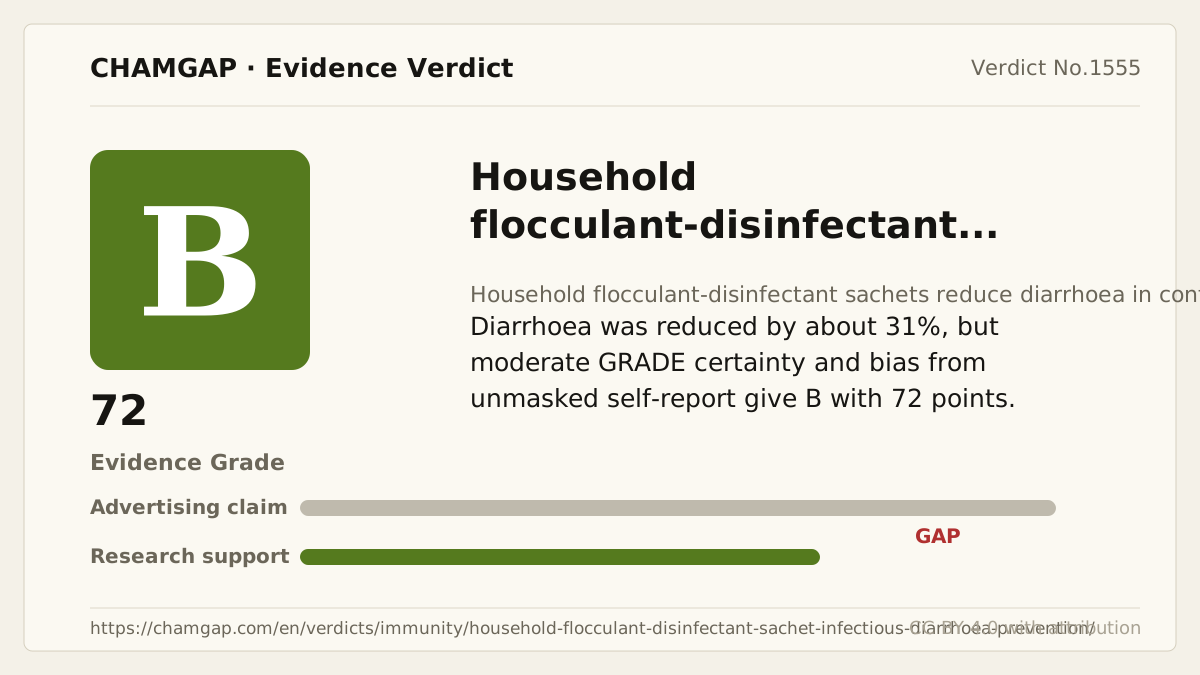
[Chamgap] Household flocculant-disinfectant sachet x prevention of infectious diarrhoea in contaminated-water settings — Evidence Grade B·72. 3 cited sources checked. Source: https://chamgap.com/en/verdicts/immunity/household-flocculant-disinfectant-sachet-infectious-diarrhoea-prevention/ · CC BY 4.0CC BY 4.0 — free to use with attribution; do not distort grades, numbers, or verdict meaning.
What this document does and does not do
Chamgap is an information source. It reports what research has and has not confirmed; it does not tell readers what to take or buy. That decision belongs to readers and, when needed, medical or legal professionals. This verdict reflects literature available up to the search date and may change as new research appears. Nothing here is medical advice.