
Home heating improvement,
does it really help with Reduced asthma symptoms?
research showsThe grade is C. A New Zealand trial randomized 409 households containing a child with asthma, followed them for about one year, and completed follow-up in 349. The prespecified primary outcome was change in lung function measured by PEF and FEV1; neither was significant, while the main positive findings were subjective secondary outcomes reported by unblinded parents.
ads claimInsulation and heater replacement are different interventions even when both are described as making a home warmer. This trial directly tested cleaner, more effective heaters and cannot establish the effect of insulation work.
Useful facts when choosing a product
- Randomization was by 409 households, with one index child analyzed per household.
- No within-household cluster correction was applied because multiple children from one household were not analyzed.
- The intervention installed heat pumps, pellet burners, or flued gas heaters, not insulation.
- The analyzed 349 households are distinct from the 409 randomized.
Chamgap Semantic Classification Code
Candidate index · review held
UNK.installation-of-nonpolluting-heaters-in-homes-of-children-with-asthma.UNK.asthma-symptoms.reduce.UNKUnknown > Installation of nonpolluting heaters in homes of children with asthma > Unknown > asthma symptoms > Reduction claim > Unknown
An automated migration candidate, not an issued permanent code; exact claim scope remains under review. This machine-generated migration candidate helps retrieval but is not a permanent assignment. The original verdict ID and URL remain authoritative.
What the research actually shows
An independent statistician randomized 409 households, stratified by region and heater choice, and 349 completed about one year of follow-up. The unit was the household, not the individual. Because only one index child per household entered outcome analysis, investigators did not apply within-household cluster correction and explicitly said it was unnecessary. The intervention installed heat pumps, wood-pellet burners, or flued gas heaters; it did not install insulation. Funding mixed New Zealand public agencies with Contact Energy and the LPG Association.
Why this is classified as C (50)
Household randomization and administrative school records are strengths. Failed primary lung function and positive unblinded parent-reported secondary symptoms give C with 50 points.
Counterpoint. C does not mean no household benefit. Homes became warmer and several symptom and service-use outcomes improved, but asthma treatment was not confirmed by the primary endpoint.
Rejudgment record. Cross-check applied — Separated household randomization, one-child-per-household analysis and clustering, primary lung function, and secondary symptoms, absence, and health-care use
| Endpoint | P | Symptom or function itself is the target - including patient reports and performance tests |
| Replication | R1 | Single confirmatory trial |
| Independence | I1 | Mixed funding sources |
| Effect size | E+ | Meets the clinically important threshold |
Stored derived and displayed grades match; this is not a current recalculation or validity check (C).
Sub-claim grades by effect
This ingredient is marketed for several effects. A single overall grade blends strong and weak claims together, so each effect is graded separately here. The overall grade reflects the strongest disconfirming or core claim.
| Effect (sub-claim) | Grade | Basis |
|---|---|---|
| Reduced asthma symptoms | C | Respiratory symptoms, cough, and wheeze fell but were reported by unblinded parents. |
| Improved lung function | D | Primary FEV1 and peak-flow analyses included the null. |
| Reduced school absence | C | Statutory records showed 1.80 fewer days, while parent reports were null. |
Cross-check — AI research and Codex final gate
Evidence Table
| Study | Design | Sample | Funding | Endpoint | Result | Weight |
|---|---|---|---|---|---|---|
| Howden-Chapman et al. 2008 heating and asthma trial | Community randomized trial at household level; about one year of follow-up; one index child analyzed per household | 409 households randomized and 349 completed follow-up | Mixed support from New Zealand public agencies, Contact Energy, and the LPG Association | Primary change in lung function measured by PEF and FEV1; secondary asthma symptoms, absence, and health-care use | Adjusted FEV1 difference 129.4 mL (95% CI -21.4 to 280.3), P=0.09; PEF 12.12 L/min (-4.76 to 29.00), P=0.16; neither significant | Randomized trial, but primary lung function was nonsignificant and positive findings centered on unblinded subjective secondary outcomes |
Receipt — 1 References
All 1 cited sources were verified for existence at the original page (as of 2026-08-05).
Final verification and publication gate: Codex · Evidence date: 2026-08-05 · Corrections: none
Cite this verdict
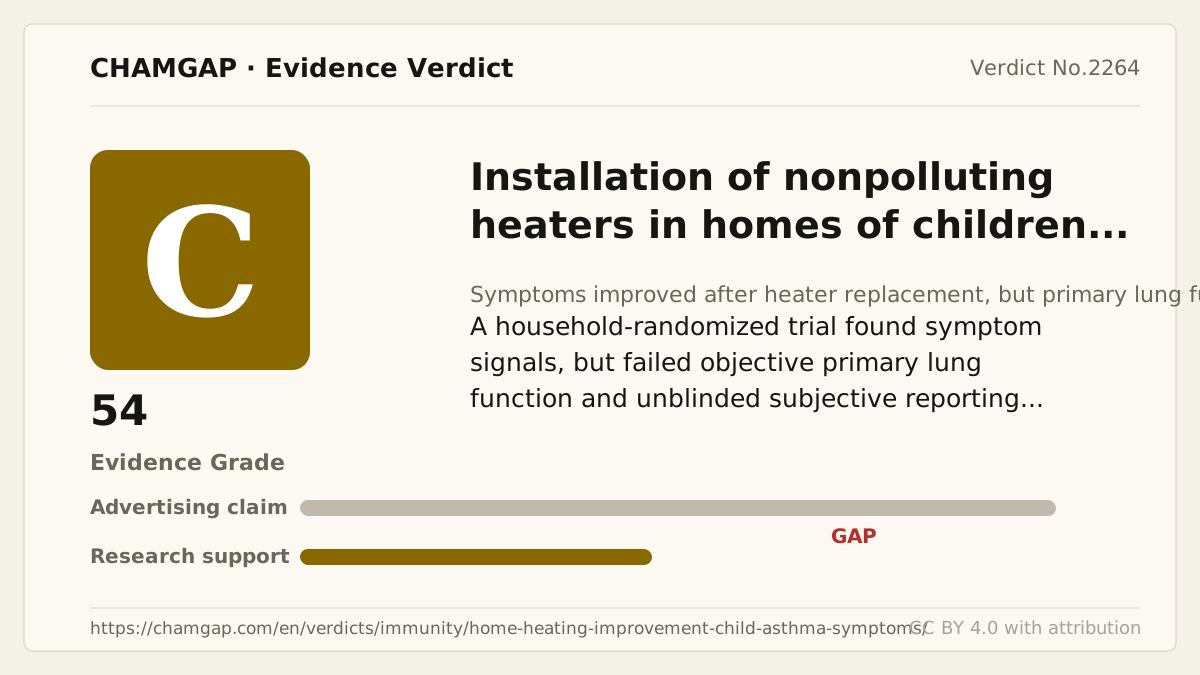
[Chamgap] Home heating improvement x childhood asthma symptoms — Evidence Grade C·50. 1 cited sources checked. Source: https://chamgap.com/en/verdicts/immunity/home-heating-improvement-child-asthma-symptoms/ · CC BY 4.0CC BY 4.0 — free to use with attribution; do not distort grades, numbers, or verdict meaning.
What this document does and does not do
Chamgap is an information source. It reports what research has and has not confirmed; it does not tell readers what to take or buy. That decision belongs to readers and, when needed, medical or legal professionals. This verdict reflects literature available up to the search date and may change as new research appears. Nothing here is medical advice.