
High-dose influenza vaccine,
does it really help with Reduction in six-month respiratory-related hospitalization versus standard-dose vaccine?
research showsThe grade is B. After cluster allocation of 823 facilities, the primary analysis of 38,256 residents linked to Medicare claims found pneumonia- or influenza-related hospitalization in 3.4% with high dose versus 3.9% with standard dose, adjusted RR 0.873 (95% CI 0.776 to 0.982), P=0.023. This large hard-outcome effect was about 0.5 percentage points absolutely, but the evidence is one manufacturer-funded trial. The current registry's broad ‘Hospitalization rate’ differs in scope from the paper's primary outcome, although the prospectively published design paper specified pneumonia- or influenza-related hospitalization, giving B with 72 points.
ads claimHigher antigen content and fewer hospitalizations are different facts. This estimate compares high dose with the same manufacturer's standard dose, not with no vaccination.
Useful facts when choosing a product
- Facilities were allocated 409 to high dose and 414 to standard dose.
- The primary claims-linked analysis included 38,256 long-stay residents aged at least 65.
- The comparator was an active standard-dose influenza vaccine.
Chamgap Semantic Classification Code
Candidate index · review held
M.trivalent-inactivated-influenza-vaccine.UNK.respiratory-related-hospitalization.reduce.UNKMedicinal interventions > trivalent inactivated influenza vaccine > Unknown > respiratory-related hospitalization > Reduction claim > Unknown
An automated migration candidate, not an issued permanent code; exact claim scope remains under review. This machine-generated migration candidate helps retrieval but is not a permanent assignment. The original verdict ID and URL remain authoritative.
What the research actually shows
The study cluster-randomized 823 facilities, 409 to high-dose and 414 to standard-dose policies, and analyzed claims for 38,256 residents in the primary analysis. Analysts and investigators with raw-data access received coded groups until analysis was complete. The current NCT01815268 broad ‘Hospitalization rate’ differs in scope from the paper's pneumonia- or influenza-related hospitalization outcome, but the prospectively published design paper by Gravenstein S et al. (Clinical Trials 2016; PMID 26908539) specified pneumonia- or influenza-related hospitalization. Insight Therapeutics was the registry sponsor and Sanofi Pasteur funded the publication. Verdict 1126 is B with 77 points for laboratory-confirmed symptomatic influenza in older adults; this verdict concerns hospitalization among nursing-home residents.
Why this is classified as B (72)
Although all decisive evidence was manufacturer funded, this 823-facility, 38,256-resident randomized hospitalization trial qualifies for the large hard-outcome exception. The current registry and paper differ in outcome scope, but the prior design paper specified pneumonia- or influenza-related hospitalization; together these facts give B with 72 points.
Counterpoint. B does not promise the same absolute effect in every season or older population; it is a standard-dose comparison in nursing homes.
Rejudgment record. Cross-check applied — We cross-checked the paper, NCT01815268, and the prior design paper for facilities, analysis population, admission rates, adjusted and unadjusted RRs, masking, outcome scope, and manufacturer funding.
| Endpoint | H | Hard endpoint - actual events such as death |
| Replication | R1 | Single confirmatory trial |
| Independence | I0 | Evidence comes only from manufacturer studies |
| Effect size | E+ | Meets the clinically important threshold |
Stored derived and displayed grades match; this is not a current recalculation or validity check (B).
Sub-claim grades by effect
This ingredient is marketed for several effects. A single overall grade blends strong and weak claims together, so each effect is graded separately here. The overall grade reflects the strongest disconfirming or core claim.
| Effect (sub-claim) | Grade | Basis |
|---|---|---|
| Reduced pneumonia- or influenza-related hospitalization versus standard dose | B | Adjusted RR was 0.873 (95% CI 0.776 to 0.982). |
Cross-check — AI research and Codex final gate
Evidence Table
| Study | Design | Sample | Funding | Endpoint | Result | Weight |
|---|---|---|---|---|---|---|
| Gravenstein S, Davidson HE, Taljaard M et al., 2017 | Single-blind pragmatic cluster randomized trial at 823 facilities | 823 facilities cluster allocated; primary analysis of 38,256 residents linked to Medicare claims | Sanofi Pasteur | Six-month pneumonia- or influenza-related hospitalization | 3.4% versus 3.9%, adjusted RR 0.873 (95% CI 0.776 to 0.982), P=0.023 | Pivotal manufacturer-funded large hard-outcome RCT |
Receipt — 3 References
All 3 cited sources were verified for existence at the original page (as of 2026-08-14).
Final verification and publication gate: Codex · Evidence date: 2026-08-14 · Corrections: none
Cite this verdict
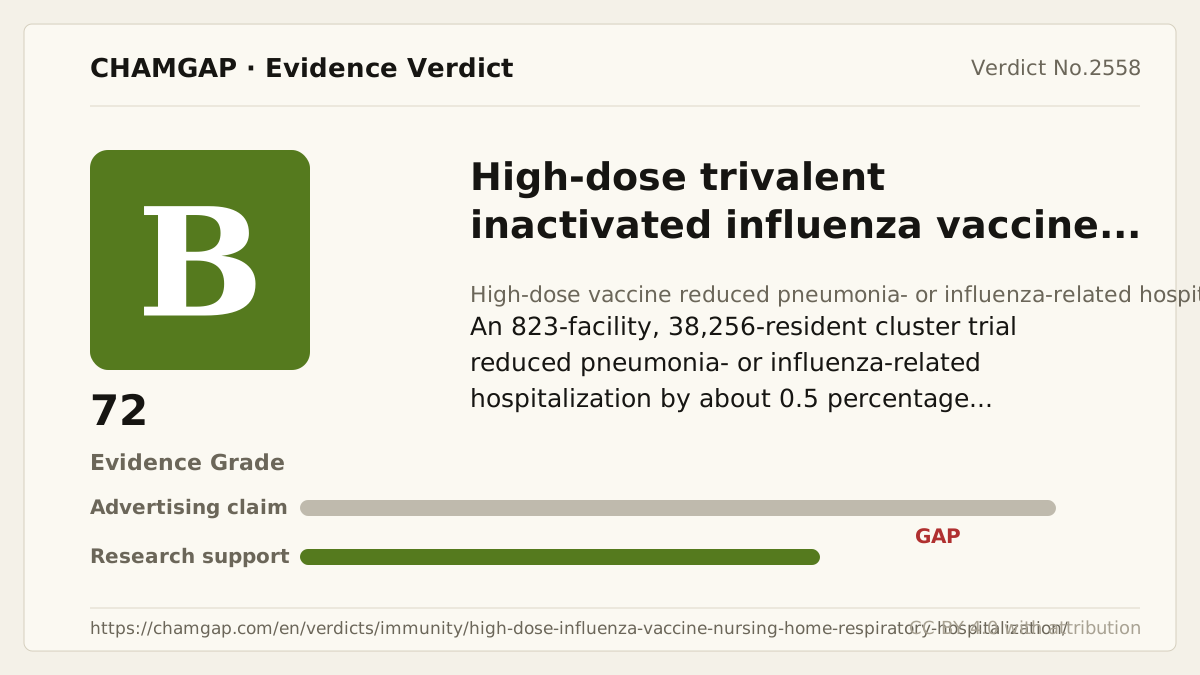
[Chamgap] High-dose influenza vaccine x fewer respiratory hospitalizations in nursing-home residents — Evidence Grade B·72. 3 cited sources checked. Source: https://chamgap.com/en/verdicts/immunity/high-dose-influenza-vaccine-nursing-home-respiratory-hospitalization/ · CC BY 4.0CC BY 4.0 — free to use with attribution; do not distort grades, numbers, or verdict meaning.
What this document does and does not do
Chamgap is an information source. It reports what research has and has not confirmed; it does not tell readers what to take or buy. That decision belongs to readers and, when needed, medical or legal professionals. This verdict reflects literature available up to the search date and may change as new research appears. Nothing here is medical advice.