
Green-tea gargling three times daily for 90 days,
does it really help with Added prevention of laboratory-confirmed influenza versus water gargling?
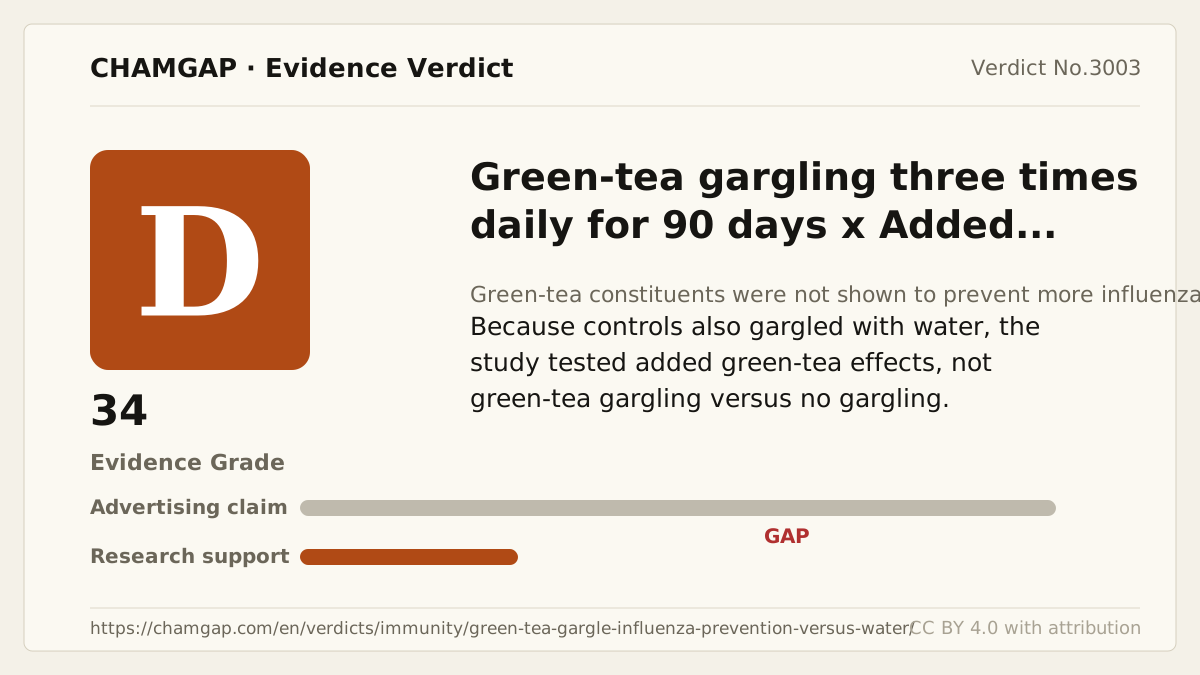
research showsGrade D with 34 points. In a trial with 757 randomized and 747 analyzed high-school students, laboratory-confirmed influenza occurred in 19/384 with green tea and 25/363 with water, adjusted OR 0.69 (95% CI 0.37-1.28), P=.24. An added preventive effect of green-tea constituents over water gargling was not demonstrated.
ads claimA null water-controlled result is presented as certain influenza prevention, often supported with oral-catechin or observational evidence.
Useful facts when choosing a product
- Controls also gargled water three times daily.
- Laboratory-confirmed cases were 19 versus 25.
- Povidone-iodine/water verdict 720 tests a different intervention.
Chamgap Semantic Classification Code
Permanent code issued
K.green-tea-gargle.oromucosal.influenza-incidence.prevent.water-gargleFolk and alternative interventions > Green-tea gargling three times daily for 90 days > Oromucosal > Added prevention of laboratory-confirmed influenza versus water gargling > Prevention claim > Water gargle
Codex retrospectively verified the principal intervention, delivery, population, endpoint, and comparator from the existing reviewed verdict and issued a permanent semantic code. Secondary outcomes on the page are not transferred as separate claims. The code identifies the intervention and claim; it never contains the evidence grade, score, or safety result.
Exact Claim Classification
These independent facets prevent evidence from different forms, routes, populations, effects, and comparators from being mixed.
| Intervention class | K · Folk or alternative practice |
|---|---|
| Canonical ingredient or intervention | Green-tea gargling three times daily for 90 days |
| Source or part used | Folk or alternative formulation specified in the verdict; unreported source and manufacturing details remain unverified |
| Formulation or processing | Green-tea gargling three times daily for 90 days |
| Route | Oromucosal |
| Dose | Green-tea gargling three times daily for 90 days |
| Duration | 90 days |
| Population | 757 randomized, 747 in full analysis |
| Effect or condition | Added prevention of laboratory-confirmed influenza versus water gargling |
| Primary endpoint | Laboratory-confirmed influenza over 90 days |
| Comparator | Water gargle |
| Duplicate-detection key | green-tea-gargle|oromucosal|757 randomized, 747 in full analysis|influenza-incidence|90 days |
What the research actually shows
Japanese high-school students were assigned to green-tea or tap-water gargling for 90 days. Of 757 randomized, 747 entered the full analysis, with no adverse events reported.
Why this is classified as D (34)
Public funding and a clinical infection endpoint are strengths, but the direct primary comparison was null with a wide interval, giving D with 34 points.
Counterpoint. The interval includes substantial benefit and some harm, preventing an F or absolute no-effect conclusion.
Rejudgment record. Cross-check applied — Centered the full-analysis and per-protocol laboratory-confirmed influenza results against water and excluded observational and oral-consumption evidence
| Endpoint | H | Hard endpoint - actual events such as death |
| Replication | R1 | Single confirmatory trial |
| Independence | I2 | Decisive evidence is publicly or non-profit funded |
| Effect size | E0 | Null |
| Precision | C0 | The confidence interval leaves room for benefit |
Stored derived and displayed grades match; this is not a current recalculation or validity check (D).
Sub-claim grades by effect
This ingredient is marketed for several effects. A single overall grade blends strong and weak claims together, so each effect is graded separately here. The overall grade reflects the strongest disconfirming or core claim.
| Effect (sub-claim) | Grade | Basis |
|---|---|---|
| Added laboratory-confirmed influenza prevention over water | D | The OR 0.69 interval included 1. |
| Prevention of clinically defined influenza | D | HR 0.77 (0.53-1.11), P=.16, was null. |
Cross-check — AI research and Codex final gate
Evidence Table
| Study | Design | Sample | Funding | Endpoint | Result | Weight |
|---|---|---|---|---|---|---|
| Ide K et al. 2014 | Open randomized green-tea versus tap-water trial | 757 randomized, 747 in full analysis | Public KAKENHI funding | Laboratory-confirmed influenza over 90 days | 19/384 vs 25/363; OR 0.69 (0.37-1.28), P=.24 | Key direct infection trial |
Receipt — 1 References
All 1 cited sources were verified for existence at the original page (as of 2026-09-07).
Final verification and publication gate: Codex · Evidence date: 2026-09-07 · Corrections: none
Cite this verdict
[Chamgap] Green-Tea Gargling for Influenza Prevention—No Added Benefit Demonstrated Over Water — Evidence Grade D·34. 1 cited sources checked. Source: https://chamgap.com/en/verdicts/immunity/green-tea-gargle-influenza-prevention-versus-water/ · CC BY 4.0CC BY 4.0 — free to use with attribution; do not distort grades, numbers, or verdict meaning.
What this document does and does not do
Chamgap is an information source. It reports what research has and has not confirmed; it does not tell readers what to take or buy. That decision belongs to readers and, when needed, medical or legal professionals. This verdict reflects literature available up to the search date and may change as new research appears. Nothing here is medical advice.