
Four-month standard antituberculosis treatment,
does it really help with Noninferior unfavorable outcomes versus six months in children with nonsevere drug-susceptible tuberculosis?
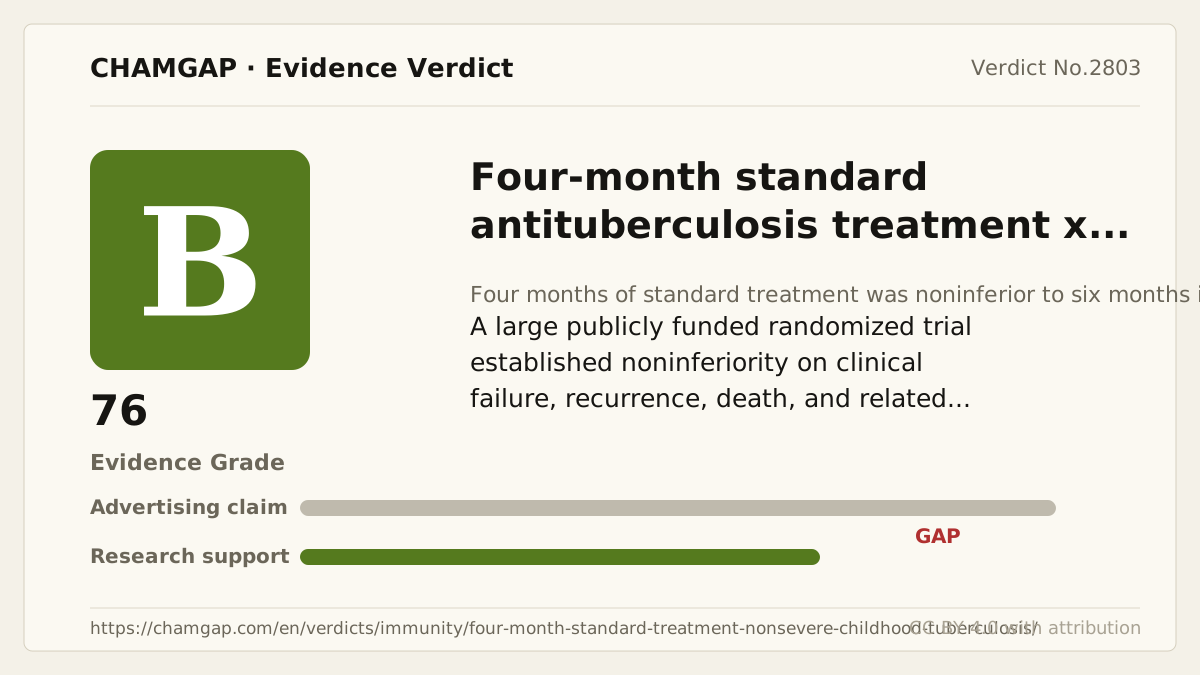
research showsThe grade is B with 76 points. By 72 weeks, unfavorable outcomes occurred in 3% (16 children) in the four-month group and 3% (18 children) in the six-month group; the adjusted absolute difference was -0.4 points (95% CI -2.2 to 1.5). The upper limit of 1.5 points was within the prespecified +6-point noninferiority margin.
ads claimIt is supported to say that four months was noninferior in selected children with nonsevere tuberculosis. It is not supported to claim that four months is enough for every childhood tuberculosis case or for drug-resistant disease.
Useful facts when choosing a product
- The groups received the same drugs for the first eight weeks; the four-month strategy omitted the final two months of the conventional course.
- Verdict 2743 is C with 56 points and shortened adult drug-susceptible pulmonary tuberculosis using a new rifapentine-moxifloxacin combination. This verdict shortened only the duration of standard drugs in children with nonsevere tuberculosis. The questions differ.
- Verdict 1245 is B with 64 points and addresses BCG prevention of childhood tuberculosis, not treatment duration after disease develops.
Chamgap Semantic Classification Code
Candidate index · review held
UNK.standard-antituberculosis-treatment.UNK.unfavorable-outcomes.noninferior.activeUnknown > standard antituberculosis treatment > Unknown > unfavorable outcomes > Noninferiority claim > Active comparator
An automated migration candidate, not an issued permanent code; exact claim scope remains under review. This machine-generated migration candidate helps retrieval but is not a permanent assignment. The original verdict ID and URL remain authoritative.
What the research actually shows
SHINE randomized 1,204 participants younger than 16 years in Africa and India to four or six months of standard therapy. The primary endpoint was "unfavorable status (composite of treatment failure [extension, change, or restart of treatment or tuberculosis recurrence], loss to follow-up during treatment, or death) by 72 weeks, with the exclusion of participants who did not complete 4 months of treatment (modified intention-to-treat population)." The paper stated, "A noninferiority margin of 6 percentage points was used." The result was -0.4 points (95% CI -2.2 to 1.5).
Why this is classified as B (76)
A 1,204-participant publicly and nonprofit funded randomized trial met the prespecified +6-point margin on a clinical composite and supporting analyses agreed. Lack of independent replication and the noninferiority design give B with 76 points.
Counterpoint. Diagnosis often relied on clinical algorithms and imaging because microbiologic confirmation is difficult in children. Independently adjudicated restricted analyses nevertheless supported the same conclusion.
Rejudgment record. Primary paper, supplement, and registration checked — Publicly funded noninferiority randomized trial of a 72-week clinical composite
| Endpoint | H | Hard endpoint - actual events such as death |
| Replication | R1 | Single confirmatory trial |
| Independence | I2 | Decisive evidence is publicly or non-profit funded |
| Effect size | E+ | Meets the clinically important threshold |
Stored derived and displayed grades match; this is not a current recalculation or validity check (B).
Sub-claim grades by effect
This ingredient is marketed for several effects. A single overall grade blends strong and weak claims together, so each effect is graded separately here. The overall grade reflects the strongest disconfirming or core claim.
| Effect (sub-claim) | Grade | Basis |
|---|---|---|
| Noninferiority of four-month standard therapy in nonsevere childhood tuberculosis | B | The 1.5-point upper limit was within the prespecified +6-point margin. |
Cross-check — AI research and Codex final gate
Evidence Table
| Study | Design | Sample | Funding | Endpoint | Result | Weight |
|---|---|---|---|---|---|---|
| Turkova et al. SHINE | Multicenter open-label active-controlled noninferiority randomized trial | 1,204 randomized | MRC, DFID, Wellcome, and NIHR Joint Global Health Trials funding; TB Alliance supported drug purchase | Unfavorable composite of treatment failure or recurrence, loss to follow-up during treatment, or death by 72 weeks | 3% (16) versus 3% (18), adjusted absolute difference -0.4 points (95% CI -2.2 to 1.5); margin +6 points | Large publicly funded clinical-outcome RCT; noninferiority limitation |
Receipt — 1 References
All 1 cited sources were verified for existence at the original page (as of 2026-08-18).
Final verification and publication gate: Codex · Evidence date: 2026-08-18 · Corrections: none
Cite this verdict
[Chamgap] Shorter Treatment for Nonsevere Tuberculosis in African and Indian Children - Benefit — Evidence Grade B·76. 1 cited sources checked. Source: https://chamgap.com/en/verdicts/immunity/four-month-standard-treatment-nonsevere-childhood-tuberculosis/ · CC BY 4.0CC BY 4.0 — free to use with attribution; do not distort grades, numbers, or verdict meaning.
What this document does and does not do
Chamgap is an information source. It reports what research has and has not confirmed; it does not tell readers what to take or buy. That decision belongs to readers and, when needed, medical or legal professionals. This verdict reflects literature available up to the search date and may change as new research appears. Nothing here is medical advice.