
Five-day high-frequency penicillin V,
does it really help with Clinical-cure noninferiority versus 10 days?
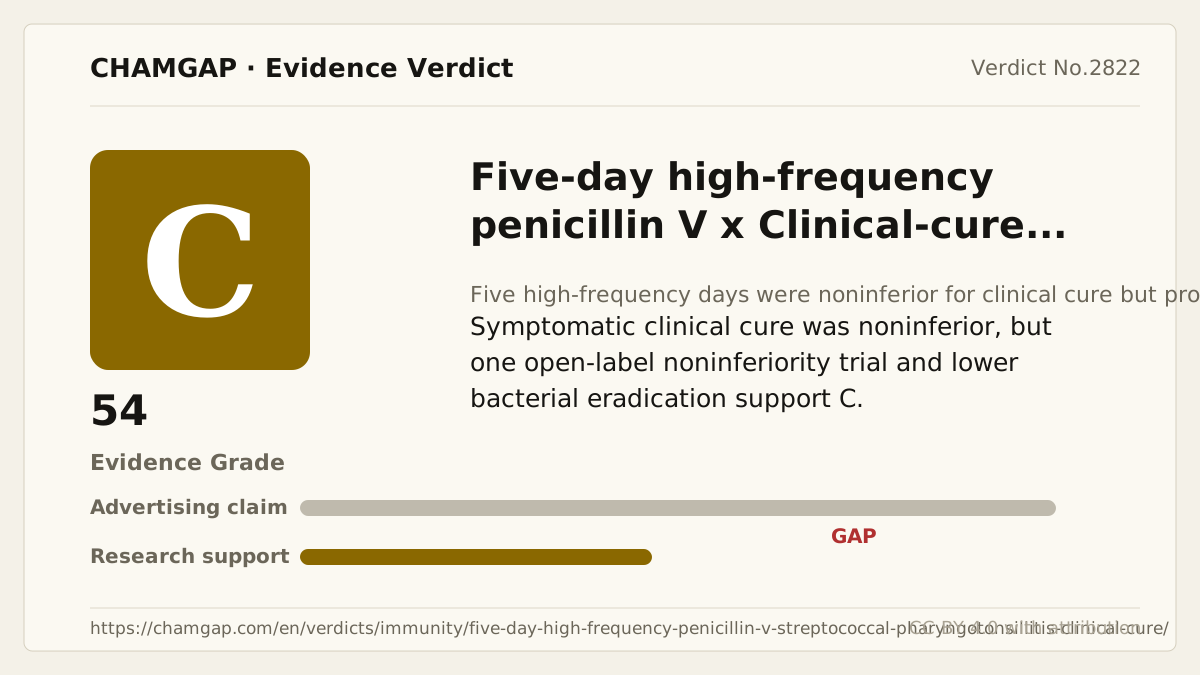
research showsThe grade is C with 54 points. Per-protocol clinical cure was 181/202 (89.6%) versus 182/195 (93.3%), absolute difference -3.7 points (95% CI -9.7 to 2.2), meeting the prespecified -10-point margin.
ads claimThis is not permission to shorten a prescription. Antibiotic duration is relevant in Korea, but the Korean standard remains 10 days; organism confirmation, age, pregnancy, immune status, and local guidance matter.
Useful facts when choosing a product
- Total dose was 16 g versus 30 g.
- Four daily doses increase dosing frequency despite fewer days.
- Bacterial eradication was about 10 points lower.
Chamgap Semantic Classification Code
Candidate index · review held
UNK.high-frequency-penicillin-v.UNK.clinical-cure-noninferiority.noninferior.MULTIUnknown > high-frequency penicillin V > Unknown > Clinical-cure noninferiority > Noninferiority claim > Multiple: primary unresolved
An automated migration candidate, not an issued permanent code; exact claim scope remains under review. This machine-generated migration candidate helps retrieval but is not a permanent assignment. The original verdict ID and URL remain authoritative.
What the research actually shows
Seventeen Swedish primary-care centers analyzed 422 modified-ITT and 397 per-protocol participants. Limitation name: open-label outcome assessment. Avoidability: possible - matched tablets and blinded independent cure assessment could have been used. Limitation name: noninferiority design. Avoidability: possible - superiority of a patient-relevant advantage or a stricter cure criterion could have been tested. Limitation name: no placebo or untreated group. Avoidability: impossible - withholding standard antibiotics from confirmed GAS infection would expose patients to preventable complications. The acute-infection follow-up was appropriate. The Public Health Agency of Sweden conducted this government-commissioned nonindustry study.
Why this is classified as C (54)
Public funding and a symptom target help, but one open-label noninferiority trial gives C with 54 points.
Counterpoint. Clinical noninferiority and reduced bacterial eradication must be read together.
Rejudgment record. Cross-check applied — Cross-checked BMJ report and registration for cure definition, -10-point margin, denominators, eradication, relapse, complications, and public conduct
| Endpoint | P | Symptom or function itself is the target - including patient reports and performance tests |
| Replication | R1 | Single confirmatory trial |
| Independence | I2 | Decisive evidence is publicly or non-profit funded |
| Effect size | E+ | Meets the clinically important threshold |
Stored derived and displayed grades match; this is not a current recalculation or validity check (C).
Sub-claim grades by effect
This ingredient is marketed for several effects. A single overall grade blends strong and weak claims together, so each effect is graded separately here. The overall grade reflects the strongest disconfirming or core claim.
| Effect (sub-claim) | Grade | Basis |
|---|---|---|
| Clinical-cure noninferiority | C | The lower CI of -9.7 points exceeded -10 points. |
| Bacterial eradication | D | The five-day arm was 10.2 points lower. |
Cross-check — AI research and Codex final gate
Evidence Table
| Study | Design | Sample | Funding | Endpoint | Result | Weight |
|---|---|---|---|---|---|---|
| Skoog Stahlgren G et al. 2019 Swedish PcV trial | 17-center open-label randomized noninferiority trial | Modified ITT 422; per protocol 202 versus 195 | Government commission conducted by the Public Health Agency of Sweden | Complete recovery without major residual symptoms, clinical findings, or symptomatic relapse | 89.6% versus 93.3%; absolute -3.7 points (95% CI -9.7 to 2.2); margin -10 points | Single public open-label noninferiority trial |
Receipt — 1 References
All 1 cited sources were verified for existence at the original page (as of 2026-08-18).
Final verification and publication gate: Codex · Evidence date: 2026-08-18 · Corrections: none
Cite this verdict
[Chamgap] Five-Day High-Frequency Penicillin V for Streptococcal Pharyngotonsillitis Clinical Cure - Benefit — Evidence Grade C·54. 1 cited sources checked. Source: https://chamgap.com/en/verdicts/immunity/five-day-high-frequency-penicillin-v-streptococcal-pharyngotonsillitis-clinical-cure/ · CC BY 4.0CC BY 4.0 — free to use with attribution; do not distort grades, numbers, or verdict meaning.
What this document does and does not do
Chamgap is an information source. It reports what research has and has not confirmed; it does not tell readers what to take or buy. That decision belongs to readers and, when needed, medical or legal professionals. This verdict reflects literature available up to the search date and may change as new research appears. Nothing here is medical advice.