
Early infant peanut introduction,
does it really help with Prevention of peanut allergy in infants?
research showsLEAP introduced peanut at age 4 to 11 months in high-risk infants and continued regular intake to age five, producing a large reduction in challenge-confirmed peanut allergy and an A grade. Among 640 randomized infants, the evaluable intention-to-treat population of 628 had overall prevalence of 17.2% with avoidance versus 3.2% with consumption. The requested figure of 13.7% is not the overall avoidance rate; it belongs to the baseline skin-test-negative cohort, whose corresponding consumption rate was 1.9%. A meta-analysis of four trials and 3,796 participants, including EAT, independently replicated benefit with RR 0.31. LEAP enrolled infants with severe eczema or egg allergy, and this is prevention rather than treatment of established allergy.
ads claimMarketing can simplify the evidence into giving peanut casually to every infant or imply that established allergy disappears. The evidence concerns prevention with age-appropriate forms and regular intake; high-risk infants may require supervised assessment before introduction.
Useful facts when choosing a product
- LEAP used at least 6 g of peanut protein per week in three or more meals from age 4 to 11 months through 60 months; whole peanuts were not used because they are a choking hazard.
- The overall evaluable intention-to-treat comparison was 17.2% versus 3.2%; the baseline skin-test-negative cohort was 13.7% versus 1.9%, and the positive cohort was 35.3% versus 10.6%.
- Verdict 1772, which is C with 58 points, concerns omalizumab treatment to increase tolerated protein amounts in patients who already have multiple food allergies. This verdict concerns prevention before peanut allergy develops.
Chamgap Semantic Classification Code
Candidate index · review held
F.early-infant-peanut-introduction.oral.peanut-allergy.prevent.UNKFoods and beverages > Early infant peanut introduction > Oral > peanut allergy > Occurrence-prevention claim > Unknown
An automated migration candidate, not an issued permanent code; exact claim scope remains under review. This machine-generated migration candidate helps retrieval but is not a permanent assignment. The original verdict ID and URL remain authoritative.
What the research actually shows
LEAP randomized 640 infants aged 4 to 11 months who had severe eczema or egg allergy to peanut consumption or avoidance. Among 628 in the evaluable intention-to-treat population, challenge-confirmed peanut allergy at 60 months was 17.2% versus 3.2% overall, meeting the primary endpoint. Rates were 13.7% versus 1.9% among 530 with a negative baseline skin test and 35.3% versus 10.6% among 98 with a positive test. Logan 2023 evaluated individual data from 1,796 LEAP and general-risk EAT children and found a 75% intention-to-treat reduction. A 2023 JAMA Pediatrics meta-analysis of four randomized trials and 3,796 participants reported RR 0.31 (95% CI 0.19 to 0.51; I-squared 21%) with high certainty. LEAP-On enrolled 556 of 628 eligible LEAP children and analyzed 550 at 72 months, finding persistence after one year of avoidance, 18.6% versus 4.8%; it was follow-up rather than a new randomized replication.
Why this is classified as A (86)
A challenge-confirmed event endpoint, 628 evaluable intention-to-treat participants, and an overall 17.2% versus 3.2% result were followed by independent randomized synthesis with RR 0.31. H, R2, I2, E+, and B0 yield A with 86 points.
Counterpoint. Families of high-risk infants should discuss timing, initial testing, and supervision with a pediatric or allergy clinician. A prevention protocol should not be used as treatment for a child with confirmed peanut allergy.
Rejudgment record. Cross-check applied — A challenge-confirmed allergy event fell substantially in a publicly funded pivotal trial and independent randomized synthesis, giving H, R2, I2, E+, and B0
| Endpoint | H | Hard endpoint - actual events such as death |
| Replication | R2 | Independently replicated across trials |
| Independence | I2 | Decisive evidence is publicly or non-profit funded |
| Effect size | E+ | Meets the clinically important threshold |
Stored derived and displayed grades match; this is not a current recalculation or validity check (A).
Sub-claim grades by effect
This ingredient is marketed for several effects. A single overall grade blends strong and weak claims together, so each effect is graded separately here. The overall grade reflects the strongest disconfirming or core claim.
| Effect (sub-claim) | Grade | Basis |
|---|---|---|
| Prevention of peanut allergy by age five in high-risk infants with severe eczema or egg allergy | A | The food-challenge primary endpoint improved substantially among 628 evaluable intention-to-treat participants in LEAP. |
| Prevention of peanut allergy across infants including those at general risk | B | EAT alone missed its composite intention-to-treat primary endpoint, but pooled LEAP-EAT intention-to-treat and four-trial meta-analysis were positive. |
| Persistence of preventive benefit for one year after early intake stops | B | The difference persisted among 550 children in LEAP-On, but this was follow-up of the original randomized groups. |
Cross-check — AI research and Codex final gate
Evidence Table
| Study | Design | Sample | Funding | Endpoint | Result | Weight |
|---|---|---|---|---|---|---|
| Du Toit G et al. 2015 LEAP | Open-label randomized controlled trial with food-challenge ascertainment at 60 months | 640 randomized; 628 in the evaluable intention-to-treat analysis (530 skin-test negative and 98 positive) | Public NIAID/NIH funding plus nonprofit Food Allergy Research and Education and MRC/Asthma UK support; peanut supplied by the National Peanut Board | Prevalence of challenge-confirmed peanut allergy at 60 months | Overall 17.2% versus 3.2%, P<0.001, meeting the primary endpoint; 13.7% versus 1.9% in the negative cohort and 35.3% versus 10.6% in the positive cohort. | Pivotal large objective-event trial |
| Logan K et al. 2023 | Individual-participant pooled analysis of the LEAP and EAT randomized trials | Peanut-allergy status evaluable in 1,796 of 1,943 children from two cohorts | European Union iFAAM public funding; parent trials had public and nonprofit support including NIAID and the UK Food Standards Agency, with some author industry conflicts disclosed | Food-challenge-based peanut allergy at age 3 to 5 years | Pooled intention-to-treat analysis showed a 75% reduction, with protection across eczema-severity strata. | Replication across broader risk strata |
| Perkin MR et al. 2016 EAT | Randomized early-allergenic-food-introduction trial in general-risk infants | 1,303 exclusively breast-fed infants randomized at age three months | Public funding from the United Kingdom Food Standards Agency and Medical Research Council plus nonprofit support | Allergy to one or more of six foods through age three years | The composite intention-to-treat primary endpoint was null at 7.1% versus 5.6%, P=0.32, with low adherence; the independent trial contributed peanut-specific data to meta-analysis. | Independent randomized evidence in general-risk infants |
| Scarpone R et al. 2023 | Systematic review and meta-analysis of randomized allergenic-food-introduction trials | Four peanut-introduction randomized trials and 3,796 participants | Peer-reviewed academic synthesis assessing funding sources and risk of bias in included trials | Development of peanut allergy | RR 0.31 (95% CI 0.19 to 0.51), I-squared 21%, a high-certainty reduction. | Independent multiple-trial synthesis supporting R2 |
| Du Toit G et al. 2016 LEAP-On | Twelve-month peanut-avoidance follow-up of the original LEAP assignments | 556 of 628 eligible enrolled; 550 had complete 72-month primary outcomes | Public NIAID/NIH funding and nonprofit FARE and MRC/Asthma UK support | Challenge-confirmed peanut allergy at 72 months | The difference persisted at 18.6% versus 4.8%, P<0.001; increase from month 60 within the consumption group was not significant. | Durability evidence, not independent replication |
Receipt — 5 References
All 5 cited sources were verified for existence at the original page (as of 2026-07-24).
Final verification and publication gate: Codex · Evidence date: 2026-07-24 · Corrections: none
Cite this verdict
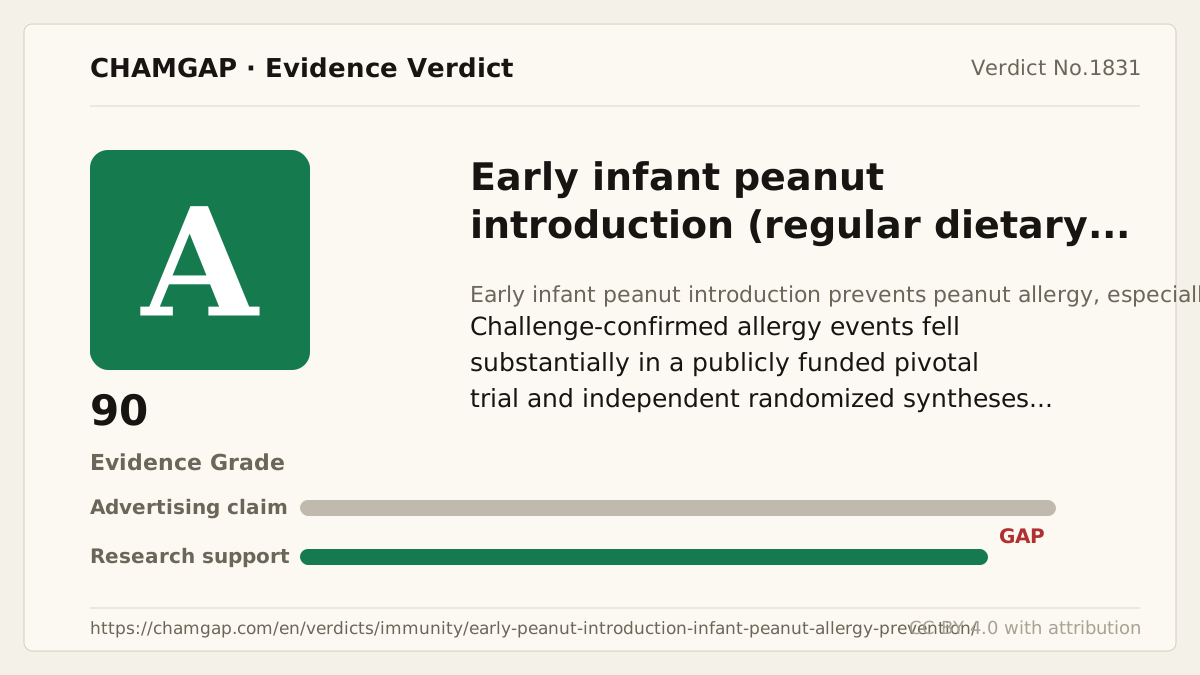
[Chamgap] Early infant peanut introduction x prevention of peanut allergy — Evidence Grade A·86. 5 cited sources checked. Source: https://chamgap.com/en/verdicts/immunity/early-peanut-introduction-infant-peanut-allergy-prevention/ · CC BY 4.0CC BY 4.0 — free to use with attribution; do not distort grades, numbers, or verdict meaning.
What this document does and does not do
Chamgap is an information source. It reports what research has and has not confirmed; it does not tell readers what to take or buy. That decision belongs to readers and, when needed, medical or legal professionals. This verdict reflects literature available up to the search date and may change as new research appears. Nothing here is medical advice.