
Early ART,
does it really help with Prevention of sexual HIV-1 transmission from a person living with HIV to a partner?
research showsEarly ART markedly reduces sexual transmission from a person living with HIV, but it is graded B under the Chamgap axis formula. HPTN 052 randomized 1,763 couples to early or delayed ART and included all 1,763 couples in the primary analysis. Phylogenetically linked partner infections numbered 1 versus 27, HR 0.04 (95% CI 0.01 to 0.27), P<0.001, so the primary endpoint succeeded. Because this was one confirmatory randomized trial using early versus delayed active treatment, the R1 and B1 ceilings apply.
ads claimClaims that treatment makes transmission disappear can omit the requirements of sustained viral suppression and sexual-exposure context.
Useful facts when choosing a product
- HPTN 052 compared immediate ART at CD4 counts of 350 to 550 per cubic millimeter with deferral until CD4 fell to 250 or less or an AIDS illness occurred; it was not placebo controlled.
- Verdict 1201, which is A with 92 points, and verdict 1281, which is A with 91 points, concern PrEP taken by an uninfected person. This verdict concerns treatment of the infected person to block transmission.
- Verdict 1301, which is A with 93 points, also protects an uninfected man through medical circumcision; its evidence was not pooled with treatment as prevention.
Chamgap Semantic Classification Code
Candidate index · review held
UNK.early-antiretroviral-therapy.UNK.sexual-hiv-1-transmission-from-a-person-living-with-hiv-to-a-partner.prevent.activeUnknown > Early antiretroviral therapy > Unknown > sexual HIV-1 transmission from a person living with HIV to a partner > Occurrence-prevention claim > Active comparator
An automated migration candidate, not an issued permanent code; exact claim scope remains under review. This machine-generated migration candidate helps retrieval but is not a permanent assignment. The original verdict ID and URL remain authoritative.
What the research actually shows
Cohen and colleagues randomized 1,763 serodifferent couples in nine countries to early ART in 886 or delayed ART in 877 and included 1,763 couples in the primary analysis. Viral sequences from new partner infections were compared with those of index participants to determine linkage. Of 28 linked infections, 1 occurred with early ART and 27 with delayed ART, HR 0.04 (0.01 to 0.27), P<0.001, making the primary endpoint successful. NIH and NIAID public funding was central. The 2016 final analysis preserved the direction but was follow-up of the same trial, not independent randomized replication.
Why this is classified as B (76)
The profile is H, R1, I2, E+, and B1. The phylogenetically linked infection endpoint is hard, the effect is large, and funding is public, but there is one confirmatory randomized trial and only an active comparator, yielding B with 76 points.
Counterpoint. The result underscores sustained viral suppression, but it is not a basis for judging adherence interruptions, treatment failure, resistance, or individual risk without clinical care.
Rejudgment record. Cross-check applied — Accepted the large hard-outcome effect in a publicly funded trial, with ceilings for one confirmatory randomized trial and an active-only comparison
| Endpoint | H | Hard endpoint - actual events such as death |
| Replication | R1 | Single confirmatory trial |
| Independence | I2 | Decisive evidence is publicly or non-profit funded |
| Effect size | E+ | Meets the clinically important threshold |
Stored derived and displayed grades match; this is not a current recalculation or validity check (B).
Sub-claim grades by effect
This ingredient is marketed for several effects. A single overall grade blends strong and weak claims together, so each effect is graded separately here. The overall grade reflects the strongest disconfirming or core claim.
| Effect (sub-claim) | Grade | Basis |
|---|---|---|
| Reduction of phylogenetically linked sexual HIV transmission with early ART | B | The primary endpoint succeeded in a large publicly funded trial, but there is one confirmatory randomized trial. |
| Prevention of linked transmission during viral suppression | B | Cohorts replicated zero linked transmissions, but they do not constitute R2 randomized evidence. |
| Expanded claim of no transmission without viral suppression | D | This does not match the benefit conditions established by the pivotal trial. |
Cross-check — AI research and Codex final gate
Evidence Table
| Study | Design | Sample | Funding | Endpoint | Result | Weight |
|---|---|---|---|---|---|---|
| Cohen MS et al. 2011 (HPTN 052) | Multinational randomized active-controlled trial | 1,763 couples randomized and 1,763 included in the primary analysis | United States public funding from NIH, NIAID, NIMH, and HPTN; some study drugs supplied by manufacturers | Phylogenetically linked partner HIV-1 infection | One versus 27 infections, HR 0.04 (95% CI 0.01 to 0.27), P<0.001; primary endpoint successful. | Decisive large hard-outcome randomized trial |
| Cohen MS et al. 2016 (HPTN 052 final) | Long-term follow-up of the randomized trial | 1,763 couples initially randomized; median follow-up 5.5 years | Public support from NIH, NIAID, NIMH, and HPTN | Phylogenetically linked partner transmission | The prevention effect persisted during long-term follow-up; this was the same trial and not independent randomized replication. | Persistence evidence |
Receipt — 2 References
All 2 cited sources were verified for existence at the original page (as of 2026-07-24).
Final verification and publication gate: Codex · Evidence date: 2026-07-24 · Corrections: none
Cite this verdict
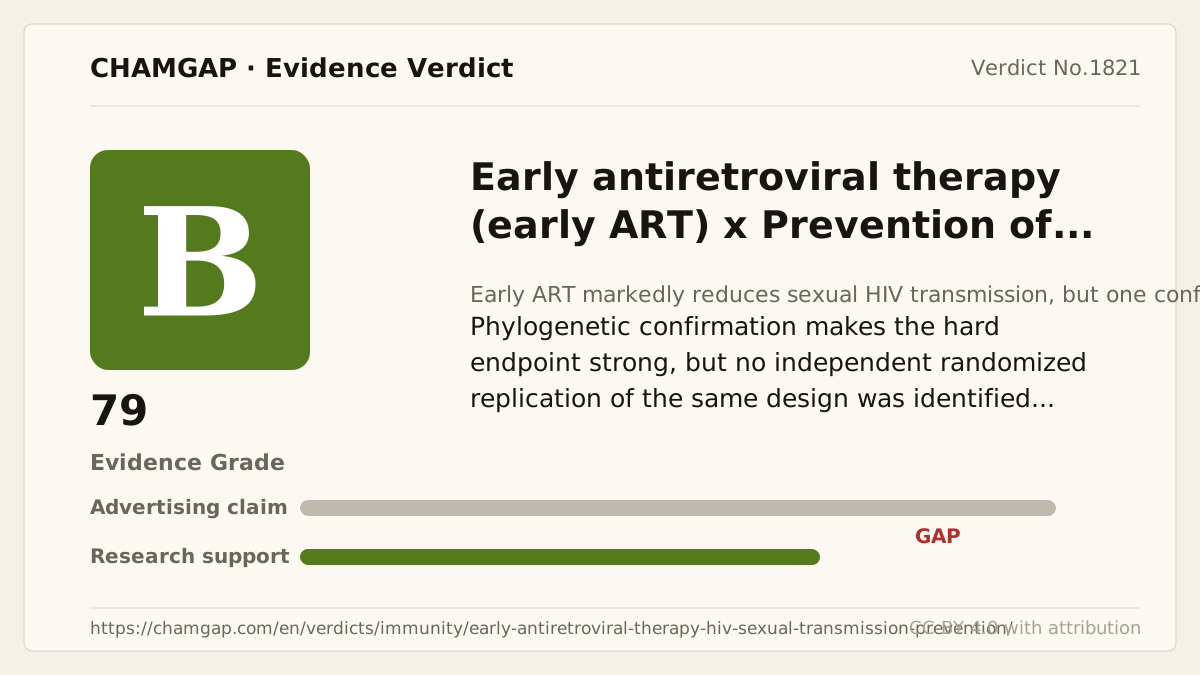
[Chamgap] Early ART x prevention of sexual HIV transmission — Evidence Grade B·76. 2 cited sources checked. Source: https://chamgap.com/en/verdicts/immunity/early-antiretroviral-therapy-hiv-sexual-transmission-prevention/ · CC BY 4.0CC BY 4.0 — free to use with attribution; do not distort grades, numbers, or verdict meaning.
What this document does and does not do
Chamgap is an information source. It reports what research has and has not confirmed; it does not tell readers what to take or buy. That decision belongs to readers and, when needed, medical or legal professionals. This verdict reflects literature available up to the search date and may change as new research appears. Nothing here is medical advice.