
Dupilumab,
does it really help with Improved congestion, nasal polyps, and disease-specific quality of life in severe chronic rhinosinusitis with nasal polyps?
research showsDupilumab substantially improves congestion and disease-specific quality of life in severe chronic rhinosinusitis with nasal polyps but is rated high C. SINUS-24 and SINUS-52 randomized and analyzed by intention to treat 276 and 448 participants, respectively; both 24-week coprimary outcomes, nasal polyp score and congestion, succeeded in both trials (P<0.0001). SNOT-22 differences of -21.12 and -17.36 exceeded the 8.9-point minimal important difference from Hopkins 2009, but both trials belonged to the same Sanofi-Regeneron development program.
ads claimClaims of curing polyps or permanent benefit after stopping treatment go beyond the evidence. Trials evaluated 24-to-52-week add-on dupilumab while patients continued intranasal corticosteroids.
Useful facts when choosing a product
- All participants in both trials used background intranasal mometasone furoate.
- SNOT-22 ranges from 0 to 110, and Hopkins et al. 2009 established a minimal important difference of 8.9 points.
- Verdict 742, which is B with 76 points, concerns atopic dermatitis; verdict 1771, which is B with 72 points, concerns eosinophilic COPD.
Chamgap Semantic Classification Code
Candidate index · review held
M.dupilumab.UNK.congestion-nasal-polyps-and-disease-specific-quality-of-life-in-severe-chronic-rhinosinusitis-with-nasal-polyps.improve.placeboMedicinal interventions > Dupilumab > Unknown > congestion, nasal polyps, and disease-specific quality of life in severe chronic rhinosinusitis with nasal polyps > Improvement claim > Placebo
An automated migration candidate, not an issued permanent code; exact claim scope remains under review. This machine-generated migration candidate helps retrieval but is not a permanent assignment. The original verdict ID and URL remain authoritative.
What the research actually shows
SINUS-24 randomized and analyzed 276 participants, while SINUS-52 randomized and analyzed 448. Both prespecified 24-week endoscopic nasal polyp score and patient-diary congestion as coprimary outcomes, and both outcomes succeeded in both trials. SNOT-22 differences were -21.12 (95% CI -25.17 to -17.06) and -17.36 (-20.87 to -13.85), exceeding the 8.9-point minimal important difference from Hopkins 2009. This indication differs from verdict 742, which is B with 76 points for atopic dermatitis, and verdict 1771, which is B with 72 points for eosinophilic COPD.
Why this is classified as C (54)
Both coprimary outcomes succeeded in two trials and SNOT-22 greatly exceeded its 8.9-point minimal important difference, but all evidence comes from one Sanofi-Regeneron development program, giving C with 54 points.
Counterpoint. Benefit was not limited to an endoscopic surrogate; congestion and SNOT-22 also improved substantially. C reflects the independence ceiling, not absence of efficacy.
Rejudgment record. Cross-check applied — Success of both coprimary outcomes in both trials and SNOT-22 benefit exceeding the minimal important difference, capped because all trials belong to one manufacturer development program
| Endpoint | P | Symptom or function itself is the target - including patient reports and performance tests |
| Replication | R1 | Single confirmatory trial |
| Independence | I0 | Evidence comes only from manufacturer studies |
| Effect size | E+ | Meets the clinically important threshold |
Stored derived and displayed grades match; this is not a current recalculation or validity check (C).
Sub-claim grades by effect
This ingredient is marketed for several effects. A single overall grade blends strong and weak claims together, so each effect is graded separately here. The overall grade reflects the strongest disconfirming or core claim.
| Effect (sub-claim) | Grade | Basis |
|---|---|---|
| Reduced nasal congestion | C | The coprimary congestion endpoint succeeded at P<0.0001 in both trials. |
| Improved disease-specific quality of life | C | SNOT-22 differences of -21.12 and -17.36 exceeded the 8.9-point minimal important difference. |
| Improved loss-of-smell symptoms | C | Patient-reported smell outcomes also improved versus placebo in both manufacturer phase 3 trials. |
Cross-check — AI research and Codex final gate
Evidence Table
| Study | Design | Sample | Funding | Endpoint | Result | Weight |
|---|---|---|---|---|---|---|
| Bachert C et al. 2019 (SINUS-24) | Multicenter randomized double-blind placebo-controlled phase 3 trial | 276 randomized and 276 analyzed by intention to treat | Sanofi and Regeneron Pharmaceuticals; sponsors participated in design, data management, analysis, and manuscript preparation | Coprimary 24-week nasal polyp score and congestion | Differences were -2.06 and -0.89, both P<0.0001, so both coprimary outcomes succeeded; SNOT-22 difference -21.12. | Pivotal manufacturer phase 3 trial |
| Bachert C et al. 2019 (SINUS-52) | Multicenter randomized double-blind placebo-controlled phase 3 trial | 448 randomized and 448 analyzed by intention to treat | Sanofi and Regeneron Pharmaceuticals; same development program as SINUS-24 | Coprimary 24-week nasal polyp score and congestion | Differences were -1.80 and -0.87, both P<0.0001, so both coprimary outcomes succeeded; SNOT-22 difference -17.36. | Replication within the same manufacturer program |
Receipt — 3 References
All 3 cited sources were verified for existence at the original page (as of 2026-07-24).
Final verification and publication gate: Codex · Evidence date: 2026-07-24 · Corrections: none
Cite this verdict
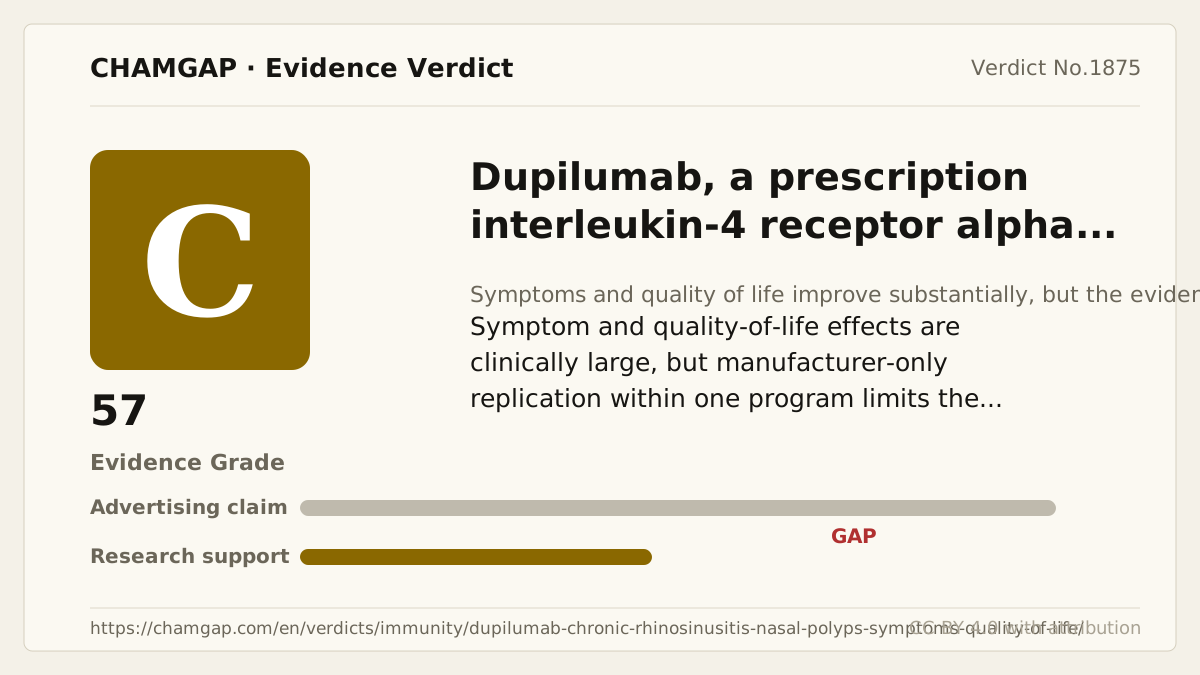
[Chamgap] Dupilumab x symptoms and quality of life in chronic rhinosinusitis with nasal polyps — Evidence Grade C·54. 3 cited sources checked. Source: https://chamgap.com/en/verdicts/immunity/dupilumab-chronic-rhinosinusitis-nasal-polyps-symptoms-quality-of-life/ · CC BY 4.0CC BY 4.0 — free to use with attribution; do not distort grades, numbers, or verdict meaning.
What this document does and does not do
Chamgap is an information source. It reports what research has and has not confirmed; it does not tell readers what to take or buy. That decision belongs to readers and, when needed, medical or legal professionals. This verdict reflects literature available up to the search date and may change as new research appears. Nothing here is medical advice.