
Duct-tape occlusion,
does it really help with Complete clearance of common nongenital warts on hands, feet, or other sites?
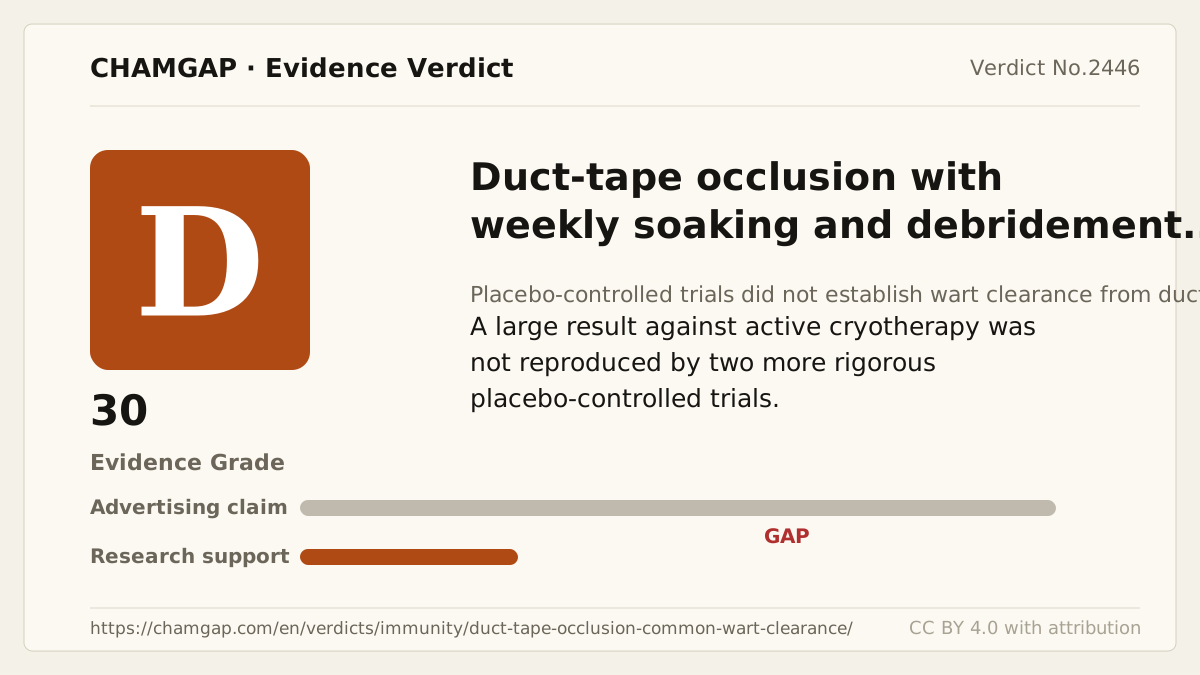
research showsThe grade is D. The initial completer trial in young patients favored standard silver duct tape over active cryotherapy, but two later placebo-controlled trials of transparent tape did not replicate clearance. Complete clearance was 8/51 versus 3/52 in children and 8/39 versus 9/41 in adults; pooled RR was 1.43 (95% CI 0.51 to 4.05). Benefit beyond spontaneous and control-group clearance was not established.
ads claimKorean folk-treatment descriptions should not omit the soaking and debridement cointervention or treat transparent and standard silver tape as interchangeable. Duct tape is not established as a substitute for diagnosis, salicylic acid, or clinician-delivered cryotherapy.
Useful facts when choosing a product
- Focht used six days of standard tape followed by soaking, debridement, an uncovered night, and reapplication for up to two months.
- The placebo-controlled trials used transparent tape against a corn ring or moleskin pad.
- Verdict 1144 is B with 76 points for quadrivalent HPV vaccination preventing genital warts; this verdict treats existing nongenital common warts.
Chamgap Semantic Classification Code
Candidate index · review held
UNK.duct-tape-occlusion-with-soaking-and-debridement.UNK.complete-clearance-of-common-nongenital-warts-on-hands-feet-or-other-sites.treat.MULTIUnknown > Duct-tape occlusion with soaking and debridement > Unknown > Complete clearance of common nongenital warts on hands, feet, or other sites > Treatment or remission claim > Multiple: primary unresolved
An automated migration candidate, not an issued permanent code; exact claim scope remains under review. This machine-generated migration candidate helps retrieval but is not a permanent assignment. The original verdict ID and URL remain authoritative.
What the research actually shows
Focht randomized 61 patients aged 3 to 22 with common warts outside the face, periungual, perianal, and genital areas. Standard duct tape remained for six days, followed by water soaking and gentle emery-board or pumice debridement, an uncovered night, and reapplication for up to two months. The active comparator was 10 seconds of liquid nitrogen per wart every two to three weeks for up to six treatments. Complete clearance at two months was primary and time to clearance secondary. Among 51 completers, clearance was 22/26 versus 15/25, risk difference 24.6 points (approximate 95% CI 0.9 to 48.3). De Haen randomized 103 children aged 4 to 12 to transparent 3M duct tape or an open-center corn-protection ring. Both groups soaked and rubbed the wart weekly. Six-week clearance was 8/51 versus 3/52, risk difference 9.9 points (approximate 95% CI -2.9 to 22.7), P=.12. Wenner randomized 90 adults to transparent acrylic-based duct tape or moleskin. The target wart was pared, covered for seven days, left open overnight, soaked and debrided, and recovered for up to two months. Among 39 versus 41 analyzed, clearance was 8/39 versus 9/41, risk difference -1.4 points (approximate 95% CI -18.8 to 16.0), P>.99. Cochrane pooled the two transparent-tape placebo trials and found RR 1.43 (95% CI 0.51 to 4.05). About two thirds of childhood warts resolve spontaneously within two years, while controls cleared 6% by six weeks and 22% by two months. All trials enrolled fewer than 200 participants and observed treatment for six to eight weeks, supporting two avoidable limitations. No separate Funding section was verified on the accessible Focht article page; de Haen and Wenner each stated “Financial Disclosure: None reported,” which does not directly establish public funding.
Why this is classified as D (30)
Null pooled clearance in two placebo-controlled trials, with common small-sample and short-observation limitations, gives D with 30 points.
Counterpoint. Different adhesives mean the evidence does not precisely exclude benefit from every silver duct-tape formulation.
Rejudgment record. Cross-check applied — Null pooled result from two transparent-tape placebo trials with small samples and short observation
| Endpoint | H | Hard endpoint - actual events such as death |
| Replication | R1 | Single confirmatory trial |
| Independence | I1 | Mixed funding sources |
| Effect size | E0 | Null |
| Precision | C0 | The confidence interval leaves room for benefit |
Stored derived and displayed grades match; this is not a current recalculation or validity check (D).
Sub-claim grades by effect
This ingredient is marketed for several effects. A single overall grade blends strong and weak claims together, so each effect is graded separately here. The overall grade reflects the strongest disconfirming or core claim.
| Effect (sub-claim) | Grade | Basis |
|---|---|---|
| Complete clearance of common warts with transparent duct tape | D | The pooled result from two placebo-controlled trials was null. |
| Complete clearance with standard silver duct tape versus cryotherapy | C | The initial 51-person completer analysis was positive but used only an active comparator. |
Cross-check — AI research and Codex final gate
Evidence Table
| Study | Design | Sample | Funding | Endpoint | Result | Weight |
|---|---|---|---|---|---|---|
| Focht DR III et al. 2002 | Prospective randomized active-comparator trial with completer analysis | 61 randomized, 51 analyzed (26/25) | No separate Funding section was verified on the accessible article page | Complete clearance at two months (primary), time to clearance (secondary) | 22/26 versus 15/25; risk difference 24.6 points, approximate 95% CI 0.9 to 48.3; P=.05 | Initial positive result with active comparator and completer analysis |
| de Haen M et al. 2006 | Randomized placebo-controlled pediatric trial | 103 randomized (51/52) | Financial Disclosure: None reported. | Complete target-wart clearance at six weeks | 8/51 versus 3/52; risk difference 9.9 points, approximate 95% CI -2.9 to 22.7; P=.12 | Null transparent-tape placebo comparison |
| Wenner R et al. 2007 | Double-blind randomized moleskin-controlled adult trial | 90 randomized, 80 analyzed at two months (39/41) | Financial Disclosure: None reported. | Complete target-wart clearance during two months (primary), six-month recurrence (secondary) | 8/39 versus 9/41; risk difference -1.4 points, approximate 95% CI -18.8 to 16.0; P>.99 | Null double-blind transparent-tape trial |
Receipt — 4 References
All 4 cited sources were verified for existence at the original page (as of 2026-08-08).
Final verification and publication gate: Codex · Evidence date: 2026-08-08 · Corrections: none
Cite this verdict
[Chamgap] Duct-tape occlusion x complete clearance of common warts — Evidence Grade D·30. 4 cited sources checked. Source: https://chamgap.com/en/verdicts/immunity/duct-tape-occlusion-common-wart-clearance/ · CC BY 4.0CC BY 4.0 — free to use with attribution; do not distort grades, numbers, or verdict meaning.
What this document does and does not do
Chamgap is an information source. It reports what research has and has not confirmed; it does not tell readers what to take or buy. That decision belongs to readers and, when needed, medical or legal professionals. This verdict reflects literature available up to the search date and may change as new research appears. Nothing here is medical advice.