
Cold shower,
does it really help with Prevention of cold or influenza symptom days and infections?
research showsCold showers are rated D with 30 points for infection prevention. The two primary endpoints were sickness-absence days and perceived illness days, reported as self-reported sickness days. In an open-label pragmatic trial with 3,018 randomized and 2,426 analyzed at 90 days, sickness absence fell with IRR 0.71 (95% CI 0.56 to 0.89), but perceived illness days did not. Clinically or microbiologically confirmed infection incidence was never measured.
ads claimClaims that cold showers prevent colds convert reduced sickness absence into reduced infection. The trial did not measure actual infection incidence, and perceived illness days did not fall.
Useful facts when choosing a product
- The tested intervention ended a usual warm shower with the coldest available water for 30, 60, or 90 seconds.
- Participants followed the assigned exposure daily for 30 days and then continued as they preferred for another 60 days.
- The 3,018 randomized participants must be distinguished from 2,426 in the actual 90-day primary analysis; attrition was 19.6%.
- People with severe cardiopulmonary disease were excluded, so the results do not generalize to them. Raynaud phenomenon, dizziness, or persistent cold sensation warrants particular caution.
Chamgap Semantic Classification Code
Candidate index · review held
UNK.cold-shower-finish.UNK.cold-or-influenza-symptom-days-and-infections.prevent.UNKUnknown > cold shower finish > Unknown > cold or influenza symptom days and infections > Occurrence-prevention claim > Unknown
An automated migration candidate, not an issued permanent code; exact claim scope remains under review. This machine-generated migration candidate helps retrieval but is not a permanent assignment. The original verdict ID and URL remain authoritative.
What the research actually shows
Buijze and colleagues randomized 3,018 healthy employed adults to three cold-shower durations or usual showers. The actual 90-day analysis included 2,426 participants. In this open-label pragmatic trial, the two primary endpoints were sickness-absence days and perceived illness days. Sickness absence fell with IRR 0.71 (95% CI 0.56 to 0.89), but perceived illness days did not. Clinically or microbiologically confirmed infection incidence was not measured. The authors reported no specific funding. Verdict 1247, which is C with 54 points, concerns cold-water immersion for exercise recovery; its purpose and exposure differ, so that evidence was not used for infection prevention.
Why this is classified as D (30)
Of two primary endpoints, sickness absence fell with IRR 0.71 (95% CI 0.56 to 0.89), but perceived illness days were null. Actual infection incidence was not measured, so prevention was unproven rather than disproved. Open-label self-reporting and no independent replication give D with 30 points.
Counterpoint. Using a brief cold finish for alertness or personal preference differs from claiming infection prevention. It should not replace vaccination, hand hygiene, ventilation, adequate sleep, or other established measures.
Rejudgment record. Cross-check applied — The two primary endpoints were sickness-absence days and perceived illness days, reported as self-reported sickness days. Sickness absence fell with IRR 0.71 (95% CI 0.56 to 0.89), but perceived illness days did not. Clinically or microbiologically confirmed infection incidence was never measured, so absence of a prevention effect was not proved; evidence for actual infection incidence was missing and the measured perceived-illness endpoint was null.
Sub-claim grades by effect
This ingredient is marketed for several effects. A single overall grade blends strong and weak claims together, so each effect is graded separately here. The overall grade reflects the strongest disconfirming or core claim.
| Effect (sub-claim) | Grade | Basis |
|---|---|---|
| Reduction in perceived illness days | D | The overall group effect on illness days at 90 days was nonsignificant. |
| Reduction in sickness absence | C | IRR was 0.71 with P=0.003, but this was an open-label self-reported behavioral endpoint without independent replication. |
| Prevention of incident infections | D | Clinically or microbiologically confirmed infection incidence was not measured, leaving prevention unproven. |
Cross-check — AI research and Codex final gate
Evidence Table
| Study | Design | Sample | Funding | Endpoint | Result | Weight |
|---|---|---|---|---|---|---|
| Buijze GA et al. 2016 | Randomized open-label four-group pragmatic trial | 3,018 randomized; 2,426 in the actual 90-day analysis (673, 611, 595, and 547), with 19.6% attrition | No specific funding; one author worked for Achmea, but the company provided no support and had no study role | Two primary endpoints: sickness-absence days and perceived illness days, reported as self-reported sickness days; confirmed infection incidence was not measured | Sickness absence fell with IRR 0.71 (95% CI 0.56 to 0.89), but perceived illness days did not. | Only large direct clinical trial |
| Cain T et al. 2025 | Systematic review and meta-analysis | 11 studies and 3,177 participants; five longer-term cold-water exposure studies | Public support from the Australian Medical Research Future Fund | Health and wellbeing outcomes including immunity, inflammation, stress, sleep, and mood | There was no independent replication of long-term infection prevention, with single-session studies, small samples, heterogeneity, and limited long-term data. | Assessment of the direct-evidence gap |
Receipt — 2 References
All 2 cited sources were verified for existence at the original page (as of 2026-07-24).
Final verification and publication gate: Codex · Evidence date: 2026-07-24 · Corrections: none
Cite this verdict
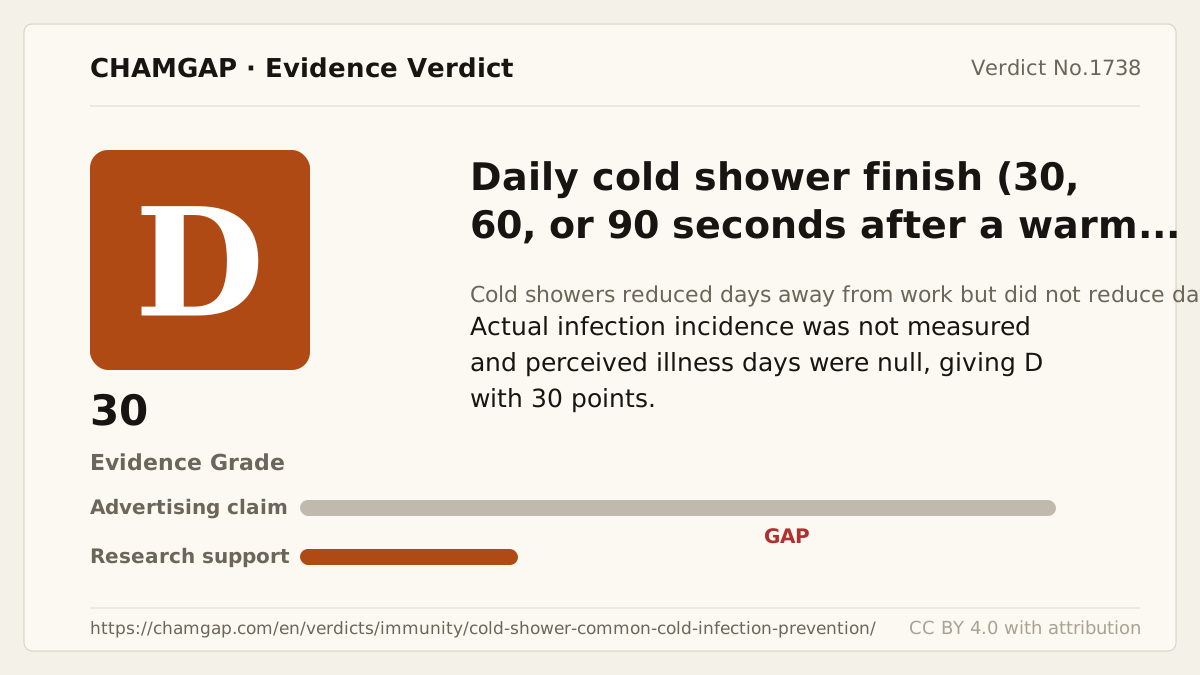
[Chamgap] Cold shower x prevention of colds and influenza — Evidence Grade D·30. 2 cited sources checked. Source: https://chamgap.com/en/verdicts/immunity/cold-shower-common-cold-infection-prevention/ · CC BY 4.0CC BY 4.0 — free to use with attribution; do not distort grades, numbers, or verdict meaning.
What this document does and does not do
Chamgap is an information source. It reports what research has and has not confirmed; it does not tell readers what to take or buy. That decision belongs to readers and, when needed, medical or legal professionals. This verdict reflects literature available up to the search date and may change as new research appears. Nothing here is medical advice.