
Colchicine,
does it really help with Reduced hospitalization, mechanical ventilation, and 28-day mortality in COVID-19?
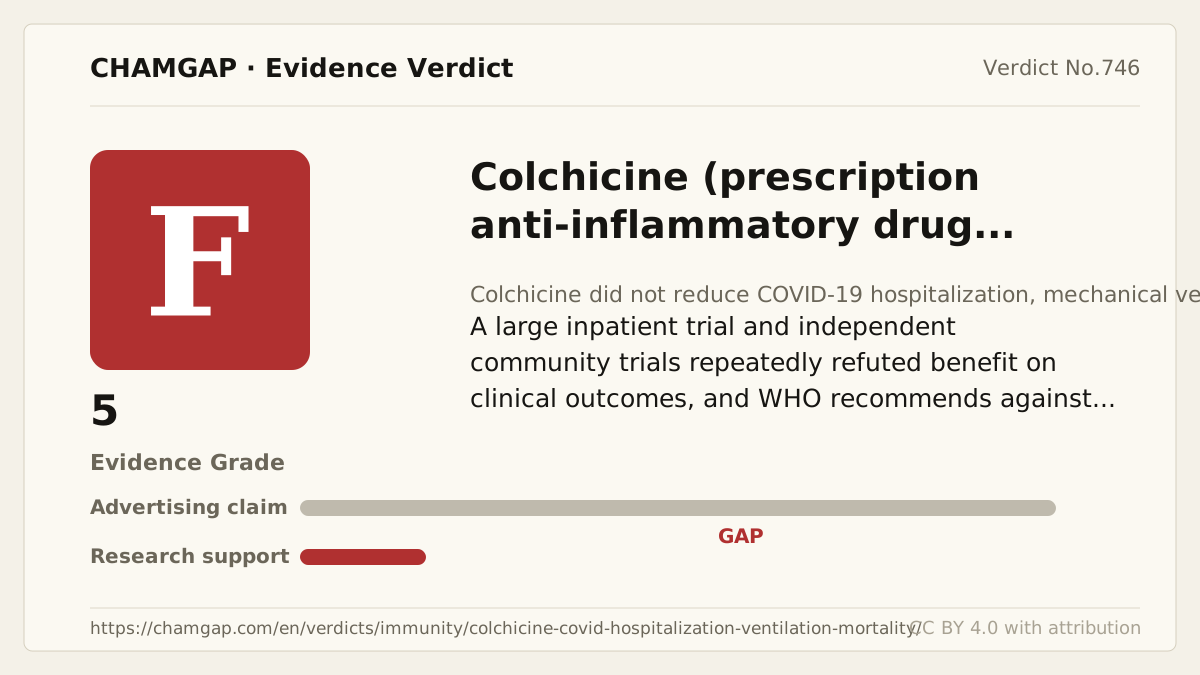
research showsColchicine is rated F because it does not reduce hospitalization, mechanical ventilation, or 28-day mortality in COVID-19. RECOVERY, involving 11,340 hospitalized patients, found no benefit for 28-day mortality, discharge, or invasive mechanical ventilation or death, and the community-based PRINCIPLE trial found no benefit for recovery time or hospitalization or death. The prespecified overall COLCORONA analysis was also nonsignificant for death or hospital admission, and WHO strongly recommends against colchicine for non-severe COVID-19. Anti-inflammatory mechanism is not the same as clinical benefit, and separate indications such as gout, pericarditis, and coronary disease were not mixed into this verdict.
ads claimMechanistic claims about inflammation and NLRP3 inhibition are expanded into prevention of pneumonia progression, admission, ventilation, and death. Targeting inflammation did not itself improve COVID-19 clinical outcomes.
Useful facts when choosing a product
- Colchicine is a prescription anti-inflammatory medicine used for conditions such as gout attacks and familial Mediterranean fever; it is not authorized as a COVID-19 treatment.
- RECOVERY and community randomized trials did not confirm reductions in COVID-19 hospitalization, mechanical ventilation, or mortality.
- Colchicine has a narrow therapeutic index, and unsupervised dose escalation can cause severe toxicity; kidney function, liver function, and interacting medicines require review.
- Diarrhea is common, while myopathy, rhabdomyolysis, bone-marrow suppression, and multiorgan toxicity can occur; interactions with strong CYP3A4 or P-glycoprotein inhibitors are particularly dangerous.
Chamgap Semantic Classification Code
Candidate index · review held
M.colchicine.UNK.hospitalization-mechanical-ventilation-and-mortality-in-covid-19.reduce.UNKMedicinal interventions > colchicine > Unknown > hospitalization, mechanical ventilation, and mortality in COVID-19 > Reduction claim > Unknown
An automated migration candidate, not an issued permanent code; exact claim scope remains under review. This machine-generated migration candidate helps retrieval but is not a permanent assignment. The original verdict ID and URL remain authoritative.
What the research actually shows
RECOVERY randomized 11,340 hospitalized patients and directly measured 28-day mortality, reporting a risk ratio of 1.01 (95% CI 0.93 to 1.10). PRINCIPLE stopped enrollment for futility in higher-risk community patients and reported recovery HR 0.92 (95% Bayesian credible interval 0.72 to 1.16) and hospitalization or death OR 0.76 (0.28 to 1.89). COLCORONA was a double-blind trial of 4,488 people, but its overall primary endpoint was nonsignificant. WHO synthesized 13 randomized trials with 18,172 participants and issued a strong recommendation against colchicine in non-severe COVID-19.
Why this is classified as F (5)
The null mortality and ventilation findings in large RECOVERY, null community evidence in PRINCIPLE, nonsignificant overall COLCORONA primary endpoint, and WHO's strong recommendation against use converge. Repeated refutation and guideline opposition yield F with 5 points; toxicity and interactions remain a separate safety assessment.
Counterpoint. Evidence for colchicine in gout, pericarditis, and some coronary settings concerns different diseases, doses, and endpoints. Validated efficacy in another indication does not establish efficacy in COVID-19.
Rejudgment record. New verdict — Treated the large null clinical endpoints in RECOVERY, failure of replication in PRINCIPLE and the overall COLCORONA analysis, and WHO's strong recommendation against use as repeated refutation, while separating mechanism and other indications
Sub-claim grades by effect
This ingredient is marketed for several effects. A single overall grade blends strong and weak claims together, so each effect is graded separately here. The overall grade reflects the strongest disconfirming or core claim.
| Effect (sub-claim) | Grade | Basis |
|---|---|---|
| Reduced COVID-19 hospitalization, mechanical ventilation, and 28-day mortality | F | Large RECOVERY, community trials, and WHO guidance converge on no benefit. |
| Inference that anti-inflammatory mechanism produces COVID-19 clinical benefit | D | The mechanism was plausible but did not translate into hospitalization, ventilation, or mortality benefit in large trials. |
| Efficacy in gout, pericarditis, and coronary disease | ? | These are separate indications and were not evaluated in this COVID-19 verdict. |
Cross-check — AI research and Codex final gate
Evidence Table
| Study | Design | Sample | Funding | Endpoint | Result | Weight |
|---|---|---|---|---|---|---|
| RECOVERY Collaborative Group 2021 | Large randomized open-label platform trial | 11,340 hospitalized patients with COVID-19 | United Kingdom public and research support | 28-day mortality, discharge, and invasive mechanical ventilation or death | The 28-day mortality RR was 1.01 (95% CI 0.93 to 1.10), with no benefit on other key clinical outcomes. | Decisive large null trial |
| Dorward J et al. 2022 PRINCIPLE | Community randomized adaptive platform trial | 2,755 SARS-CoV-2-positive participants in the primary model; 156 assigned colchicine | Public support including NIHR | Time to recovery and 28-day COVID-19 hospitalization or death | The arm stopped for futility and did not improve recovery time or hospitalization or death. | Independent community nonreplication |
| WHO living guideline 2022-2025 | Living systematic evidence assessment and clinical guideline | 13 randomized trials and 18,172 participants | World Health Organization | Hospitalization, mortality, mechanical ventilation, and harms | Issued a strong recommendation against colchicine in non-severe COVID-19. | Guideline convergence |
Receipt — 4 References
All 4 cited sources were verified for existence at the original page (as of 2026-07-20).
Final verification and publication gate: Codex · Evidence date: 2026-07-20 · Corrections: none
Cite this verdict
[Chamgap] Colchicine x reduced hospitalization, mechanical ventilation, and 28-day mortality in COVID-19 — Evidence Grade F·5. 4 cited sources checked. Source: https://chamgap.com/en/verdicts/immunity/colchicine-covid-hospitalization-ventilation-mortality/ · CC BY 4.0CC BY 4.0 — free to use with attribution; do not distort grades, numbers, or verdict meaning.
What this document does and does not do
Chamgap is an information source. It reports what research has and has not confirmed; it does not tell readers what to take or buy. That decision belongs to readers and, when needed, medical or legal professionals. This verdict reflects literature available up to the search date and may change as new research appears. Nothing here is medical advice.