
Clesrovimab,
does it really help with Prevention of RSV-associated medically attended lower respiratory infection and RSV-associated hospitalization during an infant's first RSV season?
research showsA single 105-mg intramuscular dose of clesrovimab is rated B because it reduces RSV-associated medically attended lower respiratory infection and hospitalization during an infant's first RSV season. In the peer-reviewed phase 2b/3 CLEVER original article, RSV-associated medically attended lower respiratory infection through day 150 occurred in 60 of 2,398 versus 74 of 1,201 infants, for 60.4% efficacy (95% CI 44.1% to 71.9%). RSV-associated hospitalization occurred in 9 of 2,398 versus 28 of 1,201 infants, for 84.2% efficacy (66.6% to 92.6%). These endpoints do not represent prevention of all RSV infection, including asymptomatic infection. Reliance on one pivotal Merck-sponsored trial and one-season follow-up yields B with 74 points.
ads claimMarketing can expand one shot into complete RSV prevention, mortality prevention, or protection across multiple winters. The direct evidence supports reduced RSV-associated medically attended lower respiratory disease and RSV-associated hospitalization for about 150 days after one 105-mg dose in infants born during or entering their first RSV season.
Useful facts when choosing a product
- Clesrovimab is not a vaccine; it is a long-acting monoclonal antibody targeting antigenic site IV of the RSV fusion protein and provides immediate passive immunity to the infant.
- The approved United States first-season regimen for ENFLONSIA is a single 105-mg intramuscular injection regardless of body weight.
- The most common adverse reactions are injection-site redness and swelling and rash, and rare serious hypersensitivity must be considered as with other human IgG1 monoclonal antibodies.
- Breakthrough RSV remains possible, so breathing difficulty, cyanosis, apnea, or poor feeding requires prompt medical care despite prophylaxis.
Chamgap Semantic Classification Code
Candidate index · review held
M.clesrovimab.intramuscular.rsv-associated-medically-attended-lower-respiratory-infection-and-rsv-associated-hospitalization-during-an-infants-first-rsv-season.prevent.MULTIMedicinal interventions > Clesrovimab > Intramuscular > RSV-associated medically attended lower respiratory infection and RSV-associated hospitalization during an infant's first RSV season > Occurrence-prevention claim > Multiple: primary unresolved
An automated migration candidate, not an issued permanent code; exact claim scope remains under review. This machine-generated migration candidate helps retrieval but is not a permanent assignment. The original verdict ID and URL remain authoritative.
What the research actually shows
Zar and colleagues with the CLEVER (MK-1654-004) Study Group 2025 was a peer-reviewed New England Journal of Medicine original article reporting a randomized double-blind placebo-controlled phase 2b/3 trial. Through day 150, RSV-associated medically attended lower respiratory infection occurred in 60 of 2,398 versus 74 of 1,201 infants, for 60.4% efficacy, and RSV-associated hospitalization occurred in 9 of 2,398 versus 28 of 1,201, for 84.2% efficacy. These were not endpoints for all RSV infection including asymptomatic cases. Merck sponsored the trial and several authors were company employees. Zar and colleagues with the SMART (MK-1654-007) Study Group 2025 reported original clinical data in a peer-reviewed New England Journal of Medicine letter, supporting safety and pharmacokinetics against palivizumab in high-risk infants but not providing an independent placebo efficacy replication. The FDA ENFLONSIA label is non-peer-reviewed regulatory material specifying the single 105-mg dose and injection-site erythema at 3.7%, swelling at 2.7%, and rash at 2.3%; it was not counted as a separate efficacy original article.
Why this is classified as B (74)
In CLEVER, RSV-associated medically attended lower respiratory infection occurred in 60 of 2,398 versus 74 of 1,201 infants, and RSV-associated hospitalization occurred in 9 of 2,398 versus 28 of 1,201, providing a large effect on direct clinical endpoints rather than all-infection prevention. The evidence is concentrated in one Merck-sponsored pivotal trial over 150 days, while SMART was an active palivizumab-controlled safety study rather than independent placebo replication. These limits yield B with 74 points.
Counterpoint. Maternal RSV vaccination, nirsevimab, and clesrovimab are different preventive pathways. Local policy, birth timing, maternal vaccination, and infant risk determine the appropriate maternal-immunity or passive-antibody strategy, and evidence for one antibody should not be substituted for another.
Rejudgment record. Cross-check applied — Accepted CLEVER's 60.4% and 84.2% efficacy on the direct hard clinical endpoints of RSV-associated medically attended lower respiratory infection and RSV-associated hospitalization among 3,614 injected infants, with deductions because evidence relies on one Merck-sponsored pivotal placebo-controlled trial over 150 days and SMART was an active palivizumab-controlled safety study rather than independent efficacy replication
Sub-claim grades by effect
This ingredient is marketed for several effects. A single overall grade blends strong and weak claims together, so each effect is graded separately here. The overall grade reflects the strongest disconfirming or core claim.
| Effect (sub-claim) | Grade | Basis |
|---|---|---|
| Prevention of RSV-associated medically attended lower respiratory infection during the first RSV season | B | In CLEVER, RSV-associated medically attended lower respiratory infection occurred in 60 of 2,398 versus 74 of 1,201 infants, for 60.4% efficacy (95% CI 44.1% to 71.9%); this was not an all-infection endpoint including asymptomatic cases. |
| Prevention of RSV-associated hospitalization during the first RSV season | B | Hospitalization was 9 of 2,398 versus 28 of 1,201, for 84.2% efficacy (95% CI 66.6% to 92.6%). |
| Prevention of RSV mortality and long-term respiratory sequelae | ? | Deaths were too rare, and long-term wheeze, asthma, and lung function were not pivotal objectives, leaving no human efficacy literature sufficient for judgment. |
Cross-check — AI research and Codex final gate
Evidence Table
| Study | Design | Sample | Funding | Endpoint | Result | Weight |
|---|---|---|---|---|---|---|
| Zar HJ et al.; CLEVER (MK-1654-004) Study Group. 2025 | Multinational randomized double-blind saline-placebo-controlled phase 2b/3 original trial | 3,614 injected infants; 2,412 received clesrovimab and 1,202 placebo | Funded by Merck Sharp & Dohme with multiple company authors | RSV-associated medically attended lower respiratory infection and RSV-associated hospitalization through day 150 | RSV-associated medically attended lower respiratory infection occurred in 60 of 2,398 versus 74 of 1,201 infants, for 60.4% efficacy; RSV-associated hospitalization occurred in 9 of 2,398 versus 28 of 1,201, for 84.2% efficacy. This was not an all-infection endpoint including asymptomatic cases. | Pivotal large direct-clinical-endpoint randomized trial with manufacturer sponsorship |
| Zar HJ et al.; SMART (MK-1654-007) Study Group. 2025 | Peer-reviewed research letter reporting interim data from a randomized partially masked palivizumab-controlled phase 3 trial in high-risk infants | 901 infants randomized in the interim analysis | Funded by Merck Sharp & Dohme with company participation | First-season safety, pharmacokinetics, and RSV disease incidence in high-risk infants | Adverse events were generally similar to palivizumab and day-150 concentrations resembled CLEVER in healthy infants, but this was not independent placebo efficacy replication. | Supportive active-control evidence in high-risk infants with limited efficacy independence |
| FDA ENFLONSIA prescribing information. 2025 | United States regulatory label; not peer reviewed | 2,858 clesrovimab-exposed infants in the approval safety database | Regulatory submission data | Approved dose, administration, adverse reactions, and hypersensitivity warning | The regimen is one 105-mg intramuscular dose; the most common reactions were injection-site erythema at 3.7%, swelling at 2.7%, and rash at 2.3%. | Safe-use context not counted toward the efficacy grade |
Receipt — 3 References
All 3 cited sources were verified for existence at the original page (as of 2026-07-24).
Final verification and publication gate: Codex · Evidence date: 2026-07-24 · Corrections: none
Cite this verdict
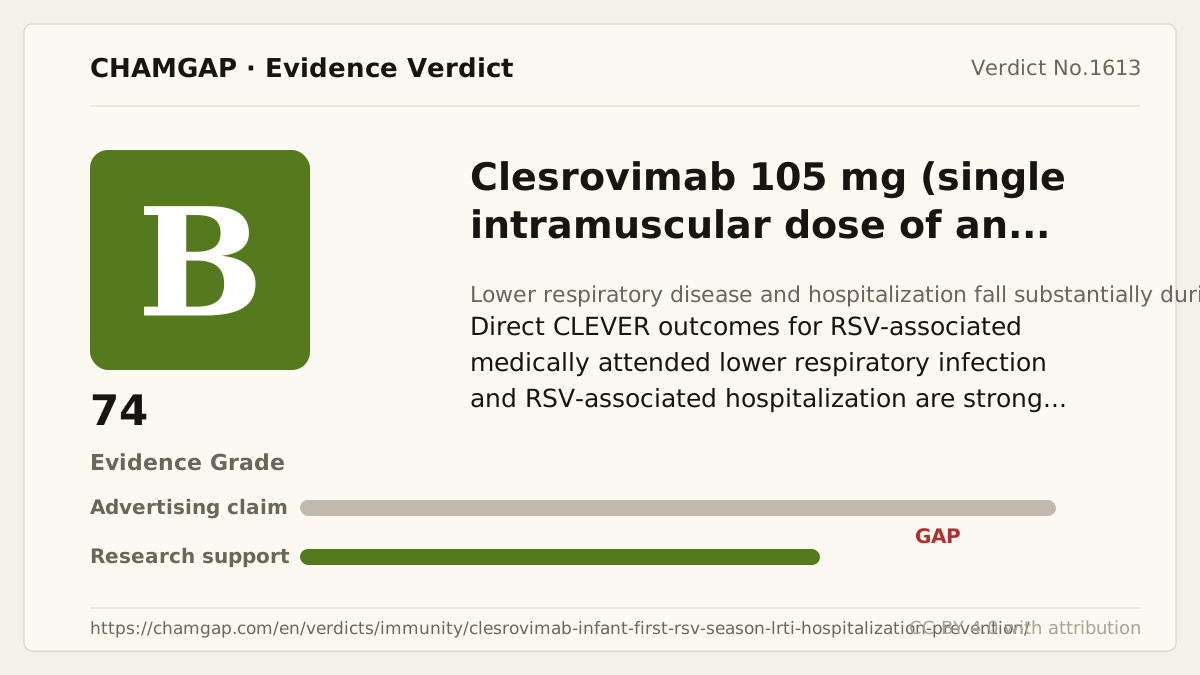
[Chamgap] Clesrovimab x prevention of RSV-associated medically attended lower respiratory infection and RSV-associated hospitalization during an infant's first RSV season — Evidence Grade B·74. 3 cited sources checked. Source: https://chamgap.com/en/verdicts/immunity/clesrovimab-infant-first-rsv-season-lrti-hospitalization-prevention/ · CC BY 4.0CC BY 4.0 — free to use with attribution; do not distort grades, numbers, or verdict meaning.
What this document does and does not do
Chamgap is an information source. It reports what research has and has not confirmed; it does not tell readers what to take or buy. That decision belongs to readers and, when needed, medical or legal professionals. This verdict reflects literature available up to the search date and may change as new research appears. Nothing here is medical advice.