
Classroom HEPA air cleaners,
does it really help with Reduced asthma symptom-days versus sham units?
research showsThe grade is D. In a sham-controlled cluster randomized trial of 236 students across 41 schools, two-week asthma symptom-days averaged 1.6 with HEPA and 1.8 with sham, and the prespecified primary analysis was not significant (IRR 1.47, 95% CI 0.79-2.75). The intervention was tested directly in people but benefit was not established, and the interval remained wide, giving D with 30 points.
ads claimA HEPA label describes a particle-filtration method; it does not guarantee fewer asthma symptoms. Room-appropriate clean-air delivery, noise, and filter replacement costs should be considered, and filtration remains an adjunct to medication and exposure management.
Useful facts when choosing a product
- Active and sham units were matched in appearance and sound to support masking.
- The trial was conducted in classrooms attended by students with asthma and does not directly establish effects in homes, adult workplaces, or wildfire-smoke episodes.
- Verdict 1518 concerns vitamin D for asthma exacerbation prevention, a different intervention; the pivotal PMID and DOI were absent from existing verdicts.
Chamgap Semantic Classification Code
Candidate index · review held
UNK.portable-classroom-hepa-air-cleaners.UNK.asthma-symptom-days.reduce.MULTIUnknown > Portable classroom HEPA air cleaners > Unknown > asthma symptom-days > Reduction claim > Multiple: primary unresolved
An automated migration candidate, not an issued permanent code; exact claim scope remains under review. This machine-generated migration candidate helps retrieval but is not a permanent assignment. The original verdict ID and URL remain authoritative.
What the research actually shows
Phipatanakul 2021 used a split-plot factorial design with school-level pest management and independently assigned classroom HEPA filtration. The air-cleaner main effect allocated 118 versus 118 and included all randomized students in the analysis framework, while the primary table observed 105 versus 97. Two-week symptom-days averaged 1.6 versus 1.8; the reported IRR was 1.47 (95% CI 0.79-2.75). Both the paper and NCT02291302 named two-week symptom-days as the prespecified primary outcome, and the registered comparator was sham. Public grants were the principal funding, while Coway supplied the purifiers.
Why this is classified as D (30)
This direct trial had long follow-up, complete retention, a sham control, and concordant prospective primary outcome, but the effect was null and the interval was too wide to exclude meaningful benefit. One null confirmatory trial gives D with 30 points.
Counterpoint. The verdict is limited to average symptom-days from portable classroom HEPA units. It does not deny physical particle removal or possible effects in specific high-exposure settings.
Rejudgment record. Cross-check applied — We cross-checked allocation, sham design, completed population, registered primary endpoint, main effect, and grant/in-kind support against the JAMA paper, protocol, and NCT02291302.
| Endpoint | P | Symptom or function itself is the target - including patient reports and performance tests |
| Replication | R1 | Single confirmatory trial |
| Independence | I1 | Mixed funding sources |
| Effect size | E0 | Null |
| Precision | C0 | The confidence interval leaves room for benefit |
Stored derived and displayed grades match; this is not a current recalculation or validity check (D).
Sub-claim grades by effect
This ingredient is marketed for several effects. A single overall grade blends strong and weak claims together, so each effect is graded separately here. The overall grade reflects the strongest disconfirming or core claim.
| Effect (sub-claim) | Grade | Basis |
|---|---|---|
| Classroom HEPA air cleaners reduce asthma symptom-days versus sham. | D | The prespecified primary analysis in 236 students was null and imprecise. |
Cross-check — AI research and Codex final gate
Evidence Table
| Study | Design | Sample | Funding | Endpoint | Result | Weight |
|---|---|---|---|---|---|---|
| Phipatanakul et al., JAMA 2021 SICAS-2 | School/classroom split-plot factorial cluster-randomized sham-controlled trial | 41 schools and 236 randomized students (118/118 for HEPA main effect); primary outcome observed in 105/97 | Public grants including NIH and EPA; HEPA units supplied by Coway | Two-week asthma symptom-days measured repeatedly over 10 months | Mean 1.6 versus 1.8 days; IRR 1.47 (95% CI 0.79-2.75), not significant | Only large direct sham-controlled trial |
Receipt — 2 References
All 2 cited sources were verified for existence at the original page (as of 2026-08-14).
Final verification and publication gate: Codex · Evidence date: 2026-08-14 · Corrections: none
Cite this verdict
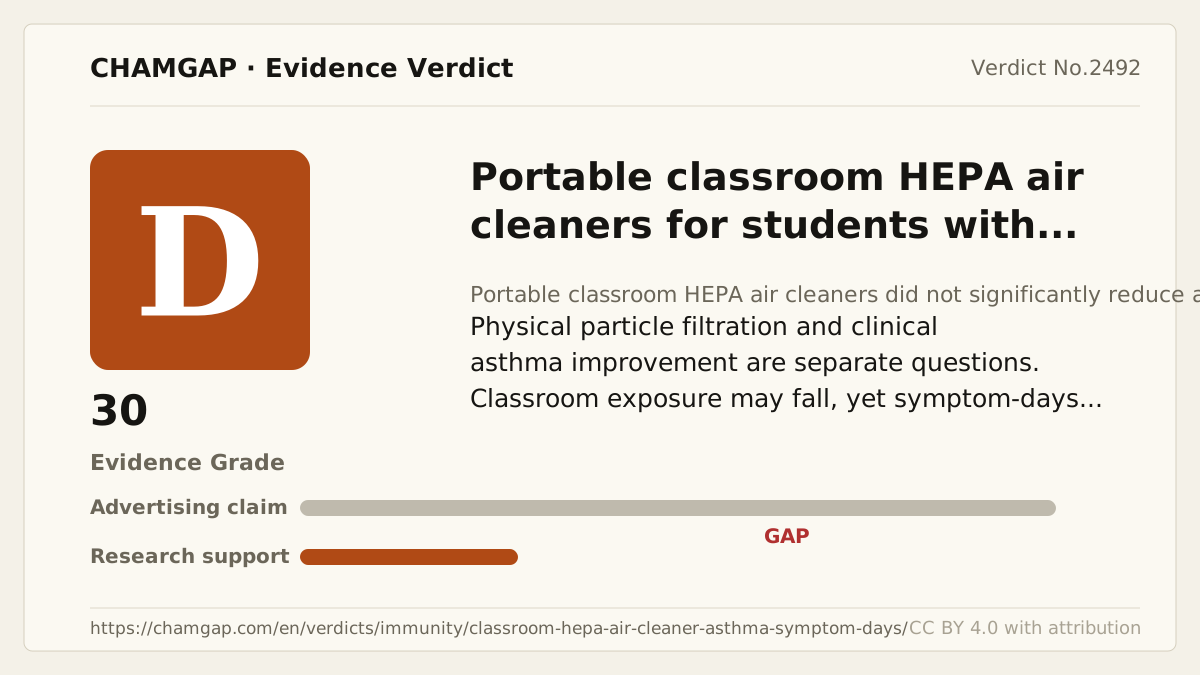
[Chamgap] Classroom HEPA air cleaners x asthma symptom-days — Evidence Grade D·30. 2 cited sources checked. Source: https://chamgap.com/en/verdicts/immunity/classroom-hepa-air-cleaner-asthma-symptom-days/ · CC BY 4.0CC BY 4.0 — free to use with attribution; do not distort grades, numbers, or verdict meaning.
What this document does and does not do
Chamgap is an information source. It reports what research has and has not confirmed; it does not tell readers what to take or buy. That decision belongs to readers and, when needed, medical or legal professionals. This verdict reflects literature available up to the search date and may change as new research appears. Nothing here is medical advice.