
Cetirizine,
does it really help with Relief of sneezing, rhinorrhea, and itching in seasonal and perennial allergic rhinitis?
research showsCetirizine is rated B because repeated randomized trials show that it reduces symptoms such as sneezing, rhinorrhea, and nasal itching versus placebo in seasonal and perennial allergic rhinitis. Once-daily 10 mg improved total symptom scores in a 215-patient perennial-rhinitis trial and a separate 321-patient perennial-rhinitis trial, with seasonal-rhinitis studies pointing in the same direction. Outcomes were nevertheless short-term patient-rated symptom scores, the effect on congestion is relatively smaller, and the drug does not remove the allergic cause or modify the disease. Mild drowsiness, dry mouth, and individual driving impairment are separated from efficacy under safety.
ads claimMarketing may expand one-tablet relief into complete control of every rhinitis symptom or a cure for the allergic tendency. The evidence supports reduced sneezing, rhinorrhea, and itching during use, not elimination of congestion in every patient or removal of the underlying allergen sensitization.
Useful facts when choosing a product
- A common regimen for adults and eligible children is cetirizine 10 mg once daily, but age, kidney function, and the specific product can require a different dose, so its label should be followed.
- Cetirizine is a second-generation antihistamine with less central sedation than first-generation agents, but it is not completely nonsedating.
- Until an individual knows whether drowsiness or impaired concentration occurs, avoiding driving, machinery operation, and alcohol is prudent.
- Prominent congestion or persistent symptoms may require an intranasal corticosteroid, allergen avoidance, or diagnostic reassessment.
Chamgap Semantic Classification Code
Candidate index · review held
M.cetirizine.UNK.sneezing-rhinorrhea-and-itching-in-seasonal-and-perennial-allergic-rhinitis.relieve.placeboMedicinal interventions > Cetirizine > Unknown > sneezing, rhinorrhea, and itching in seasonal and perennial allergic rhinitis > Symptom-relief claim > Placebo
An automated migration candidate, not an issued permanent code; exact claim scope remains under review. This machine-generated migration candidate helps retrieval but is not a permanent assignment. The original verdict ID and URL remain authoritative.
What the research actually shows
Mansmann 1992 assigned 216 adults with perennial allergic rhinitis to 10 mg, 20 mg, or placebo for four weeks and found optimal overall relief at 10 mg. Skoner 2014 randomized 321 adults at 15 United States centers to 10 mg or placebo and improved both total symptom severity and disease-specific quality of life. Two seasonal-rhinitis randomized trials reported by Urdaneta 2018 also found lower total symptom scores with cetirizine than placebo, although most authors were employed by Johnson & Johnson. Replication supports genuine symptom relief, while short-term subjective scales and substantial industry involvement limit certainty.
Why this is classified as B (72)
Separate placebo-controlled trials in seasonal and perennial allergic rhinitis repeatedly improved direct symptom scores that included sneezing, rhinorrhea, and itching. Most evidence nevertheless uses patient-reported outcomes over only a few weeks, some large data are industry-linked, and effects on congestion and disease modification are limited, yielding B with 72 points. Drowsiness and dry mouth are separate safety issues.
Counterpoint. Cetirizine is a reasonable first-line symptomatic medicine when sneezing, clear rhinorrhea, and itching predominate. If congestion dominates or control remains poor, the dose should not be increased without reviewing the diagnosis and treatment combination.
Rejudgment record. New verdict — Credited multiple placebo-controlled trials showing improvement in direct sneezing, rhinorrhea, and itching scores in seasonal and perennial allergic rhinitis, while assigning B for short-term subjective scales, relatively weaker congestion effects, and absence of disease modification
Sub-claim grades by effect
This ingredient is marketed for several effects. A single overall grade blends strong and weak claims together, so each effect is graded separately here. The overall grade reflects the strongest disconfirming or core claim.
| Effect (sub-claim) | Grade | Basis |
|---|---|---|
| Relief of sneezing, rhinorrhea, and nasal itching in allergic rhinitis | B | Direct symptom scores repeatedly improved in multiple placebo-controlled seasonal and perennial rhinitis trials. |
| Relief of nasal congestion in allergic rhinitis | C | Some trials show improvement, but oral antihistamine effects on congestion are smaller and less consistent than effects on sneezing and itching. |
| Removal of allergic sensitization or disease cure | F | It is a symptomatic medicine during use and has no clinical evidence of removing the underlying allergic sensitization. |
Cross-check — AI research and Codex final gate
Evidence Table
| Study | Design | Sample | Funding | Endpoint | Result | Weight |
|---|---|---|---|---|---|---|
| Mansmann HC Jr et al. 1992 | Randomized double-blind placebo-controlled dose trial | 216 adults with perennial allergic rhinitis; 215 in the efficacy analysis | Not reported in the abstract | Overall and individual rhinitis symptom severity over four weeks | Both 10 mg and 20 mg relieved overall symptoms versus placebo, with 10 mg optimal and little added benefit at 20 mg. | Direct placebo-controlled evidence |
| Skoner DP et al. 2014 | Multicenter randomized double-blind placebo-controlled trial | 321 adults with perennial allergic rhinitis | Several industry-affiliated authors in a product-development context | Four-week total symptom severity complex and rhinitis quality of life | Cetirizine 10 mg significantly improved total symptom scores over the treatment period and quality of life at four weeks versus placebo. | Moderate-sized direct symptom trial |
| Urdaneta ER et al. 2018 | Analysis of two randomized placebo-controlled seasonal-rhinitis trials | Two trials with several cetirizine regimens and placebo | Johnson & Johnson Consumer authorship and industry involvement | Two-week participant- and investigator-rated total symptom severity complex | Cetirizine regimens generally produced lower total symptom scores than placebo with effects across 12 to 24 hours. | Seasonal-rhinitis replication with industry-bias caution |
Receipt — 4 References
All 4 cited sources were verified for existence at the original page (as of 2026-07-20).
Final verification and publication gate: Codex · Evidence date: 2026-07-20 · Corrections: none
Cite this verdict
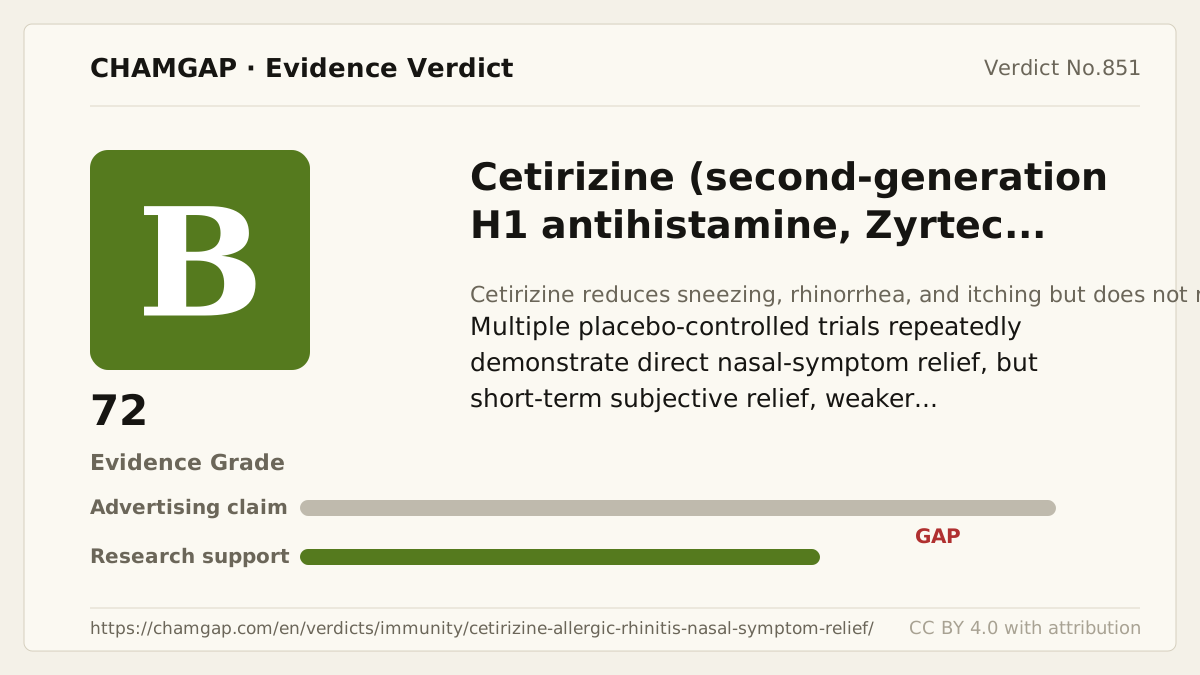
[Chamgap] Cetirizine x relief of nasal symptoms in allergic rhinitis — Evidence Grade B·72. 4 cited sources checked. Source: https://chamgap.com/en/verdicts/immunity/cetirizine-allergic-rhinitis-nasal-symptom-relief/ · CC BY 4.0CC BY 4.0 — free to use with attribution; do not distort grades, numbers, or verdict meaning.
What this document does and does not do
Chamgap is an information source. It reports what research has and has not confirmed; it does not tell readers what to take or buy. That decision belongs to readers and, when needed, medical or legal professionals. This verdict reflects literature available up to the search date and may change as new research appears. Nothing here is medical advice.