
Buteyko breathing training added to adult asthma care,
does it really help with Reduced symptoms and rescue bronchodilator use?
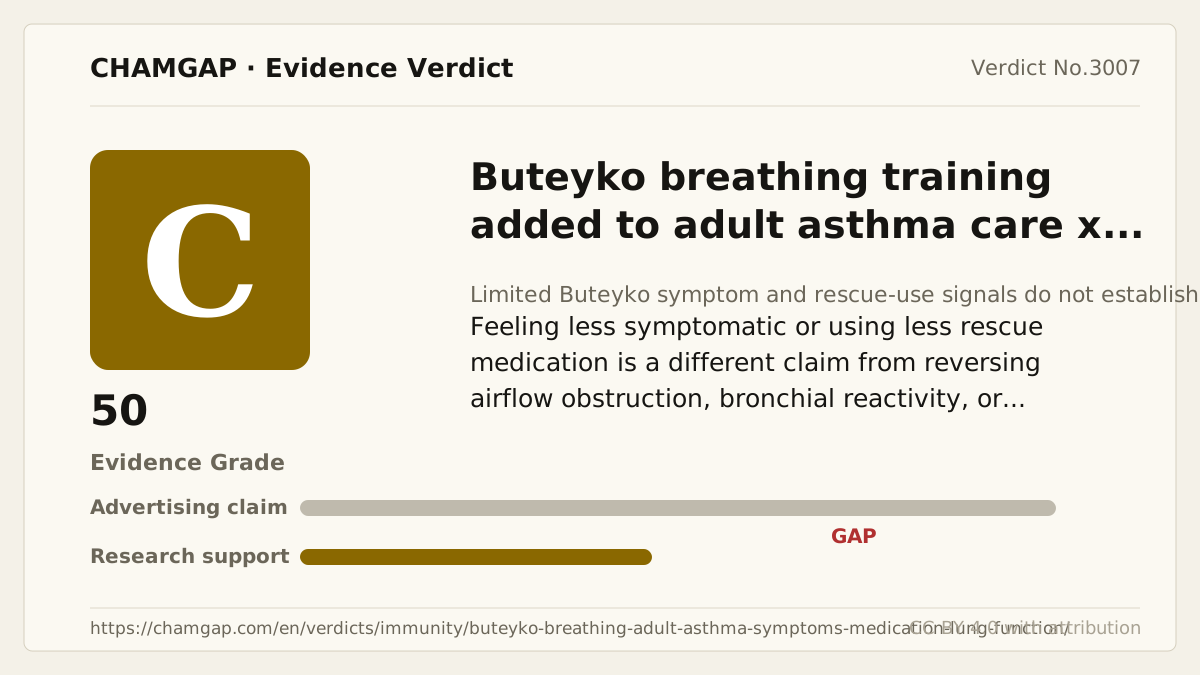
research showsGrade C with 50 points. A 90-person three-arm trial had a positive symptom co-primary and some trials reported less rescue use or better quality of life, while the paired airway-responsiveness outcome and asthma control versus active breathing education were null. This is limited adjunctive evidence, not support for replacing inhaled treatment or preventing exacerbations.
ads claimClaims that breathing retraining cures asthma or lets people stop inhalers extend limited symptom results to null lung-function and exacerbation outcomes.
Useful facts when choosing a product
- The evidence concerns an adjunct to standard inhaled care.
- Medication reduction used clinical review rather than unsupervised withdrawal.
- General breathing retraining and pranayama were not pooled as Buteyko effects.
Chamgap Semantic Classification Code
Permanent code issued
X.buteyko-breathing.behavioral.asthma-symptoms.reduce.active-breathing-educationBehaviors, exposures and policies > Buteyko breathing training added to adult asthma care > Behavioral delivery > Reduced symptoms and rescue bronchodilator use > Reduction claim > Active breathing education
Codex retrospectively verified the principal intervention, delivery, population, endpoint, and comparator from the existing reviewed verdict and issued a permanent semantic code. Secondary outcomes on the page are not transferred as separate claims. The code identifies the intervention and claim; it never contains the evidence grade, score, or safety result.
Exact Claim Classification
These independent facets prevent evidence from different forms, routes, populations, effects, and comparators from being mixed.
| Intervention class | X · Behavior, exposure, or policy |
|---|---|
| Canonical ingredient or intervention | Buteyko breathing training added to adult asthma care |
| Source or part used | Plant source not applicable; specified behavior or training |
| Formulation or processing | Buteyko breathing training added to adult asthma care |
| Route | Behavioral delivery |
| Dose | Buteyko breathing training added to adult asthma care |
| Duration | Several weeks to six months across trials |
| Population | 39 adults with asthma |
| Effect or condition | Reduced symptoms and rescue bronchodilator use |
| Primary endpoint | Beta2-agonist and ICS use, QOL, FEV1 and PEF |
| Comparator | Active breathing education |
| Duplicate-detection key | buteyko-breathing|behavioral|39 adults with asthma|asthma-symptoms|Several weeks to six months across trials |
What the research actually shows
Buteyko education was compared with asthma education, a sham device, or active pranayama. Medication reduction was medically reviewed, and objective lung function and exacerbations were assessed separately.
Why this is classified as C (50)
The symptom co-primary is a strength, but independently funded replication is unverified; split co-primary results, lack of masking, 23% attrition, and null objective outcomes give C with 50 points.
Counterpoint. Null FEV1, PEF, PD20, FeNO, and exacerbation findings prevent translating symptom signals into improved airway physiology or exacerbation prevention.
Rejudgment record. Cross-check applied — Read the positive symptom co-primary alongside null PD20 and null control versus active breathing education; incorporated unverified independent funding, 23% attrition, and taper safeguards
| Endpoint | P | Symptom or function itself is the target - including patient reports and performance tests |
| Replication | R1 | Single confirmatory trial |
| Independence | I1 | Mixed funding sources |
| Effect size | E+ | Meets the clinically important threshold |
| Precision | CX | No pooled confidence interval could be confirmed |
Stored derived and displayed grades match; this is not a current recalculation or validity check (C).
Sub-claim grades by effect
This ingredient is marketed for several effects. A single overall grade blends strong and weak claims together, so each effect is graded separately here. The overall grade reflects the strongest disconfirming or core claim.
| Effect (sub-claim) | Grade | Basis |
|---|---|---|
| Reduced asthma symptoms and rescue bronchodilator use | C | Several small trials signal benefit, limited by masking and endpoint selection. |
| Improved FEV1, PEF, or airway responsiveness | D | Direct trials repeatedly failed to show improvement. |
| Prevention of exacerbations or replacement of inhaled therapy | D | Exacerbations did not improve and reductions were clinically supervised. |
Cross-check — AI research and Codex final gate
Evidence Table
| Study | Design | Sample | Funding | Endpoint | Result | Weight |
|---|---|---|---|---|---|---|
| Bowler SD et al. 1998 | Blinded randomized controlled trial | 39 adults with asthma | Specific funding and conflicts unverified | Beta2-agonist and ICS use, QOL, FEV1 and PEF | Median beta2-agonist reduction 904 versus 57 mcg, P=.002; FEV1 and PEF null; ICS P=.06 and QOL P=.09 | Early direct trial |
| Cooper S et al. 2003 | Three-arm randomized Buteyko, pranayama, and placebo trial | 90 randomized and 69 completed | Specific funding and conflicts unverified | Symptoms and rescue use; PD20, FEV1, exacerbations, and ICS | Median symptom change -3 versus -1 versus 0, P=.003; bronchodilator -2 puffs/day, P=.005; objective outcomes, exacerbations, and ICS null | Key trial with active control |
| Cowie RL et al. 2008 | Randomized Buteyko versus physiotherapist-led breathing education trial | 129 randomized and 119 assessed at six months | Anonymous donor; independence unverified | Six-month asthma-control primary and ICS-reduction secondary | Control 79% versus 72%, P=.4; missing-as-failure 68% versus 70%, P=.7; ICS reduction 23/56 versus 13/63, P=.02 | Key contrary active-education control |
| Vagedes K et al. 2024 | Randomized Buteyko versus usual-care trial | 60 adults | Reported public or institutional support; full conflicts cross-checked | Primary voluntary control pause; secondary ACQ and medication; FEV1 and FeNO | Primary and some secondary signals; FEV1 and FeNO null, registered after recruitment began | Modern supporting trial |
Receipt — 4 References
All 4 cited sources were verified for existence at the original page (as of 2026-09-07).
Final verification and publication gate: Codex · Evidence date: 2026-09-07 · Corrections: none
Cite this verdict
[Chamgap] Buteyko Breathing for Adult Asthma—Separate Symptom and Rescue-Medication Signals From Null Lung Function — Evidence Grade C·50. 4 cited sources checked. Source: https://chamgap.com/en/verdicts/immunity/buteyko-breathing-adult-asthma-symptoms-medication-lung-function/ · CC BY 4.0CC BY 4.0 — free to use with attribution; do not distort grades, numbers, or verdict meaning.
What this document does and does not do
Chamgap is an information source. It reports what research has and has not confirmed; it does not tell readers what to take or buy. That decision belongs to readers and, when needed, medical or legal professionals. This verdict reflects literature available up to the search date and may change as new research appears. Nothing here is medical advice.