
Budesonide,
does it really help with Prevention of severe exacerbations, emergency treatment, and hospitalization in early mild persistent asthma?
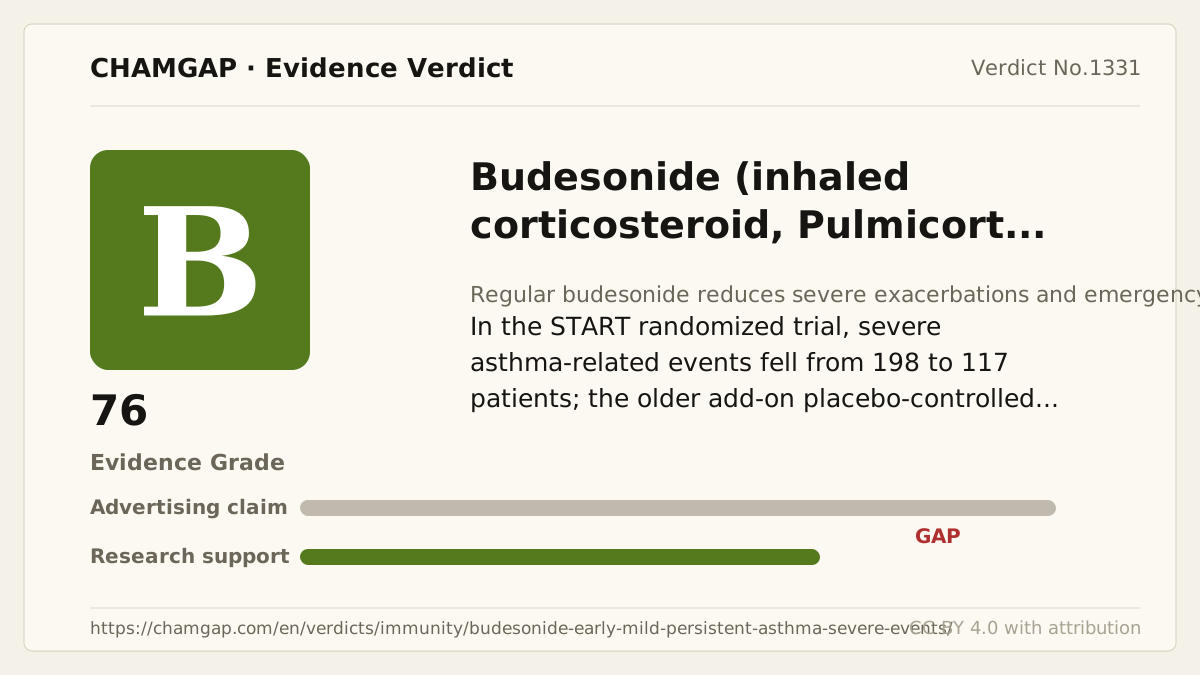
research showsIn the START randomized trial, severe asthma-related events fell from 198 to 117 patients; the older add-on placebo-controlled evidence supports a component-specific B with 76 points. The reduction in hard health-care-use events is clear even in early mild persistent asthma. The trial did not directly compare modern as-needed ICS-formoterol strategies, and its evidence must not be conflated with biologics such as mepolizumab or tezepelumab for severe asthma.
ads claimMarketing can expand early inhaled corticosteroid treatment into a cure or complete prevention of lung-function decline. The evidence supports fewer severe events and less need for additional medication with regular low-dose treatment; budesonide is not a rescue drug that immediately stops an acute attack.
Useful facts when choosing a product
- Inhaled budesonide is used regularly as a controller for persistent asthma and is not a rescue medicine for immediate relief of established acute bronchospasm.
- Rinsing the mouth with water without swallowing after inhalation helps reduce the risk of oral and pharyngeal candidiasis.
- Dysphonia and oral candidiasis can occur, and growth velocity should be monitored in children.
- Pulmicort formulations and age-specific approved doses differ, so the prescription and product labeling take priority.
Chamgap Semantic Classification Code
Candidate index · review held
M.budesonide.inhaled.severe-exacerbations-emergency-treatment-and-hospitalization-in-early-mild-persistent-asthma.prevent.MULTIMedicinal interventions > Budesonide > Inhaled > severe exacerbations, emergency treatment, and hospitalization in early mild persistent asthma > Occurrence-prevention claim > Multiple: primary unresolved
An automated migration candidate, not an issued permanent code; exact claim scope remains under review. This machine-generated migration candidate helps retrieval but is not a permanent assignment. The original verdict ID and URL remain authoritative.
What the research actually shows
START randomized 7,241 patients with mild persistent asthma of less than two years' duration and analyzed 7,165 after administrative exclusions. Adding once-daily budesonide rather than placebo to usual care for three years reduced a first severe asthma-related event to 117 of 3,597 patients from 198 of 3,568 patients (HR 0.56, 95% CI 0.45 to 0.71). The outcome included exacerbations requiring hospitalization or emergency-department treatment and death. Five-year follow-up still favored initial budesonide assignment for severe events, although both groups received open-label budesonide during the final two years, weakening the long-term comparison. Lung-function benefits were small and did not prevent the five-year decline in postbronchodilator FEV1.
Why this is classified as B (76)
Large randomized placebo-controlled START data show a component-specific reduction in severe asthma events. Because this was an older add-on-to-usual-care trial and preservation of lung function was limited, the rating is B rather than A, with 76 points. Safety was assessed separately from efficacy.
Counterpoint. The reduction in hard health-care-use events is clear even in early mild persistent asthma. The trial did not directly compare modern as-needed ICS-formoterol strategies, and its evidence must not be conflated with biologics such as mepolizumab or tezepelumab for severe asthma.
Rejudgment record. Cross-check applied — Rated B by accepting the component-specific reduction in severe events, emergency visits, and hospitalization in the large START trial while accounting for its older add-on design and limited preservation of lung function
Sub-claim grades by effect
This ingredient is marketed for several effects. A single overall grade blends strong and weak claims together, so each effect is graded separately here. The overall grade reflects the strongest disconfirming or core claim.
| Effect (sub-claim) | Grade | Basis |
|---|---|---|
| Prevention of severe asthma-related events | B | In three-year START, first severe events decreased from 198 to 117 patients. |
| Prevention of exacerbations requiring emergency treatment or hospitalization | B | The primary hard endpoint included emergency-department treatment and hospitalization, and budesonide reduced its risk. |
| Long-term asthma control and reduced need for additional medication | B | At five years, the early-assignment group had fewer severe events and used less additional asthma medication, although the open-label phase weakened the comparison. |
Cross-check — AI research and Codex final gate
Evidence Table
| Study | Design | Sample | Funding | Endpoint | Result | Weight |
|---|---|---|---|---|---|---|
| START Investigators (Pauwels RA et al.). 2003 | Multinational randomized double-blind placebo-controlled trial | 7,165 analyzed; 3,597 budesonide and 3,568 placebo | Supported by AstraZeneca | First severe asthma-related event | 117 versus 198 patients; HR 0.56 (95% CI 0.45 to 0.71), p<0.0001. | Key large component-specific hard-endpoint randomized trial |
| START Investigators (Busse WW et al.). 2008 | Five-year START follow-up; three years double blind then two years open label | 7,241 originally enrolled | Supported by AstraZeneca | Severe asthma-related events, lung function, and additional medication | Initial budesonide assignment produced a five-year severe-event OR of 0.61; FEV1 declined in both groups. | Durability support limited by open-label phase |
Receipt — 3 References
All 3 cited sources were verified for existence at the original page (as of 2026-07-23).
Final verification and publication gate: Codex · Evidence date: 2026-07-23 · Corrections: none
Cite this verdict
[Chamgap] Budesonide x prevention of severe exacerbations, emergency treatment, and hospitalization in early mild persistent asthma — Evidence Grade B·76. 3 cited sources checked. Source: https://chamgap.com/en/verdicts/immunity/budesonide-early-mild-persistent-asthma-severe-events/ · CC BY 4.0CC BY 4.0 — free to use with attribution; do not distort grades, numbers, or verdict meaning.
What this document does and does not do
Chamgap is an information source. It reports what research has and has not confirmed; it does not tell readers what to take or buy. That decision belongs to readers and, when needed, medical or legal professionals. This verdict reflects literature available up to the search date and may change as new research appears. Nothing here is medical advice.