
Bronchial thermoplasty,
does it really help with Improvement of quality of life and exacerbations in severe persistent asthma?
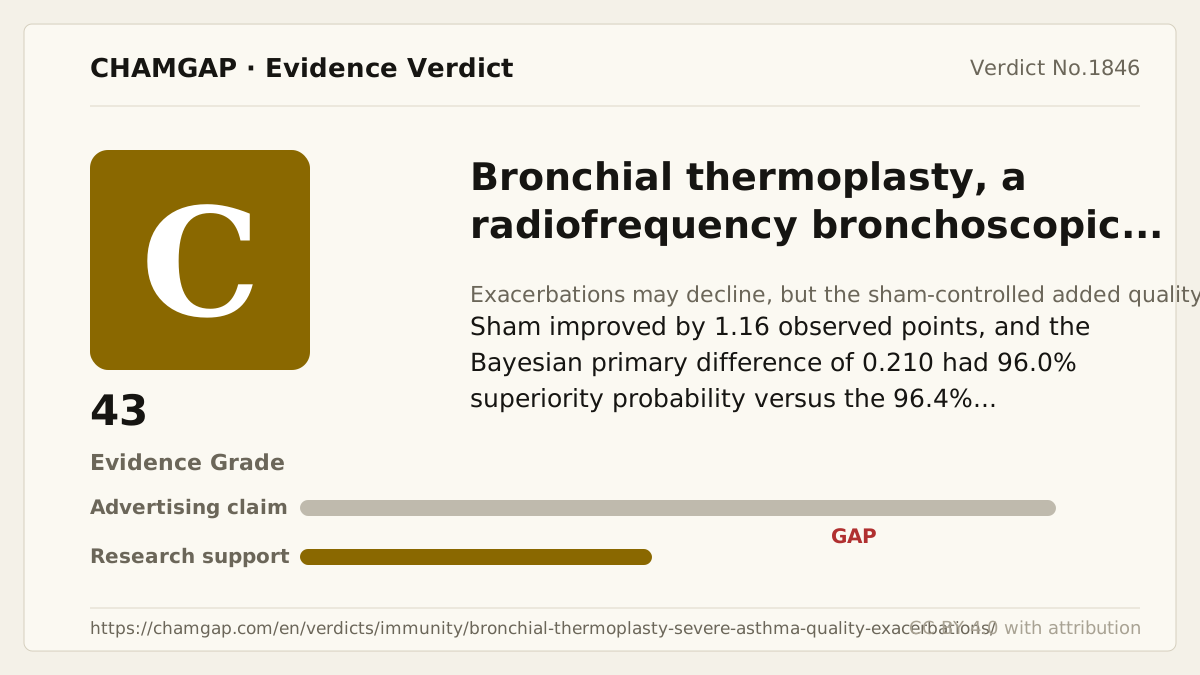
research showsBronchial thermoplasty is rated C because AIR2 failed its primary AQLQ endpoint. Observed 12-month changes were +1.35 versus +1.16, while the separate Bayesian primary analysis estimated a 0.210 between-group difference, below the 0.5 AQLQ MCID.
ads claimMarketing can expand airway-smooth-muscle reduction into assured long-term symptom normalization. The sham-controlled added quality-of-life effect was small, while the favorable exacerbation result was secondary.
Useful facts when choosing a product
- AIR2 randomized 297 and analyzed 288 who underwent bronchoscopy, 190 treatment and 98 sham.
- A course is generally delivered through three bronchoscopic procedures to different lung regions.
Chamgap Semantic Classification Code
Candidate index · review held
P.bronchial-thermoplasty.procedural.quality-of-life-and-exacerbations-in-severe-persistent-asthma.improve.shamProcedures, devices and tests > Bronchial thermoplasty > Procedural > quality of life and exacerbations in severe persistent asthma > Improvement claim > Sham procedure or device
An automated migration candidate, not an issued permanent code; exact claim scope remains under review. This machine-generated migration candidate helps retrieval but is not a permanent assignment. The original verdict ID and URL remain authoritative.
What the research actually shows
AIR2 randomized 297 and analyzed 288 who underwent bronchoscopy. Observed 12-month AQLQ changes of +1.35 versus +1.16 are distinct from the Bayesian primary-analysis difference of 0.210 (95% credible interval -0.025 to 0.445). Sham improved by 1.16, and 96.0% superiority probability missed the 96.4% threshold. The 0.5-point AQLQ MCID comes from Juniper and colleagues in 1994, linked to patient global assessment. The independent 2017 AHRQ review by D'Anci and colleagues confirmed the failed intention-to-treat analysis. verdict 1322, which is B with 74 points, verdict 820, which is B with 78 points, and verdict 1331, which is B with 76 points, concern drug evidence not transferred here.
Why this is classified as C (50)
P, R0, I0, E~, and B0 derive C with 50 points. Periprocedural hospitalization is recorded only under safety.
Counterpoint. Selected patients uncontrolled on medication may discuss the exacerbation signal with a specialist severe-asthma team, but biologic-drug evidence cannot be transferred to the procedure.
Rejudgment record. Cross-check applied — Failed primary AQLQ endpoint, sub-MCID sham-controlled difference, manufacturer-centered single confirmatory evidence, and discordant trial structures
| Endpoint | P | Symptom or function itself is the target - including patient reports and performance tests |
| Replication | R0 | Trials conflict in direction |
| Independence | I0 | Evidence comes only from manufacturer studies |
| Effect size | E~ | Statistically positive but below the threshold |
Stored derived and displayed grades match; this is not a current recalculation or validity check (C).
Sub-claim grades by effect
This ingredient is marketed for several effects. A single overall grade blends strong and weak claims together, so each effect is graded separately here. The overall grade reflects the strongest disconfirming or core claim.
| Effect (sub-claim) | Grade | Basis |
|---|---|---|
| Improvement in asthma-related quality of life | C | The 0.19-point sham-controlled difference missed the 0.5-point MCID and the primary endpoint failed. |
| Reduction in severe asthma exacerbations | C | AIR2 favored treatment, but this was secondary and lacks independent confirmation. |
| Reduction in emergency-department visits | C | This favorable secondary health-care-use signal comes from one manufacturer-sponsored trial. |
Cross-check — AI research and Codex final gate
Evidence Table
| Study | Design | Sample | Funding | Endpoint | Result | Weight |
|---|---|---|---|---|---|---|
| Castro M et al. AIR2, 2010 | Multicenter randomized double-blind sham-bronchoscopy-controlled trial | 297 randomized; 288 undergoing bronchoscopy analyzed by intention to treat (190/98) | Manufacturer sponsorship by Asthmatx Inc. with employee coauthors | Observed 12-month AQLQ change and Bayesian integrated primary analysis | Observed change +1.35 versus +1.16; Bayesian difference 0.210 (95% credible interval -0.025 to 0.445), with 96.0% superiority probability below 96.4% | Key sham-controlled trial |
| D'Anci KE et al. AHRQ review, 2017 | Systematic review and comparative-effectiveness assessment | Three randomized trials: AIR, RISA, and AIR2 | Public funding from the United States AHRQ | AQLQ, exacerbations, and health-care use | AIR2 intention-to-treat AQLQ missed its prespecified threshold and the difference was below the 0.5 MID; evidence strength was low | Independent synthesis |
Receipt — 3 References
All 3 cited sources were verified for existence at the original page (as of 2026-07-24).
Final verification and publication gate: Codex · Evidence date: 2026-07-24 · Corrections: none
Cite this verdict
[Chamgap] Bronchial thermoplasty x symptoms and exacerbations in severe asthma — Evidence Grade C·50. 3 cited sources checked. Source: https://chamgap.com/en/verdicts/immunity/bronchial-thermoplasty-severe-asthma-quality-exacerbations/ · CC BY 4.0CC BY 4.0 — free to use with attribution; do not distort grades, numbers, or verdict meaning.
What this document does and does not do
Chamgap is an information source. It reports what research has and has not confirmed; it does not tell readers what to take or buy. That decision belongs to readers and, when needed, medical or legal professionals. This verdict reflects literature available up to the search date and may change as new research appears. Nothing here is medical advice.