
Bovine thymus glandular,
does it really help with T-cell activation, enhanced immunity, and infection prevention?
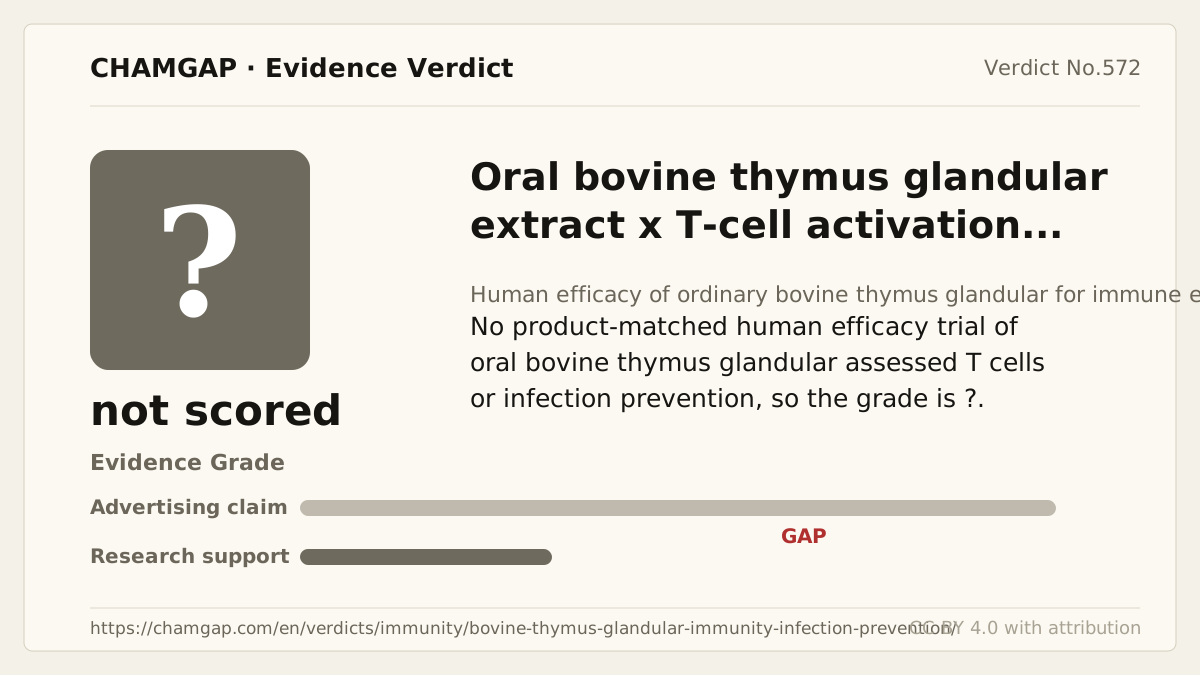
research showsThe grade is ? because no product-matched human efficacy literature was found showing that an ordinary oral bovine thymus glandular activates T cells or prevents infection in healthy people. Animal and in-vitro work from the 1970s and 1980s, and a pediatric trial of the separate standardized drug derivative thymomodulin, cannot be transferred to ordinary organ powder or extract. A manufacturer-sponsored trial completed in 2025 enrolled 80 people but measured safety and tolerability, not efficacy, and posted no results. This concerns a different organ and claim from bovine adrenal cortex in verdict 537.
ads claimMarketing turns the thymus gland's role in T-cell maturation into a claim that eating animal thymus restores human thymic function. An organ name and mechanistic analogy do not establish oral absorption, product equivalence, or fewer infections.
Useful facts when choosing a product
- Retail glandulars can be dried organ powders, crude extracts, or nuclear fractions, so they are not compositionally equivalent to the old thymomodulin product.
- FDA inspections address records showing that cattle-derived supplement materials exclude prohibited tissues and BSE hazards, and older guidance listed thymus as a tissue with suspected low infectivity.
- Prions resist ordinary disinfection and sterilization, making origin, slaughter controls, specified-risk-material exclusion, and traceability important product-quality facts.
- People with immune disease, a transplant, immunosuppressive treatment, pregnancy or lactation, or bovine-protein allergy should consult a clinician because efficacy and long-term safety are unknown.
Chamgap Semantic Classification Code
Candidate index · review held
S.bovine-thymus-glandular-extract.oral.t-cell-activation-enhanced-immunity-and-infection-prevention.prevent.placeboSupplements and nutraceuticals > bovine thymus glandular extract > Oral > T-cell activation, enhanced immunity, and infection prevention > Occurrence-prevention claim > Placebo
An automated migration candidate, not an issued permanent code; exact claim scope remains under review. This machine-generated migration candidate helps retrieval but is not a permanent assignment. The original verdict ID and URL remain authoritative.
What the research actually shows
Belokrylov et al. 1976 injected purified low-molecular-weight bovine thymus extract into mice and observed more antibody-forming cells. Stepien et al. 1982 tracked fraction activity in an in-vitro assay using spleen cells from neonatally thymectomized mice. Neither was human oral efficacy. Fiocchi et al. 1986 reported infection-frequency and salivary-IgA signals for the distinct medicinal derivative thymomodulin in children with recurrent respiratory infection, not for a generic glandular. Manufacturer Standard Process registered NCT06795945 to assess vital signs, laboratory tests, and adverse events across three oral bovine thymus nuclear-extract doses; it was not an efficacy trial.
Why this is classified as ?
Animal and in-vitro mechanisms and a different standardized derivative exist, but no product-matched human efficacy literature exists for an ordinary oral bovine thymus glandular. The registered study measured safety rather than efficacy, giving ? and a null score. BSE, prion, and product-variation concerns are separated under safety.
Counterpoint. This is not F for repeatedly disproven efficacy; it is ? because suitable human efficacy research for the claim and product was not found. A future independent trial of a fully specified product would require reassessment.
Rejudgment record. New verdict — No product-matched human efficacy trial of ordinary oral bovine thymus glandular; excluded animal, in-vitro, separate standardized-derivative, and safety-only registry evidence from efficacy grading
Sub-claim grades by effect
This ingredient is marketed for several effects. A single overall grade blends strong and weak claims together, so each effect is graded separately here. The overall grade reflects the strongest disconfirming or core claim.
| Effect (sub-claim) | Grade | Basis |
|---|---|---|
| T-cell activation or improved immune markers | ? | No product-matched human efficacy trial of ordinary oral bovine thymus glandular exists. |
| Infection prevention or reduced frequency | ? | No human trial exists for the general population and ordinary glandular; only an old pediatric trial of another standardized derivative was found. |
Cross-check — AI research and Codex final gate
Evidence Table
| Study | Design | Sample | Funding | Endpoint | Result | Weight |
|---|---|---|---|---|---|---|
| Belokrylov GA et al. 1976 | Mouse injection experiment | CBA mice; number not stated in the abstract | Inadequately reported | Splenic antibody-forming cells and serum hemagglutinins | Immune responses increased after injection of purified bovine thymus extract. | Not human efficacy |
| Stepien H et al. 1982 | In-vitro fractionation and cell-proliferation assay | Spleen cells from thymectomized mice | Inadequately reported | Cell proliferation measured by thymidine incorporation into DNA | Activity was detected in selected bovine thymus fractions. | Not human efficacy |
| NCT06795945 | Randomized triple-masked placebo-controlled safety trial | 80 healthy adults | Standard Process Inc. | Vital signs, laboratory tests, adverse events, and tolerability | Completed without posted results and did not assess immune or infection efficacy. | Safety registry study, not efficacy |
Receipt — 5 References
All 5 cited sources were verified for existence at the original page (as of 2026-07-19).
Final verification and publication gate: Codex · Evidence date: 2026-07-19 · Corrections: none
Cite this verdict
[Chamgap] Bovine thymus glandular x T-cell activation, immune enhancement, and infection prevention — Evidence Grade ?. 5 cited sources checked. Source: https://chamgap.com/en/verdicts/immunity/bovine-thymus-glandular-immunity-infection-prevention/ · CC BY 4.0CC BY 4.0 — free to use with attribution; do not distort grades, numbers, or verdict meaning.
What this document does and does not do
Chamgap is an information source. It reports what research has and has not confirmed; it does not tell readers what to take or buy. That decision belongs to readers and, when needed, medical or legal professionals. This verdict reflects literature available up to the search date and may change as new research appears. Nothing here is medical advice.