
5% benzoyl peroxide wash,
does it really help with Reduced shoulder Cutibacterium acnes skin burden versus 4% chlorhexidine?
research showsThe grade is C. In an 80-person double-blind randomized trial, BPO reduced counts 0.67 log more anteriorly and 0.70 log more posteriorly than CHG, with P=.027 and .0045. Standardized effects approximated from P values and sample sizes were anterior d≈0.50, posterior d≈0.66, lateral d≈0.40, and axillary d≈0, ranging from 0 to 0.66 by site. No validated clinical criterion exists, so magnitude was classified by statistical convention; effects were uneven and both groups had zero clinical infections, giving C with 50 points.
ads claimBenzoyl peroxide is genuinely antibacterial against C. acnes, and cultures fell at some sites. Evidence does not yet continue from that fact to fewer shoulder-surgery infections.
Useful facts when choosing a product
- Participants applied 118 mL of 5% BPO or 4% CHG to the shoulder and axilla for three minutes on each of three mornings before surgery.
- Patients, surgeons, and outcome analyzers were blinded, and all 80 randomized participants were analyzed.
- Postoperative infection and wound complications were 0/41 with BPO and 0/39 with CHG.
Chamgap Semantic Classification Code
Candidate index · review held
P.preoperative-5-percent-benzoyl-peroxide-shoulder-wash.procedural.shoulder-cutibacterium-acnes-skin-burden.reduce.activeProcedures, devices and tests > preoperative 5% benzoyl peroxide shoulder wash > Procedural > shoulder Cutibacterium acnes skin burden > Reduction claim > Active comparator
An automated migration candidate, not an issued permanent code; exact claim scope remains under review. This machine-generated migration candidate helps retrieval but is not a permanent assignment. The original verdict ID and URL remain authoritative.
What the research actually shows
Kolakowski L, Lai JK, Duvall GT, Jauregui JJ et al. randomized 80 shoulder-surgery patients, 41 to BPO and 39 to CHG. Participants applied solution for three minutes on each of the three mornings before surgery, and an independent on-campus laboratory counted colonies at four sites; all 80 were analyzed. The paper's methods explicitly state ANOVA with Tukey post hoc analysis for individual sites, so multiplicity adjustment was mentioned. NCT02510144 lists one primary outcome, Skin Swab and Culture With CFUs, with submission on 2015-07-23 before primary completion in 2018-07; no selective-reporting flag was set. The registry sponsor was the University of Maryland, Baltimore, and the article states that the authors and related foundations received no financial payments or benefits from a related commercial entity. Verdict 2566 addresses a different intervention and clinical endpoint.
Why this is classified as C (50)
No validated clinical criterion exists, so magnitude was classified by statistical convention. Approximations reverse-calculated from P values and sample sizes were anterior d≈0.50, posterior d≈0.66, lateral d≈0.40, and axillary d≈0; this uneven pattern gives E~, not established clinical importance. Surrogate status and the 80-person B1 limitation keep the grade C with 50 points.
Counterpoint. Lower bacterial counts suggest possible prevention, but do not establish fewer clinical infections.
Rejudgment record. Cross-check applied — We cross-checked randomized and analyzed counts, masking, prospective registered primary outcome, Tukey adjustment, site-specific log reductions and reverse-calculated effect sizes, clinical infections, and commercial disclosure against the article and NCT02510144.
| Endpoint | S | Surrogate marker - laboratory or imaging measures |
| Replication | R1 | Single confirmatory trial |
| Independence | I2 | Decisive evidence is publicly or non-profit funded |
| Effect size | E~ | Statistically positive but below the threshold |
Stored derived and displayed grades match; this is not a current recalculation or validity check (C).
Sub-claim grades by effect
This ingredient is marketed for several effects. A single overall grade blends strong and weak claims together, so each effect is graded separately here. The overall grade reflects the strongest disconfirming or core claim.
| Effect (sub-claim) | Grade | Basis |
|---|---|---|
| Reduced same-day shoulder C. acnes culture burden | C | Anterior and posterior sites improved; lateral and axillary sites did not. |
| Prevention of clinical surgical-site infection | D | Both groups had zero infections, so no difference was demonstrated. |
Cross-check — AI research and Codex final gate
Evidence Table
| Study | Design | Sample | Funding | Endpoint | Result | Weight |
|---|---|---|---|---|---|---|
| Kolakowski L, Lai JK, Duvall GT, Jauregui JJ et al., 2018 | Single-center double-blind randomized active-controlled trial | 80 randomized and analyzed by intention to treat, 41 BPO and 39 CHG | University of Maryland, Baltimore sponsor; no related commercial payments or benefits disclosed | Positive C. acnes cultures and log colony-count reduction at four sites on surgery day | BPO-minus-CHG log reduction: anterior 0.67 (P=.027), lateral 0.57 (P=.081), posterior 0.70 (P=.0045), axilla 0 (P=.99); infections 0/41 vs 0/39 | Single small culture-surrogate trial |
Receipt — 2 References
All 2 cited sources were verified for existence at the original page (as of 2026-08-14).
Final verification and publication gate: Codex · Evidence date: 2026-08-14 · Corrections: none
Cite this verdict
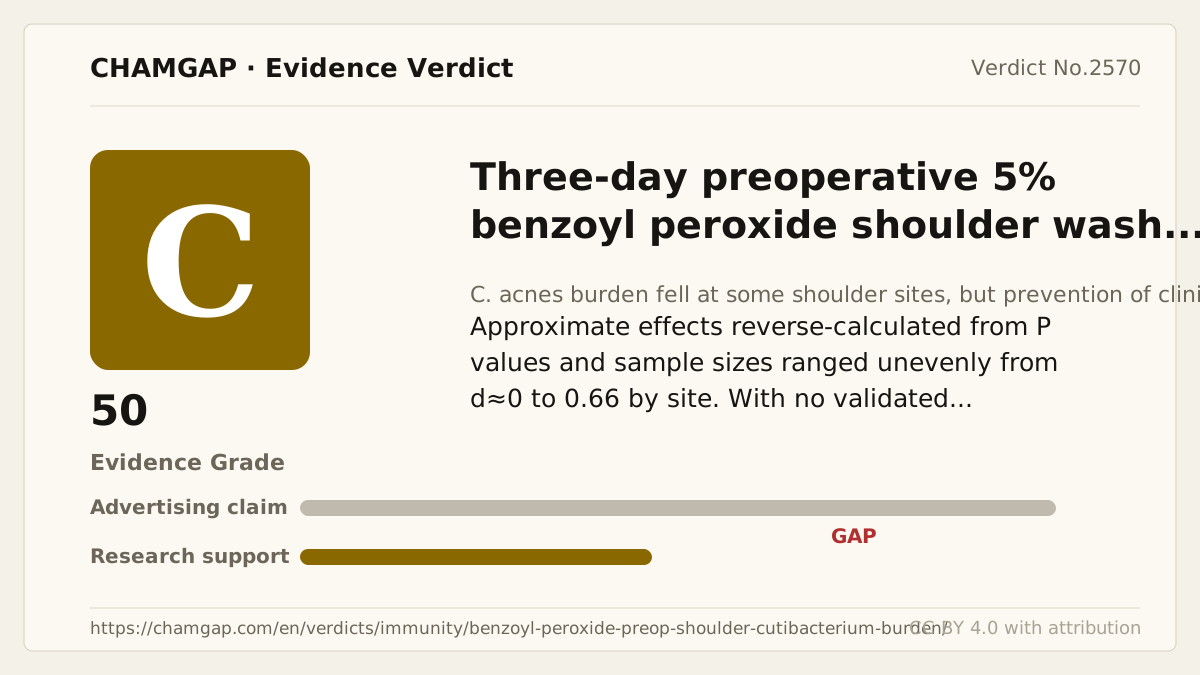
[Chamgap] 5% benzoyl peroxide wash x reduced shoulder C. acnes burden — Evidence Grade C·50. 2 cited sources checked. Source: https://chamgap.com/en/verdicts/immunity/benzoyl-peroxide-preop-shoulder-cutibacterium-burden/ · CC BY 4.0CC BY 4.0 — free to use with attribution; do not distort grades, numbers, or verdict meaning.
What this document does and does not do
Chamgap is an information source. It reports what research has and has not confirmed; it does not tell readers what to take or buy. That decision belongs to readers and, when needed, medical or legal professionals. This verdict reflects literature available up to the search date and may change as new research appears. Nothing here is medical advice.