
Azithromycin,
does it really help with Reduced acute-exacerbation frequency and delayed first recurrence in patients with COPD at high risk of exacerbation?
research showsAzithromycin is rated B because it reduces acute-exacerbation frequency and delays the first exacerbation over one year in selected patients with chronic obstructive pulmonary disease at high risk of exacerbation. The NIH-funded Albert trial randomized 1,142 participants without hearing impairment, resting tachycardia, or apparent QTc-prolongation risk to azithromycin 250 mg daily or placebo. Median time to first exacerbation was 266 versus 174 days, HR 0.73 (95% CI 0.63 to 0.84), and annual exacerbation rates were 1.48 versus 1.83. A 2018 Cochrane review also found that prophylactic antibiotics reduced the odds of experiencing at least one exacerbation, with benefit most evident for continuous or intermittent macrolides. Hearing decrement, QT prolongation, macrolide resistance, and lack of evidence beyond one year make this a selected-use B verdict with 75 points rather than routine long-term treatment for every patient with COPD.
ads claimMarketing or habitual prescribing may simplify this to an antibiotic that prevents infection in advance. Evidence best fits selected patients with repeated exacerbations despite optimized inhaled treatment, assessed for QT, hearing, and resistance risk, and treated for up to one year. It should not be expanded to colds, stable cough, or routine antibiotics for every patient with COPD.
Useful facts when choosing a product
- The pivotal Albert trial added azithromycin 250 mg once daily to usual COPD treatment for one year. Guidelines include other low-dose schedules such as 500 mg three times weekly, but identical efficacy and tolerability across schedules cannot be assumed.
- An electrocardiogram, QT-prolonging drugs, electrolyte abnormalities, and cardiac disease should be reviewed before treatment. Syncope or palpitations during therapy require prompt evaluation for arrhythmic risk.
- Baseline hearing and symptoms of tinnitus or disequilibrium should be assessed and monitored. Audiometric decrement was about five percentage points more frequent with azithromycin than placebo in the Albert trial.
- Sputum and infection assessment, including possible nontuberculous mycobacteria, liver tests, and drug interactions should be reviewed. Long-term use can increase individual and community macrolide resistance, so continued need requires regular reassessment.
Chamgap Semantic Classification Code
Candidate index · review held
M.azithromycin.UNK.acute-exacerbation-frequency-and-delayed-first-recurrence-with-copd-at-high-risk-of-exacerbation.reduce.MULTIMedicinal interventions > Azithromycin > Unknown > acute-exacerbation frequency and delayed first recurrence with COPD at high risk of exacerbation > Reduction claim > Multiple: primary unresolved
An automated migration candidate, not an issued permanent code; exact claim scope remains under review. This machine-generated migration candidate helps retrieval but is not a permanent assignment. The original verdict ID and URL remain authoritative.
What the research actually shows
Albert and the COPD Clinical Research Network enrolled 1,142 patients with COPD at increased exacerbation risk because of a prior exacerbation or continuous oxygen use and without hearing impairment, resting tachycardia, or apparent QTc-prolongation risk. Adding 250 mg daily for one year prolonged median time to first exacerbation by 92 days and reduced the rate from 1.83 to 1.48 per patient-year. Hearing decrement occurred in 25% versus 20% by the abstract definition, and macrolide resistance among newly colonizing isolates was 81% versus 41%. The Cochrane review by Herath and colleagues found OR 0.57 (95% CI 0.42 to 0.78) for at least one exacerbation across eight trials and 2,716 participants and a rate ratio of 0.67 (95% CI 0.54 to 0.83), but pooled different antibiotics and schedules and found mean quality-of-life improvement below the four-point threshold of clinical importance. ERS/ATS guidance treats macrolides as a conditional option after weighing exacerbation benefit against hearing, cardiac, and resistance burdens.
Why this is classified as B (75)
The NIH-funded, double-blind, placebo-controlled trial of 1,142 participants showed HR 0.73 for first exacerbation, a 92-day median delay, and fewer annual exacerbations, with supportive Cochrane synthesis. The endpoint is directly clinical but not mortality; selected participants, hearing decrement, QT risk, resistance, and lack of evidence beyond one year give B with 75 points.
Counterpoint. For some patients with recurrent exacerbations despite optimized inhaled therapy, smoking cessation, vaccination, and pulmonary rehabilitation, absolute benefit can outweigh harm. Exacerbation frequency, hearing, electrocardiography, liver function, and resistance risk should be reassessed after about three months and regularly thereafter.
Rejudgment record. Cross-check applied — Rated the NIH-funded, 1,142-participant, double-blind, placebo-controlled trial result of HR 0.73 for first exacerbation and lower annual exacerbation rate, with supportive Cochrane synthesis, as direct symptomatic clinical efficacy while deducting for no mortality benefit, selected participants, hearing decrement, QT risk, resistance, and lack of evidence beyond one year
Sub-claim grades by effect
This ingredient is marketed for several effects. A single overall grade blends strong and weak claims together, so each effect is graded separately here. The overall grade reflects the strongest disconfirming or core claim.
| Effect (sub-claim) | Grade | Basis |
|---|---|---|
| Reduction in acute COPD exacerbation frequency over one year | B | Annual rates were 1.48 versus 1.83 per patient-year, and the Cochrane rate ratio was 0.67. |
| Prolongation of time to first acute COPD exacerbation | B | Median time was 266 versus 174 days, HR 0.73 (95% CI 0.63 to 0.84). |
| Sustained prevention of COPD exacerbations beyond one year | ? | GOLD states that efficacy and safety data beyond one year are absent, so longer-term durability cannot be judged. |
Cross-check — AI research and Codex final gate
Evidence Table
| Study | Design | Sample | Funding | Endpoint | Result | Weight |
|---|---|---|---|---|---|---|
| Albert RK et al.; COPD Clinical Research Network. 2011 | Multicenter double-blind randomized placebo-controlled add-on trial | 1,142 patients with COPD at high exacerbation risk; 570 azithromycin and 572 placebo | Public funding from the United States National Institutes of Health | Time to first acute exacerbation and annual exacerbation frequency | Time to first exacerbation was 266 versus 174 days, HR 0.73 (95% CI 0.63 to 0.84); annual rates were 1.48 versus 1.83. | Pivotal independent large direct clinical-endpoint trial |
| Herath SC et al. 2018 | Cochrane systematic review and meta-analysis of prophylactic antibiotics for COPD | Eight trials and 2,716 participants for at least one exacerbation; five trials and 1,384 participants for exacerbation rate | Cochrane academic synthesis | At least one exacerbation, exacerbation rate, time to first exacerbation, and quality of life | OR was 0.57 and NNT 8 for at least one exacerbation; rate ratio was 0.67 per patient-year. Continuous and intermittent regimens appeared more effective than pulsed regimens. | Moderate-certainty synthesis support |
| Wedzicha JA et al.; ERS/ATS Task Force. 2017 | Clinical guideline for COPD exacerbation prevention based on systematic evidence appraisal | Randomized evidence for macrolides and other exacerbation-prevention interventions | European Respiratory Society and American Thoracic Society | COPD exacerbation rate, occurrence, time to first exacerbation, quality of life, and harms | Macrolides reduced exacerbation rate and occurrence but were treated as a conditional option because of harms, burden, and uncertainty. | Scope and benefit-harm balance for selected use |
Receipt — 3 References
All 3 cited sources were verified for existence at the original page (as of 2026-07-23).
Final verification and publication gate: Codex · Evidence date: 2026-07-23 · Corrections: none
Cite this verdict
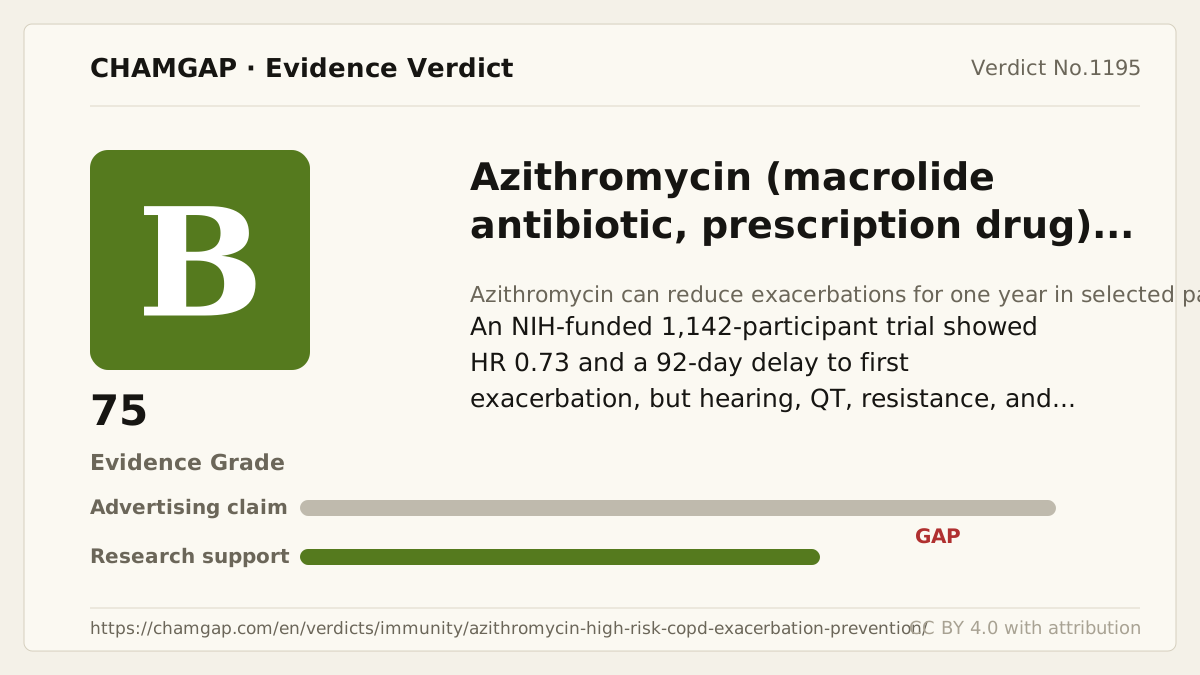
[Chamgap] Azithromycin x prevention of acute exacerbation and recurrence in high-risk COPD — Evidence Grade B·75. 3 cited sources checked. Source: https://chamgap.com/en/verdicts/immunity/azithromycin-high-risk-copd-exacerbation-prevention/ · CC BY 4.0CC BY 4.0 — free to use with attribution; do not distort grades, numbers, or verdict meaning.
What this document does and does not do
Chamgap is an information source. It reports what research has and has not confirmed; it does not tell readers what to take or buy. That decision belongs to readers and, when needed, medical or legal professionals. This verdict reflects literature available up to the search date and may change as new research appears. Nothing here is medical advice.