
Aspiration before vaccination,
does it really help with Prevention of intravascular injection with greater safety and less pain?
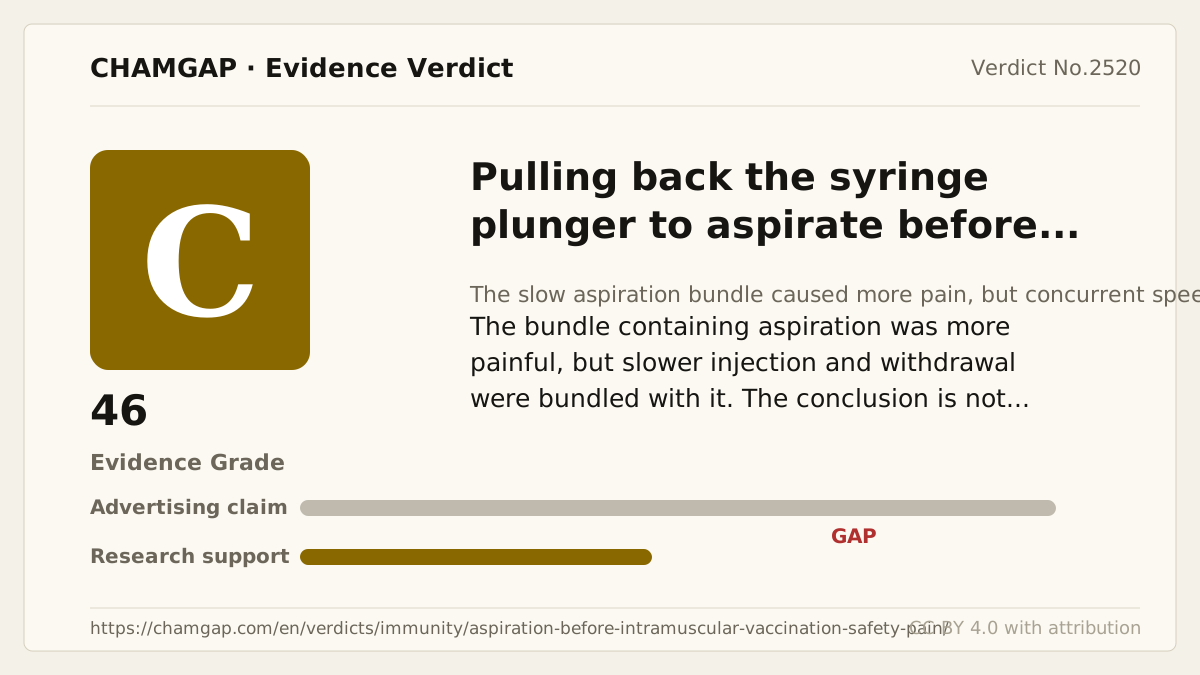
research showsThe grade is C. In 113 infants, the aspiration-plus-slow-injection bundle had MBPS pain of 5.6 versus 3.3 with rapid no aspiration, and crying in 82% versus 43%. Injection speed and needle dwell also changed, so aspiration alone cannot be isolated. This is EX, not evidence of no effect, giving C with 46 points.
ads claimSeeing no blood after pulling the plunger is not evidence that serious adverse events are reduced. Conversely, lower pain with a rapid no-aspiration bundle cannot be rewritten as proof that aspiration alone doubles pain.
Useful facts when choosing a product
- Ipp's arms differed in aspiration, injection speed, and needle-withdrawal speed.
- Median injection time was 8.8 seconds with the slow aspiration technique and 0.9 seconds with rapid no aspiration.
- No duplicate verdict or reuse of the two PMID/DOI pairs was found.
Chamgap Semantic Classification Code
Candidate index · review held
M.pulling-back-the-syringe-plunger-to-aspirate-before-intramuscular-vaccination.intramuscular.intravascular-injection-with-greater-safety-and-less-pain.prevent.UNKMedicinal interventions > Pulling back the syringe plunger to aspirate before intramuscular vaccination > Intramuscular > intravascular injection with greater safety and less pain > Occurrence-prevention claim > Unknown
An automated migration candidate, not an issued permanent code; exact claim scope remains under review. This machine-generated migration candidate helps retrieval but is not a permanent assignment. The original verdict ID and URL remain authoritative.
What the research actually shows
Ipp randomized 113 infants aged four to six months, 57 versus 56, during DTaP-Hib vaccination and measured immediate MBPS, crying, and parent and pediatrician VAS. No adverse events were observed, but this size cannot test rare intravascular injection or serious-event reduction. Göl assigned 128 infants, 32 per arm, to manual pressure, rapid no aspiration, their combination, or control. Both trials were under 200 and lacked a comparator changing aspiration alone, providing two limitations.
Why this is classified as C (46)
Pain is patient-centered, but studies changed aspiration together with speed or pressure. The unfavorable bundled result remains, yet it cannot establish no isolated aspiration effect, so magnitude is EX; rare safety benefit was also untested. This gives C with 46 points.
Counterpoint. This verdict does not make a universal claim about aspiration for every intramuscular medicine and anatomical site. It is limited to vaccination at recommended intramuscular sites.
Rejudgment record. Cross-check applied — We cross-checked simultaneous changes in aspiration, speed, and pressure and classified the result as an unidentifiable isolated aspiration effect, EX, rather than no effect.
| Endpoint | P | Symptom or function itself is the target - including patient reports and performance tests |
| Replication | R1 | Single confirmatory trial |
| Independence | I1 | Mixed funding sources |
| Effect size | EX | The clinical size of the effect could not be judged |
| Precision | CX | No pooled confidence interval could be confirmed |
Stored derived and displayed grades match; this is not a current recalculation or validity check (C).
Sub-claim grades by effect
This ingredient is marketed for several effects. A single overall grade blends strong and weak claims together, so each effect is graded separately here. The overall grade reflects the strongest disconfirming or core claim.
| Effect (sub-claim) | Grade | Basis |
|---|---|---|
| Aspiration before vaccination reduces pain. | C | The slow bundle containing aspiration was more painful, but speed differed concurrently, preventing isolation of aspiration. |
| Aspiration prevents intravascular administration and serious adverse events during vaccination. | ? | The small available trials were not designed to test rare safety events. |
Cross-check — AI research and Codex final gate
Evidence Table
| Study | Design | Sample | Funding | Endpoint | Result | Weight |
|---|---|---|---|---|---|---|
| Ipp et al., Archives of Disease in Childhood 2007 | Single-center randomized controlled trial in infants | All 113: 57 slow aspiration and 56 rapid no aspiration | Unrestricted grant from Sanofi Pasteur; the principal investigator reported prior research funding and honoraria from Sanofi Pasteur | Immediate MBPS pain, crying, parent and pediatrician VAS, and adverse events | MBPS 5.6 (95% CI 5.0-6.3) versus 3.3 (2.6-3.9); crying 47/57 (82%) versus 24/56 (43%); P<.001; no adverse events | Pivotal trial with absolute pain data but a bundled intervention |
| Göl and Özsoy, Worldviews on Evidence-Based Nursing 2017 | Randomized double-blind four-arm infant trial at two health centers | 128 infants, 32 per group | Primary-paper funding was not verified in the accessible record | Pain, crying time, heart rate, and oxygen saturation during and after vaccination | Manual pressure, rapid no aspiration, and combined groups all had less pain and crying than control, P=.001; arm-specific absolute values and CIs absent from the public abstract | Supportive direction without an isolated aspiration estimate |
Receipt — 3 References
Of 3 cited sources, 1 had limited original-page access (blocked or summary-only) and were verified via index/summary, marked partial; the rest were verified at the original page. As of 2026-08-14.
Final verification and publication gate: Codex · Evidence date: 2026-08-14 · Corrections: none
Cite this verdict
[Chamgap] Aspiration before vaccination x greater safety and less pain — Evidence Grade C·46. 3 cited sources checked. Source: https://chamgap.com/en/verdicts/immunity/aspiration-before-intramuscular-vaccination-safety-pain/ · CC BY 4.0CC BY 4.0 — free to use with attribution; do not distort grades, numbers, or verdict meaning.
What this document does and does not do
Chamgap is an information source. It reports what research has and has not confirmed; it does not tell readers what to take or buy. That decision belongs to readers and, when needed, medical or legal professionals. This verdict reflects literature available up to the search date and may change as new research appears. Nothing here is medical advice.