
Amoxicillin,
does it really help with Shorter cough and recovery in uncomplicated acute bronchitis when pneumonia is not suspected?
research showsThe claim that amoxicillin meaningfully shortens cough or recovery in uncomplicated acute bronchitis when pneumonia is not suspected is rated F. In a 12-country, 2,061-person placebo-controlled trial, neither the duration of moderately bad or worse symptoms nor mean symptom severity differed significantly. In a 660-person acute-bronchitis trial, clinical cure at day 14 was equivalent at 81.7% with amoxicillin and 84.0% with placebo. A Cochrane review of 17 randomized trials and 5,099 participants also found no difference in overall clinical improvement; mean cough duration was only 0.46 day shorter, while adverse effects increased. The Centers for Disease Control and Prevention and the National Institute for Health and Care Excellence advise against antibiotics for routine uncomplicated acute bronchitis in people who are not at high risk of complications. Diarrhea, rash, allergy, and antimicrobial resistance are recorded separately under safety.
ads claimDiscolored sputum or a persistent cough can be interpreted as proof of bacterial infection and a reason that antibiotics will clear inflammation faster. Sputum color does not predict antibiotic response, and acute-bronchitis cough commonly lasts three to four weeks without antibiotics.
Useful facts when choosing a product
- Amoxicillin is a prescription penicillin that disrupts bacterial cell-wall synthesis, and it has no target in uncomplicated acute bronchitis caused predominantly by viruses.
- Pneumonia, pertussis, bacterial sinusitis, and acute exacerbations of chronic obstructive pulmonary disease are diagnostically distinct from uncomplicated acute bronchitis and require a clinician to assess whether antibiotics are needed.
- Worsening cough, shortness of breath, chest pain, high fever, low oxygen, or altered consciousness calls for reassessment for pneumonia or another serious cause. Leftover antibiotics should not be self-administered.
- Diarrhea, nausea, rash, and candidiasis can occur, and anaphylaxis or severe skin reactions are rare but serious. Unnecessary use increases antimicrobial resistance for the individual and the community.
Chamgap Semantic Classification Code
Candidate index · review held
M.amoxicillin.UNK.shorter-cough-and-recovery-in-uncomplicated-acute-bronchitis-when-pneumonia-is-not-suspected.assess.placeboMedicinal interventions > Amoxicillin > Unknown > Shorter cough and recovery in uncomplicated acute bronchitis when pneumonia is not suspected > Association or change assessment > Placebo
An automated migration candidate, not an issued permanent code; exact claim scope remains under review. This machine-generated migration candidate helps retrieval but is not a permanent assignment. The original verdict ID and URL remain authoritative.
What the research actually shows
Little and colleagues in 2013 randomized 2,061 adults with acute lower-respiratory-tract infection in whom pneumonia was not clinically suspected to amoxicillin 1 g three times daily or placebo for seven days. The hazard ratio of 1.06 for duration of moderately bad or worse symptoms and the -0.07 mean symptom-severity difference were both nonsignificant, while diarrhea, nausea, or rash increased. Nduba and colleagues in 2008 excluded pneumonia and tuberculosis by chest imaging and showed equivalent 14-day cure rates of 81.7% with amoxicillin and 84.0% with placebo among 660 adults with acute bronchitis. The 2017 Cochrane review by Smith and colleagues included 17 randomized trials and 5,099 participants and reported overall clinical improvement RR 1.07 (95% CI 0.99 to 1.15), mean cough-duration difference -0.46 day, and adverse-effect RR 1.20. The National Institute for Health and Care Excellence and the Centers for Disease Control and Prevention advise against routine antibiotics for uncomplicated acute bronchitis.
Why this is classified as F (8)
Two large amoxicillin-specific randomized trials found no improvement in symptom duration or cure, and the 17-trial Cochrane synthesis found no overall clinical improvement, only a 0.46-day mean cough reduction, and more adverse effects. Repeated refutation and official recommendations against use give F with 8 points; allergy, diarrhea, and resistance are separate safety issues.
Counterpoint. People who are systemically very unwell or at high risk of complications, or whose reassessment identifies pneumonia or a specific bacterial infection, fall outside this verdict. An antibiotic chosen for the diagnosis and local resistance pattern may then be necessary.
Rejudgment record. New verdict — Assigned F based on negative large amoxicillin-specific placebo-controlled trials for symptom duration and cure, the clinically trivial mean effect and increased adverse events in a 17-trial Cochrane review, and recommendations against routine use from the Centers for Disease Control and Prevention and the National Institute for Health and Care Excellence
Sub-claim grades by effect
This ingredient is marketed for several effects. A single overall grade blends strong and weak claims together, so each effect is graded separately here. The overall grade reflects the strongest disconfirming or core claim.
| Effect (sub-claim) | Grade | Basis |
|---|---|---|
| Shorter cough and recovery in uncomplicated acute bronchitis | F | Large amoxicillin trials repeatedly found no benefit, and the pooled antibiotic effect was only 0.46 day on average. |
| Additional benefit in adults aged 60 or older when pneumonia is not suspected | F | The GRACE trial found no meaningful additional benefit among adults aged 60 or older. |
| Use in pneumonia, specific bacterial infection, or acute COPD exacerbation | ? | These are different diagnoses and indications, so their efficacy is not pooled into this uncomplicated-bronchitis verdict. |
Cross-check — AI research and Codex final gate
Evidence Table
| Study | Design | Sample | Funding | Endpoint | Result | Weight |
|---|---|---|---|---|---|---|
| Little P et al. 2013 GRACE | Twelve-country multicenter randomized double-blind placebo-controlled trial | 2,061 adults with acute lower-respiratory-tract infection in whom pneumonia was not suspected | Public research through the European Union Sixth Framework GRACE program | Duration of moderately bad or worse symptoms, mean symptom severity, and adverse events | The symptom-duration hazard ratio of 1.06 and severity difference of -0.07 were nonsignificant, while amoxicillin caused slight harms. | Large independent direct negative randomized trial |
| Nduba VN et al. 2008 | Triple-blind randomized placebo-controlled equivalence trial | 660 adults with acute bronchitis after chest imaging excluded pneumonia and tuberculosis | Public and academic support associated with the United States National Institutes of Health and the University of Washington | Clinical cure defined as at least a 75% reduction in acute-bronchitis severity score at day 14 | Cure rates were equivalent at 81.7% with amoxicillin and 84.0% with placebo. | Direct amoxicillin-specific negative randomized trial |
| Smith SM et al. 2017 Cochrane | Systematic review of randomized antibiotic trials for acute bronchitis | 17 randomized trials and 5,099 participants | Academic Cochrane review; funding varied across included trials | Overall clinical improvement, cough duration, and adverse effects | Overall clinical improvement was not significant; cough was 0.46 day shorter on average, while the adverse-effect risk ratio was 1.20. | Synthesis of repeated trials and assessment of clinical importance |
Receipt — 3 References
All 3 cited sources were verified for existence at the original page (as of 2026-07-20).
Final verification and publication gate: Codex · Evidence date: 2026-07-20 · Corrections: none
Cite this verdict
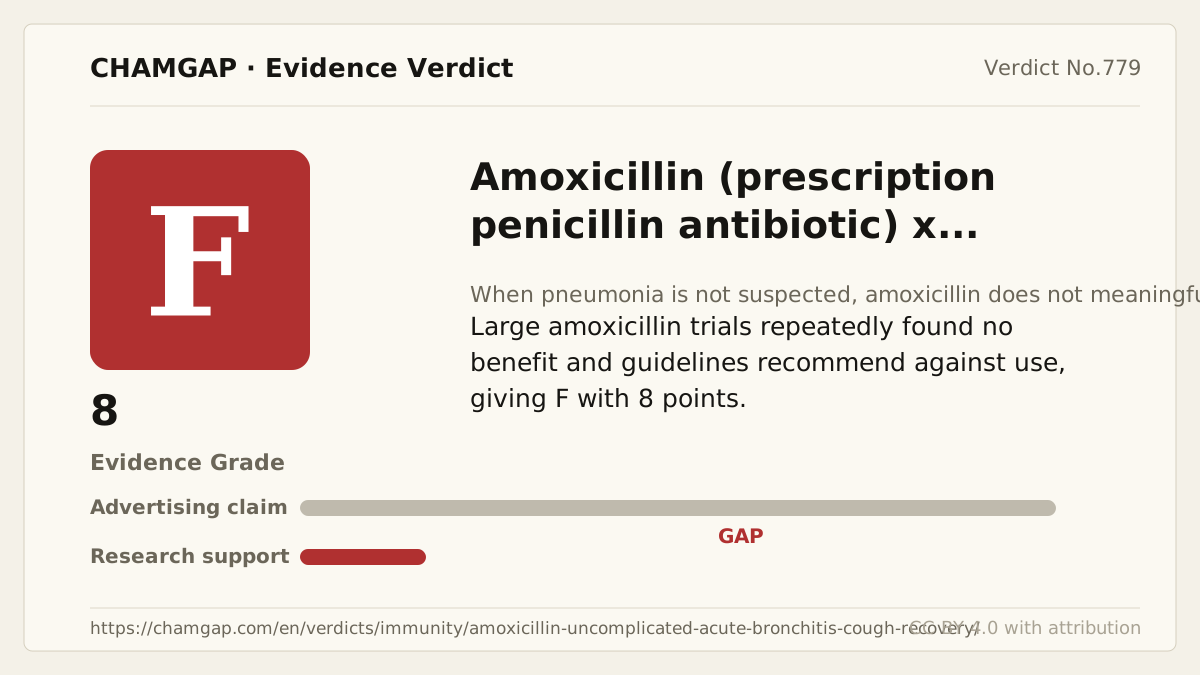
[Chamgap] Amoxicillin x shorter cough and recovery in uncomplicated acute bronchitis — Evidence Grade F·8. 3 cited sources checked. Source: https://chamgap.com/en/verdicts/immunity/amoxicillin-uncomplicated-acute-bronchitis-cough-recovery/ · CC BY 4.0CC BY 4.0 — free to use with attribution; do not distort grades, numbers, or verdict meaning.
What this document does and does not do
Chamgap is an information source. It reports what research has and has not confirmed; it does not tell readers what to take or buy. That decision belongs to readers and, when needed, medical or legal professionals. This verdict reflects literature available up to the search date and may change as new research appears. Nothing here is medical advice.