
Habitual alcohol hand-sanitizer use,
does it really help with Prevention of respiratory-illness absence in children?
research showsThe grade is D with 34 points. Sixty-eight New Zealand primary schools were randomized as clusters, and 2,443 children were followed, 1,301 intervention and 1,142 control. Both groups received the same 30-minute hand-hygiene lesson; only intervention schools received alcohol-sanitizer dispensers. Caregiver symptom-defined respiratory absence was not reduced, incidence-rate ratio 1.05, 95% CI 0.92 to 1.20. The interval leaves some preventive benefit possible and therefore does not constitute refutation.
ads claimThis was not sanitizer alone versus no program. It measured the incremental effect of sanitizer on top of education in both arms. Neither the bundled intervention nor handwashing evidence for diarrhea can be rewritten as a sanitizer-only respiratory benefit.
Useful facts when choosing a product
- Sixty-eight schools were randomized, while absence episodes from 2,443 children were analyzed.
- Generalized estimating equations and robust variance accounted for school clustering.
- Both arms received education; only intervention schools added sanitizer.
- Respiratory illness was caregiver symptom-defined absence, not laboratory-confirmed infection.
Chamgap Semantic Classification Code
Candidate index · review held
X.provision-and-use-of-alcohol-hand-sanitizer-added-to-school-hand-hygiene-education.behavioral.respiratory-illness-absence.prevent.addonBehaviors, exposures and policies > Provision and use of alcohol hand sanitizer added to school hand-hygiene education > Behavioral delivery > respiratory-illness absence > Occurrence-prevention claim > Added intervention on common background care
An automated migration candidate, not an issued permanent code; exact claim scope remains under review. This machine-generated migration candidate helps retrieval but is not a permanent assignment. The original verdict ID and URL remain authoritative.
What the research actually shows
Priest and colleagues randomized 68 primary schools to added sanitizer or control. A total of 1,301 intervention and 1,142 control children, 2,443 overall, were followed for two winter terms. Both groups received the same 30-minute classroom hand-hygiene lesson; intervention classrooms also received alcohol-sanitizer dispensers for use after coughing or sneezing and before breaks and lunch. Respiratory illness was a caregiver-reported absence episode with at least two symptoms for one day or one symptom for two days among runny nose, blocked or noisy breathing, cough, fever, sore throat, and sneeze; fever alone did not qualify. It was not laboratory-confirmed infection. The New Zealand Health Research Council publicly funded the trial and had no role in design or analysis.
Why this is classified as D (34)
A publicly funded cluster trial was null for respiratory absence, but the interval left benefit possible and unblinded subjective classification remained, giving D with 34 points.
Counterpoint. Cluster adjustment was appropriate and the sample was substantial. The result argues against a large benefit but does not precisely exclude a small one.
Rejudgment record. Cross-check applied — The original methods were checked for school-level randomization, child and episode analysis, generalized-estimating-equation cluster adjustment, education in both arms, caregiver symptom definition, public funding, and the respiratory confidence interval
| Endpoint | H | Hard endpoint - actual events such as death |
| Replication | R1 | Single confirmatory trial |
| Independence | I2 | Decisive evidence is publicly or non-profit funded |
| Effect size | E0 | Null |
| Precision | C0 | The confidence interval leaves room for benefit |
Stored derived and displayed grades match; this is not a current recalculation or validity check (D).
Sub-claim grades by effect
This ingredient is marketed for several effects. A single overall grade blends strong and weak claims together, so each effect is graded separately here. The overall grade reflects the strongest disconfirming or core claim.
| Effect (sub-claim) | Grade | Basis |
|---|---|---|
| Prevention of respiratory-illness absence | D | The IRR was 1.05, 95% CI 0.92 to 1.20, with no reduction. |
| Prevention of all illness absence | D | The primary endpoint IRR was 1.06, 95% CI 0.94 to 1.18. |
| Prevention of laboratory-confirmed respiratory infection | ? | The trial did not measure laboratory-confirmed infection. |
Cross-check — AI research and Codex final gate
Evidence Table
| Study | Design | Sample | Funding | Endpoint | Result | Weight |
|---|---|---|---|---|---|---|
| Priest P et al. 2014 | School-level cluster randomized trial | 68 schools and 2,443 children: 1,301 intervention and 1,142 control | Public funding from the New Zealand Health Research Council; funder had no study role | Respiratory-illness absence defined by caregiver-reported symptoms | Respiratory absence IRR 1.05, 95% CI 0.92 to 1.20; all-illness absence IRR 1.06, 0.94 to 1.18. | Pivotal publicly funded cluster trial |
Receipt — 1 References
All 1 cited sources were verified for existence at the original page (as of 2026-08-05).
Final verification and publication gate: Codex · Evidence date: 2026-08-05 · Corrections: none
Cite this verdict
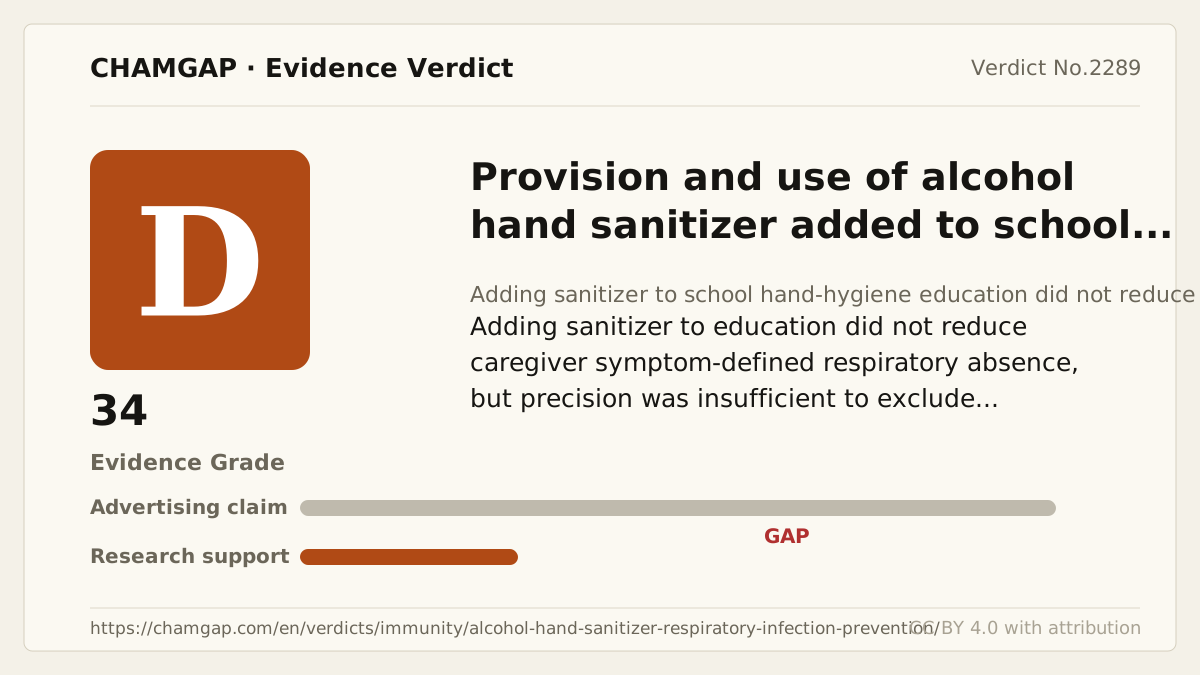
[Chamgap] Habitual alcohol hand-sanitizer use x respiratory infection prevention — Evidence Grade D·34. 1 cited sources checked. Source: https://chamgap.com/en/verdicts/immunity/alcohol-hand-sanitizer-respiratory-infection-prevention/ · CC BY 4.0CC BY 4.0 — free to use with attribution; do not distort grades, numbers, or verdict meaning.
What this document does and does not do
Chamgap is an information source. It reports what research has and has not confirmed; it does not tell readers what to take or buy. That decision belongs to readers and, when needed, medical or legal professionals. This verdict reflects literature available up to the search date and may change as new research appears. Nothing here is medical advice.