
Acupuncture,
does it really help with Improvement of seasonal allergic rhinitis symptoms, quality of life, and antihistamine use?
research showsThe publicly funded 422-person trial met its co-primary endpoints statistically, but the 28-item RQLQ difference versus sham was only the 0.5-point MCID boundary and durability was weak, supporting C with 48 points.
ads claimMarketing often expands a short course of acupuncture into correction of an allergic constitution and a medication-free pollen season. The evidence supports only small, short-term improvements in symptoms, quality of life, and rescue-medication use during an 8-week pollen-season course.
Useful facts when choosing a product
- ACUSAR delivered 12 real-acupuncture sessions over 8 weeks and allowed cetirizine as rescue medication.
- Effects can vary with practitioner, point selection, sham method, and pollen exposure, so one protocol cannot be generalized to every form of acupuncture.
- The evidence does not support replacing standard rhinitis care; persistent symptoms should be managed alongside allergen avoidance, intranasal corticosteroids, antihistamines, and other established options.
Chamgap Semantic Classification Code
Candidate index · review held
K.acupuncture.UNK.seasonal-allergic-rhinitis-symptoms-quality-of-life-and-antihistamine-use.improve.shamFolk and alternative interventions > Acupuncture > Unknown > seasonal allergic rhinitis symptoms, quality of life, and antihistamine use > Improvement claim > Sham procedure or device
An automated migration candidate, not an issued permanent code; exact claim scope remains under review. This machine-generated migration candidate helps retrieval but is not a permanent assignment. The original verdict ID and URL remain authoritative.
What the research actually shows
The 2013 ACUSAR trial by Brinkhaus randomized 422 participants to real acupuncture (212), sham acupuncture (102), or rescue medication alone (108). The actual primary analyses included 413 participants with baseline RQLQ data and 404 with rescue-medication-score data. At weeks 7 and 8, real acupuncture improved RQLQ by 0.5 point versus sham (97.5% CI, 0.2 to 0.8) and the medication score by 1.1 points (0.4 to 1.9); both co-primary endpoints succeeded statistically at P<0.001. The 28-item RQLQ difference only reached the 0.5-point MCID boundary for the 28-item RQLQ, not the 0.4-point Mini-RQLQ MCID, and between-group differences disappeared by week 16. A 2022 meta-analysis of 30 trials and 4,413 participants also found symptom and quality-of-life signals, but direct sham-controlled data were sparse and Chinese drug-comparator trials had serious risk of bias.
Why this is classified as C (48)
The publicly funded 422-person trial met its co-primary endpoints statistically, but the 28-item RQLQ difference versus sham was only the 0.5-point MCID boundary and durability was weak, supporting C with 48 points. Patient-reported symptoms are not surrogate endpoints, but the 28-item RQLQ difference versus sham only reached the 0.5-point MCID boundary, did not persist at week 16, and the broader literature had substantial bias and heterogeneity, so rule ①-ⓒ supports C.
Counterpoint. Patient-reported rhinitis symptoms and quality of life are direct treatment targets rather than surrogate endpoints. However, the sham-controlled effect only reached the MCID boundary and long-term persistence was not established, so a B grade is not justified.
Rejudgment record. Cross-check applied — Distinguished 422 randomized participants from 413 analyzed for RQLQ and 404 for medication score; the observed 0.5-point difference (97.5% CI, 0.2 to 0.8) exactly met the 0.5-point MCID for the 28-item RQLQ, not the 0.4-point Mini-RQLQ MCID, and disappeared by week 16, supporting C
Sub-claim grades by effect
This ingredient is marketed for several effects. A single overall grade blends strong and weak claims together, so each effect is graded separately here. The overall grade reflects the strongest disconfirming or core claim.
| Effect (sub-claim) | Grade | Basis |
|---|---|---|
| Improvement in quality of life for seasonal allergic rhinitis | C | The 0.5-point 28-item RQLQ difference versus sham reached, but did not exceed, the MCID boundary. |
| Reduced antihistamine use during pollen season | C | The 8-week rescue-medication score was positive, but the effect was small and the week-16 difference disappeared. |
| Rhinitis improvement sustained into the next pollen season | D | Second-year differences were small and of uncertain clinical importance, so durable efficacy was not confirmed. |
Cross-check — AI research and Codex final gate
Evidence Table
| Study | Design | Sample | Funding | Endpoint | Result | Weight |
|---|---|---|---|---|---|---|
| Brinkhaus B et al. 2013 ACUSAR | Multicenter randomized sham- and rescue-medication-controlled trial | 422 randomized; actual co-primary analyses included 413 for RQLQ and 404 for medication score | German Research Foundation public grant WI 957/16-1; not manufacturer-led | Co-primary changes in RQLQ and rescue-medication score at weeks 7 and 8 | The observed 28-item RQLQ difference versus sham was 0.5 point (97.5% CI, 0.2 to 0.8), exactly at its 0.5-point MCID boundary rather than the 0.4-point Mini-RQLQ MCID, and disappeared by week 16. | Key direct symptom trial |
| He M et al. 2022 | Systematic review and meta-analysis of randomized trials | 30 trials and 4,413 participants; sham-controlled RQLQ data came from a limited subset | Academic and public grants from Shanxi provincial programs and Shanxi Medical University | Rhinitis symptoms, RQLQ, and comparisons with medication | Signals favored acupuncture over sham for symptoms and quality of life, but direct data were sparse and Chinese drug-comparator trials had serious risk of bias. | Assessment of breadth and uncertainty |
Receipt — 2 References
All 2 cited sources were verified for existence at the original page (as of 2026-07-24).
Final verification and publication gate: Codex · Evidence date: 2026-07-24 · Corrections: none
Cite this verdict
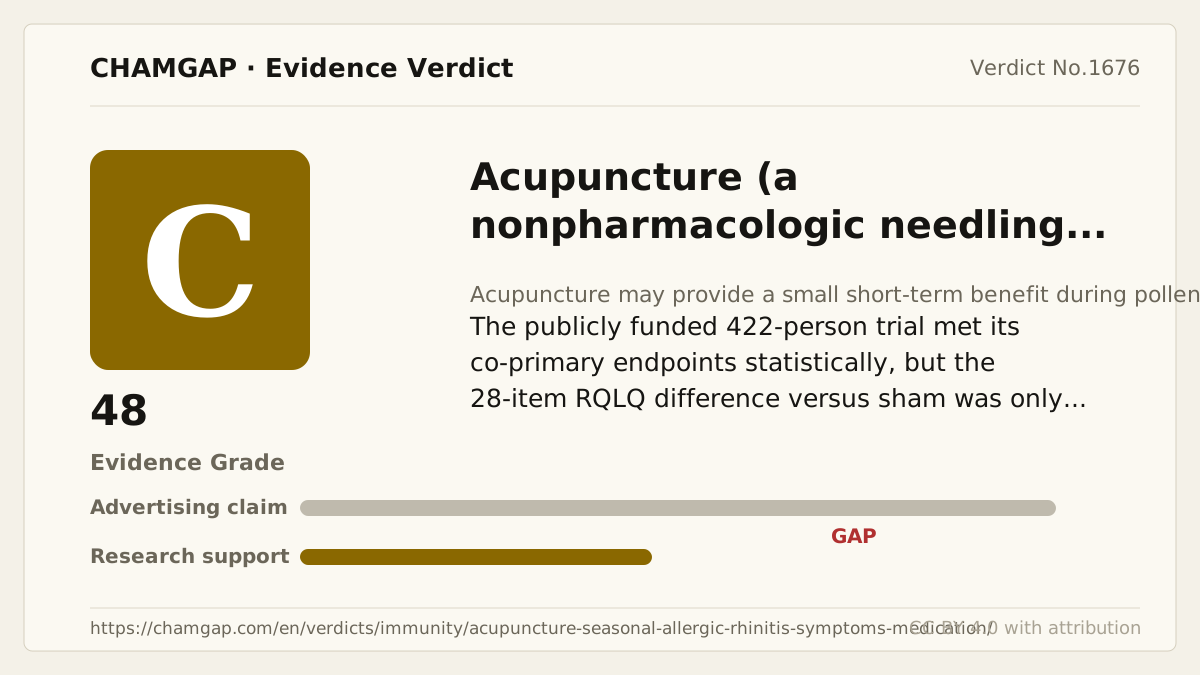
[Chamgap] Acupuncture x improvement of seasonal allergic rhinitis symptoms, quality of life, and antihistamine use — Evidence Grade C·48. 2 cited sources checked. Source: https://chamgap.com/en/verdicts/immunity/acupuncture-seasonal-allergic-rhinitis-symptoms-medication/ · CC BY 4.0CC BY 4.0 — free to use with attribution; do not distort grades, numbers, or verdict meaning.
What this document does and does not do
Chamgap is an information source. It reports what research has and has not confirmed; it does not tell readers what to take or buy. That decision belongs to readers and, when needed, medical or legal professionals. This verdict reflects literature available up to the search date and may change as new research appears. Nothing here is medical advice.