
4CMenB or Bexsero,
does it really help with Prevention of laboratory-confirmed gonorrhea in high-risk men?
research showsThe grade is D. GoGoVax randomized 654 participants and used a prespecified per-protocol primary population of 587. After two doses, urogenital, anorectal, and oropharyngeal nucleic-acid testing was performed quarterly for two years. First gonorrhea occurred in 160/296 (54.1%) with vaccine and 155/291 (53.3%) with placebo, 48.1 versus 47.8 events per 100 person-years, IRR 1.01, 95% CI 0.80 to 1.26, vaccine efficacy -0.5%, 95% CI -26.2 to 19.9. This was laboratory-confirmed infection, not symptom-only diagnosis, and no prevention was shown.
ads claimEfficacy of the same vaccine in its original indication cannot be transferred to gonorrhea. Verdict 1081 is B with 76 points for invasive meningococcal group B disease, whereas this D with 34 points comes from direct trials in a different pathogen and indication.
Useful facts when choosing a product
- 4CMenB was developed to prevent meningococcal group B disease; gonorrhea prevention is a different indication.
- GoGoVax tested three anatomical sites quarterly regardless of symptoms.
- Two-year infection events were nearly identical with vaccine and placebo.
- MenGO randomized 130 people; its per-protocol groups were 57 versus 57 and the incidence rate ratio was 0.78, 95% CI 0.40 to 1.51.
- GoGoVax and MenGO shared four coauthors, so they were not double-counted as fully independent teams.
- The Abara observational paper states: There was no funding source for this study.
Chamgap Semantic Classification Code
Candidate index · review held
M.four-component-meningococcal-serogroup-b-vaccine.UNK.laboratory-confirmed-gonorrhea.prevent.placeboMedicinal interventions > Four-component meningococcal serogroup B vaccine > Unknown > laboratory-confirmed gonorrhea > Occurrence-prevention claim > Placebo
An automated migration candidate, not an issued permanent code; exact claim scope remains under review. This machine-generated migration candidate helps retrieval but is not a permanent assignment. The original verdict ID and URL remain authoritative.
What the research actually shows
GoGoVax enrolled men who have sex with men after a recent gonorrhea or infectious-syphilis diagnosis, either HIV-negative while taking preexposure prophylaxis or living with HIV. They received 4CMenB or saline at months zero and three, and first laboratory-confirmed infection was counted from month four through month 24. Funding came from the Australian NHMRC and GSK. The full author-by-author disclosure text was not accessible in the public material reviewed, so absence of conflicts was not assumed. Hong Kong authors declared no competing interests. The randomized French DOXYVAC vaccine comparison, not an observational study, reported 103/274 versus 122/270, 58.3 versus 77.1 per 100 person-years, adjusted HR 0.78, 95% CI 0.60 to 1.01, a borderline null result.
Why this is classified as D (34)
Four randomized trials across three independent research-team clusters repeatedly failed to lower laboratory-confirmed gonorrhea, but their intervals do not exclude every small benefit. This combination gives D with 34 points.
Counterpoint. This verdict is limited to gonorrhea prevention and does not dispute meningococcal-disease protection or future gonorrhea-specific vaccines.
Rejudgment record. Cross-check applied — GoGoVax, Hong Kong, DOXYVAC, and MenGO designs, analysis populations, laboratory endpoints, absolute events, and team overlap separated from observational studies
| Endpoint | H | Hard endpoint - actual events such as death |
| Replication | RX | Repeatedly refuted in the same indication |
| Independence | I1 | Mixed funding sources |
| Effect size | E0 | Null |
| Precision | C0 | The confidence interval leaves room for benefit |
Stored derived and displayed grades match; this is not a current recalculation or validity check (D).
Sub-claim grades by effect
This ingredient is marketed for several effects. A single overall grade blends strong and weak claims together, so each effect is graded separately here. The overall grade reflects the strongest disconfirming or core claim.
| Effect (sub-claim) | Grade | Basis |
|---|---|---|
| Prevention of laboratory-confirmed gonorrhea in high-risk men | D | Multiple randomized trials found no reduction. |
| Prevention of invasive meningococcal group B disease | B | This is separately covered by verdict 1081. |
Cross-check — AI research and Codex final gate
Evidence Table
| Study | Design | Sample | Funding | Endpoint | Result | Weight |
|---|---|---|---|---|---|---|
| Seib KL et al. 2026 GoGoVax | Multicenter double-blind placebo-controlled randomized trial | 654 randomized, 587 in the per-protocol primary analysis, 296 versus 291 | Australian NHMRC and GSK | First NAAT-confirmed gonorrhea from months four through 24 | 160/296 (54.1%) versus 155/291 (53.3%), IRR 1.01, 0.80 to 1.26 | Decisive large null trial |
| Kwan TH et al. 2026 Hong Kong trial | Double-blind placebo-controlled randomized trial | 152 randomized | Sponsored by the Chinese University of Hong Kong; detailed funding was not confirmed in accessible material | First gonorrhea episode in year one | HR 0.76, 95% CI 0.31 to 1.87, null | Independent repeated null result but imprecise |
| Thng C et al. 2026 MenGO | Randomized clinical trial | 130 randomized; 57 versus 57 per protocol | Four coauthors overlapped with GoGoVax | Incidence of all NAAT-confirmed gonorrhea episodes from 30 days after dose two through two years | Vaccine 22 events, 27.1 per 100 person-years, versus no vaccine 27 events, 34.9 per 100 person-years; IRR 0.78, 95% CI 0.40 to 1.51, P=0.457 | Null trial not double-counted as fully independent from GoGoVax |
| Abara WE et al. 2022 US observational study | Retrospective linked infection and immunization records | 109,737 persons and 167,706 infection records | None | Association with gonorrhea diagnosis prevalence | Complete vaccination APR 0.60, 95% CI 0.47 to 0.77 | Positive observational evidence kept separate from randomization |
Receipt — 6 References
All 6 cited sources were verified for existence at the original page (as of 2026-08-06).
Final verification and publication gate: Codex · Evidence date: 2026-08-06 · Corrections: none
Cite this verdict
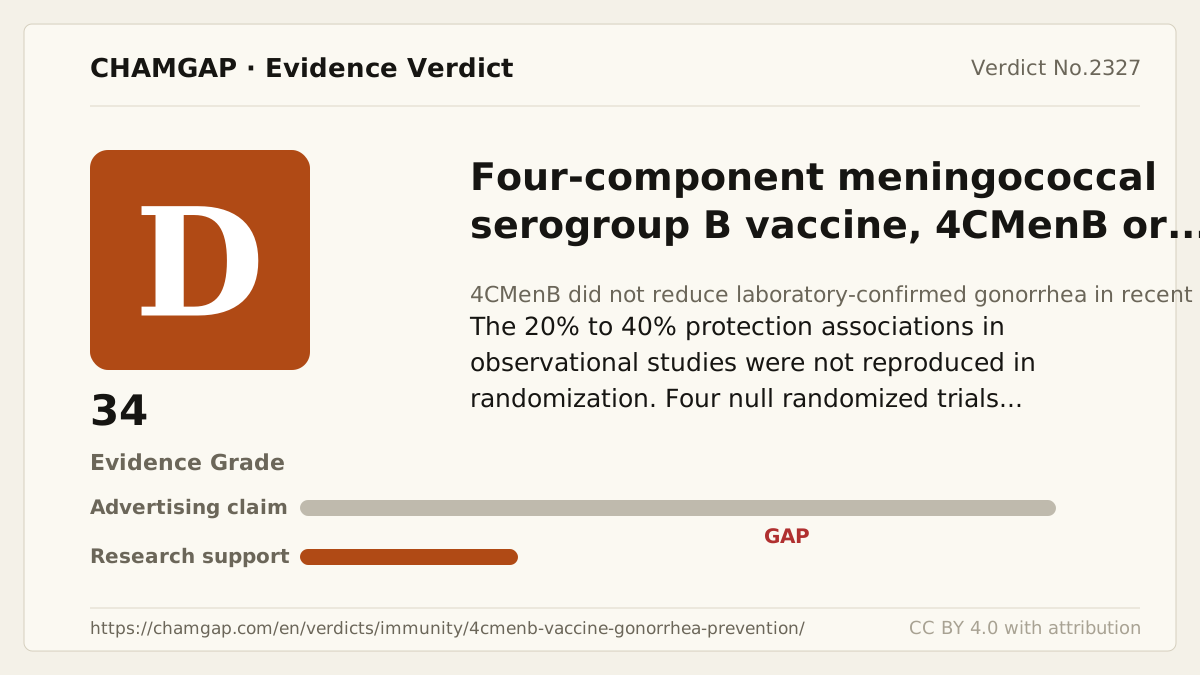
[Chamgap] 4CMenB or Bexsero x gonorrhea prevention — Evidence Grade D·34. 6 cited sources checked. Source: https://chamgap.com/en/verdicts/immunity/4cmenb-vaccine-gonorrhea-prevention/ · CC BY 4.0CC BY 4.0 — free to use with attribution; do not distort grades, numbers, or verdict meaning.
What this document does and does not do
Chamgap is an information source. It reports what research has and has not confirmed; it does not tell readers what to take or buy. That decision belongs to readers and, when needed, medical or legal professionals. This verdict reflects literature available up to the search date and may change as new research appears. Nothing here is medical advice.