
4CMenB/Bexsero,
does it really help with Prevention of invasive meningococcal group B disease from two months of age?
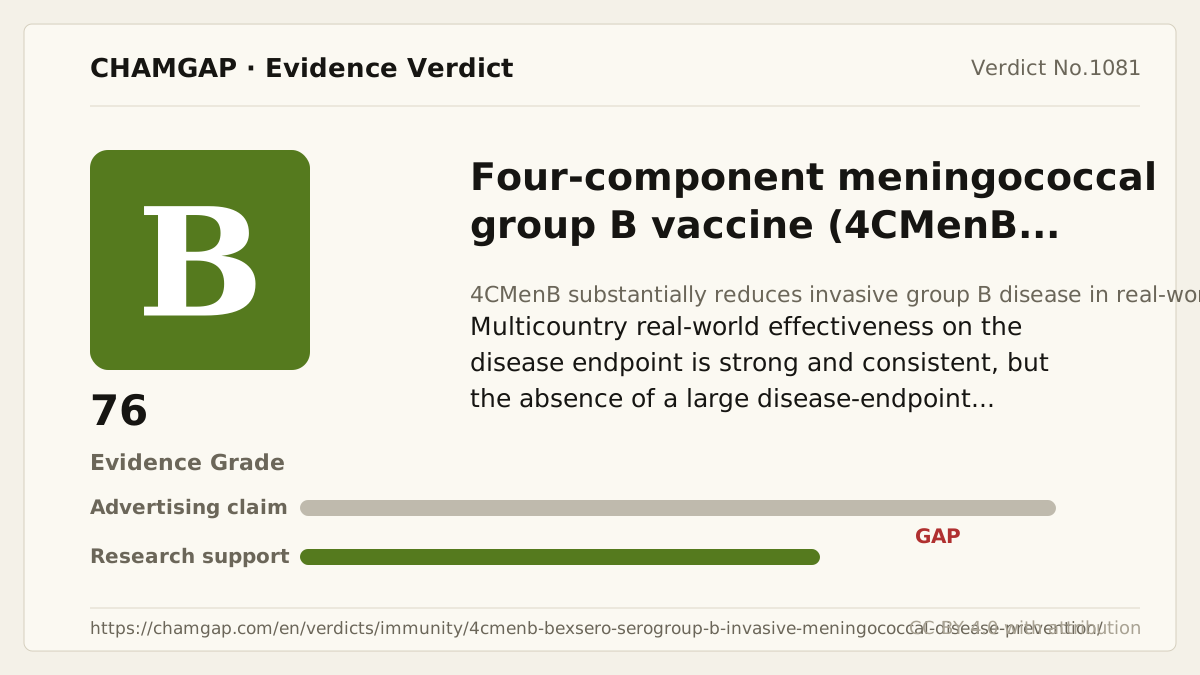
research shows4CMenB is rated B because real-world evidence indicates that a completed series prevents about 80% of invasive meningococcal group B disease in infants and children. A 2026 meta-analysis of observational studies from five countries estimated pooled vaccine effectiveness at 79.7% (95% CI 70.4 to 86.1), and England's national program observed a 75% incidence reduction in fully eligible age groups. Because the disease is rare, however, no large randomized trial used invasive disease as the endpoint; prelicensure trials mainly relied on the surrogate of human serum bactericidal antibody. It therefore remains distinct from the A ratings for influenza and rotavirus vaccines, which have randomized disease-endpoint trials, and receives B with 76 points. Fever and injection-site reactions are kept separate under safety.
ads claimPromotional summaries may expand high average effectiveness into complete coverage of every group B strain or lifelong immunity. Actual effectiveness varies with circulating-strain match, age, dose completion, and time since vaccination, and infant antibody waning makes the recommended schedule and boosters important.
Useful facts when choosing a product
- 4CMenB contains recombinant fHbp, NadA, and NHBA proteins plus PorA in outer membrane vesicles from a New Zealand strain, targeting several surface antigens rather than the group B capsular polysaccharide.
- Bexsero can be used from two months of age in jurisdictions where authorized, but the number and spacing of primary doses and the need for a booster depend on age at initiation and official national recommendations.
- The vaccine does not cover every group B strain lacking a sufficient match to its antigens, so suspected meningitis or sepsis still requires immediate medical assessment after vaccination.
- Injection-site pain or tenderness, fever, and irritability are common in infants, and fever can be more frequent with concomitant routine vaccines. Prophylactic antipyretic use should follow the product information and local immunization guidance.
Chamgap Semantic Classification Code
Candidate index · review held
M.four-component-meningococcal-group-b-vaccine.UNK.invasive-meningococcal-group-b-disease-from-of-age.prevent.UNKMedicinal interventions > Four-component meningococcal group B vaccine > Unknown > invasive meningococcal group B disease from of age > Occurrence-prevention claim > Unknown
An automated migration candidate, not an issued permanent code; exact claim scope remains under review. This machine-generated migration candidate helps retrieval but is not a permanent assignment. The original verdict ID and URL remain authoritative.
What the research actually shows
Marijic and colleagues' 2026 systematic review combined five observational studies from five countries in a random-effects model and reported 79.7% effectiveness (95% CI 70.4 to 86.1) in fully vaccinated infants and children. Ladhani and colleagues used enhanced national surveillance in England from 2015 through 2018 and observed 63 cases in vaccine-eligible cohorts versus 253 expected, an incidence rate ratio of 0.25 (95% CI 0.19 to 0.36). Individual vaccination-history estimates were imprecise: 52.7% effectiveness (95% CI -33.5 to 83.2) after a two-dose infant primary series and 59.1% (95% CI -31.1 to 87.2) after that series plus a 12-month booster. Prelicensure and schedule trials measured human serum bactericidal antibody titers and putative protective thresholds rather than randomizing participants to an invasive-disease endpoint.
Why this is classified as B (76)
Pooled effectiveness of 79.7% across five countries and a 75% incidence reduction in England provide strong real-world evidence on the direct disease endpoint. Nevertheless, there is no large randomized disease-endpoint trial, the prelicensure program relied on the human serum bactericidal antibody surrogate, and the latest meta-analysis was manufacturer supported. Distinguishing it from influenza and rotavirus vaccines with randomized disease-endpoint evidence yields B with 76 points.
Counterpoint. Vaccination and scheduling should follow age, risk conditions, epidemiology, and national recommendations; average effectiveness does not guarantee complete individual protection.
Rejudgment record. New verdict — Credited the pooled 79.7% effectiveness across five completed-series observational studies and England's direct reduction in invasive group B disease, but applied B rather than A because no large randomized disease-endpoint trial exists, prelicensure evidence relied on the human serum bactericidal antibody surrogate, and the meta-analysis was manufacturer supported
Sub-claim grades by effect
This ingredient is marketed for several effects. A single overall grade blends strong and weak claims together, so each effect is graded separately here. The overall grade reflects the strongest disconfirming or core claim.
| Effect (sub-claim) | Grade | Basis |
|---|---|---|
| Prevention of invasive meningococcal group B disease from two months of age | B | Multicountry real-world evidence shows fewer direct disease outcomes, but no large disease-endpoint randomized trial exists. |
| Approximately 80% real-world effectiveness in fully vaccinated infants and children | B | Five observational studies from five countries yielded pooled effectiveness of 79.7% (95% CI 70.4 to 86.1). |
| Protection for at least two years after an infant primary-plus-booster program | B | England's program found protection sustained for at least two years after three doses, but antibody waning and strain variation make adherence to recommended booster schedules important. |
Cross-check — AI research and Codex final gate
Evidence Table
| Study | Design | Sample | Funding | Endpoint | Result | Weight |
|---|---|---|---|---|---|---|
| Marijic P et al. 2026 | Systematic review and random-effects meta-analysis of real-world evidence | Five observational studies from five countries reporting effectiveness in fully vaccinated infants and children | Supported by GSK; several GSK employee authors and a paid evidence-review contractor participated | Completed-series vaccine effectiveness against invasive meningococcal group B disease | Pooled effectiveness was 79.7% (95% CI 70.4 to 86.1), with no material change in sensitivity analyses. | Key multicountry observational evidence on a direct disease endpoint; manufacturer involvement |
| Ladhani SN et al. 2020 | Enhanced-surveillance evaluation of England's national immunization program | An average annual birth cohort of about 650,000; 169 group B cases in vaccine-eligible cohorts over three years | Public Health England | Group B disease incidence, cases prevented, and screening-method vaccine effectiveness | Incidence fell 75% in fully eligible age groups; 63 cases were observed versus 253 expected, for an incidence rate ratio of 0.25 (95% CI 0.19 to 0.36). An estimated 277 cases (95% CI 236 to 323) were prevented over three years. | Large independent public-health evidence on a direct disease endpoint; nonrandomized |
Receipt — 2 References
All 2 cited sources were verified for existence at the original page (as of 2026-07-22).
Final verification and publication gate: Codex · Evidence date: 2026-07-22 · Corrections: none
Cite this verdict
[Chamgap] 4CMenB/Bexsero x prevention of invasive meningococcal group B disease — Evidence Grade B·76. 2 cited sources checked. Source: https://chamgap.com/en/verdicts/immunity/4cmenb-bexsero-serogroup-b-invasive-meningococcal-disease-prevention/ · CC BY 4.0CC BY 4.0 — free to use with attribution; do not distort grades, numbers, or verdict meaning.
What this document does and does not do
Chamgap is an information source. It reports what research has and has not confirmed; it does not tell readers what to take or buy. That decision belongs to readers and, when needed, medical or legal professionals. This verdict reflects literature available up to the search date and may change as new research appears. Nothing here is medical advice.