
25-mm needle,
does it really help with Reduced post-vaccination local reactions compared with a 16-mm needle?
research showsThe grade is B. In a 696-infant three-arm randomized trial, a 23G 25-mm needle reduced all local reactions after the two-, three-, and four-month vaccinations by about 17, 14, and 13 percentage points compared with a 25G 16-mm needle. There was no clear signal of materially reduced immune response. The two trials shared Diggle investigators and differed in outcomes and vaccination schedule, so they were not counted as independent replication.
ads claimThis verdict compares needle length with the same vaccines and standardized intramuscular technique. It does not establish that 25 mm is right for every body size, age, or injection site, or that it prevents more infections through higher antibody levels.
Useful facts when choosing a product
- A 23G needle has an outside diameter of about 0.6 mm and a 25G needle about 0.5 mm; higher gauge numbers indicate a thinner needle.
- The later trial separated length and gauge using 23G 25 mm, 25G 16 mm, and 25G 25 mm groups.
- Unlike other vaccination verdicts in the corpus, this intervention is needle length rather than a vaccine ingredient.
Chamgap Semantic Classification Code
Candidate index · review held
M.25-mm-needle.intramuscular.post-vaccination-local-reactions.reduce.UNKMedicinal interventions > 25-mm needle > Intramuscular > post-vaccination local reactions > Reduction claim > Unknown
An automated migration candidate, not an issued permanent code; exact claim scope remains under review. This machine-generated migration candidate helps retrieval but is not a permanent assignment. The original verdict ID and URL remain authoritative.
What the research actually shows
The 2006 trial randomized 696 healthy infants to 23G 25 mm, 25G 16 mm, or 25G 25 mm, with 240, 230, and 226 assigned respectively. Parents recorded redness, swelling, tenderness, and hardness for three days after vaccinations at two, three, and four months; antibodies were measured at five months. Reactogenicity data were available for 97% to 99% after dose one and 88% to 93% after dose three. Laboratory staff were blind to needle allocation. Registration ISRCTN62032215 was confirmed.
Why this is classified as B (68)
A large randomized trial found consistent reductions in local reactions after repeated vaccinations without a clear immunogenicity penalty, but overlapping investigators and incomplete parent blinding give B with 68 points.
Counterpoint. Needle length should be matched to infant size, injection site, and technique. These results do not automatically apply to other ages or sites.
Rejudgment record. Cross-check applied — A 696-infant randomized trial found fewer local reactions after repeated vaccinations, but investigators overlapped across trials and parent blinding was incomplete
| Endpoint | P | Symptom or function itself is the target - including patient reports and performance tests |
| Replication | R1 | Single confirmatory trial |
| Independence | I1 | Mixed funding sources |
| Effect size | E+ | Meets the clinically important threshold |
Stored derived and displayed grades match; this is not a current recalculation or validity check (B).
Sub-claim grades by effect
This ingredient is marketed for several effects. A single overall grade blends strong and weak claims together, so each effect is graded separately here. The overall grade reflects the strongest disconfirming or core claim.
| Effect (sub-claim) | Grade | Basis |
|---|---|---|
| Reduction of local reactions with a 25-mm needle | B | Rates were lower than with a 16-mm needle after all three vaccinations. |
| No major reduction in immune response | C | Noninferiority was shown for some antigens but was not conclusive for every antigen. |
Cross-check — AI research and Codex final gate
Evidence Table
| Study | Design | Sample | Funding | Endpoint | Result | Weight |
|---|---|---|---|---|---|---|
| Diggle L, Deeks JJ, Pollard AJ. 2006 | Three-arm randomized needle-length and gauge trial | 696 randomized (240/230/226); reactogenicity data available for 88% to 99% depending on dose | NHS Executive South East research grant plus an unrestricted grant from Becton Dickinson | Parent-recorded local reactions for three days and post-series antibody responses | For 23G 25 mm versus 25G 16 mm, absolute differences in any local reaction were -17 points (95% CI -26 to -8), -14 (-23 to -4), and -13 (-22 to -3). | Pivotal large trial |
| Diggle L, Deeks J. 2000 | Two-arm randomized preliminary trial | 119 recruited and 110 diaries analyzed | Funding could not be confirmed from the publicly checked text | Redness, swelling, and tenderness for three days after the four-month vaccination | The longer needle gave day-one redness RR 0.66 (95% CI 0.45 to 0.99) and swelling RR 0.39 (0.23 to 0.67), preventing any local reaction in about one of every five infants. | Small preliminary trial by overlapping investigators |
Receipt — 2 References
All 2 cited sources were verified for existence at the original page (as of 2026-08-15).
Final verification and publication gate: Codex · Evidence date: 2026-08-15 · Corrections: none
Cite this verdict
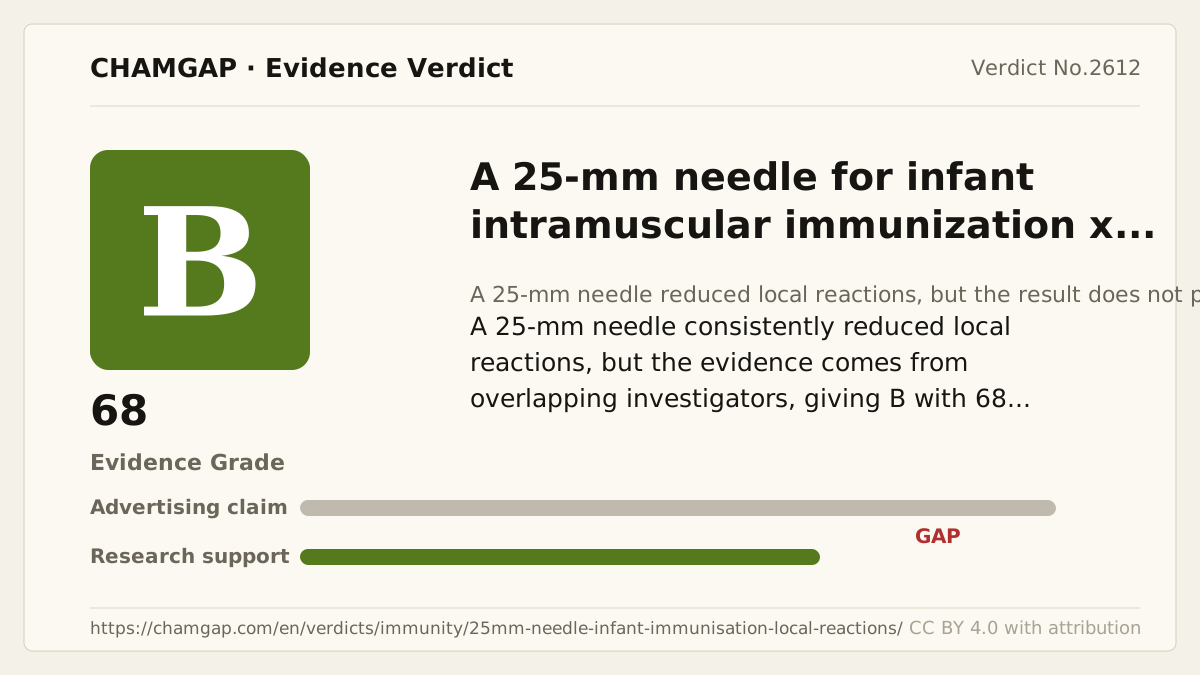
[Chamgap] 25-mm needle x local reactions after infant immunization — Evidence Grade B·68. 2 cited sources checked. Source: https://chamgap.com/en/verdicts/immunity/25mm-needle-infant-immunisation-local-reactions/ · CC BY 4.0CC BY 4.0 — free to use with attribution; do not distort grades, numbers, or verdict meaning.
What this document does and does not do
Chamgap is an information source. It reports what research has and has not confirmed; it does not tell readers what to take or buy. That decision belongs to readers and, when needed, medical or legal professionals. This verdict reflects literature available up to the search date and may change as new research appears. Nothing here is medical advice.