
Tocotrienols,
does it really help with Reduction in LDL cholesterol and cardiovascular protection?
research showsThe general claim that tocotrienols lower LDL cholesterol is not supported by the largest synthesis. In a meta-analysis of 15 RCT articles, LDL did not decrease (WMD +0.095 mmol/L; I²=87.4%), and total cholesterol and triglycerides were also null. Separate randomized trials in 40 and 67 participants likewise failed to reproduce lipid improvement. Prevention of myocardial infarction or stroke cannot be judged because no clinical-event trial was identified.
ads claimCellular antioxidant findings, an HMG-CoA reductase mechanism, or research on vitamin E mixtures containing tocotrienols cannot be converted into prevention of myocardial infarction or stroke. Tocopherol evidence also does not automatically apply to tocotrienols.
Useful facts when choosing a product
- Products sold in Korea are mainly palm-, annatto-, or rice-bran-derived tocotrienol complexes or mixed vitamin E products.
- Human-study doses are commonly about 140-300 mg/day, but alpha, gamma, and delta compositions differ.
- Annatto products are mainly delta and gamma isomers, while palm products may also contain tocopherols.
- People using anticoagulant or antiplatelet drugs and those around surgery should separately check the safety of high-dose vitamin E family products.
Chamgap Semantic Classification Code
Candidate index · review held
UNK.tocotrienols.UNK.ldl-cholesterol-and-cardiovascular-protection.reduce.UNKUnknown > Tocotrienols > Unknown > LDL cholesterol and cardiovascular protection > Reduction claim > Unknown
An automated migration candidate, not an issued permanent code; exact claim scope remains under review. This machine-generated migration candidate helps retrieval but is not a permanent assignment. The original verdict ID and URL remain authoritative.
What the research actually shows
A 2020 meta-analysis of 15 articles and 20 trial arms found a nonsignificant LDL WMD of +0.095 mmol/L with I²=87.4%; total cholesterol and triglycerides were also nonsignificant. The 40-person Mensink trial used a mixture containing 140 mg tocotrienols plus 80 mg alpha-tocopherol, so it must not be described as a pure-tocotrienol trial; its lipid findings were null. The 67-person Mustad trial likewise found no significant lipid improvement with any of three compositionally different supplements.
Why this is classified as D (32)
LDL RCTs exist, but the 15-article meta-analysis and separate trials with 40 and 67 participants repeatedly produced null findings, so the general LDL-lowering claim is D. Cardiovascular-event prevention is unknown because no prevention trial was identified. Isomer and formulation heterogeneity and selected early positive findings prevent an F rating; the overall verdict is D with 32 points.
Counterpoint. Animal antioxidant or penetration findings and specific-isomer mechanisms cannot be repurposed as general lipid efficacy. Independent large lipid RCTs using the same isomer composition and separate cardiovascular-event trials are needed.
Rejudgment record. Reassessment (cross-check reflected) — Applied D to repeated null LDL findings in the 15-article meta-analysis and the 40- and 67-person RCTs, and unknown to the absence of cardiovascular-event prevention trials
Sub-claim grades by effect
This ingredient is marketed for several effects. A single overall grade blends strong and weak claims together, so each effect is graded separately here. The overall grade reflects the strongest disconfirming or core claim.
| Effect (sub-claim) | Grade | Basis |
|---|---|---|
| Lowering LDL cholesterol | D | Null 15-RCT meta-analysis, WMD +0.095 mmol/L |
| Prevention of cardiovascular events | ? | No prevention trial identified |
Cross-check — AI research and Codex final gate
Evidence Table
| Study | Design | Sample | Funding | Endpoint | Result | Weight |
|---|---|---|---|---|---|---|
| Zuo et al. (2020), Complementary Therapies in Medicine | Meta-analysis of randomized trials | 20 | Authors reported no conflict of interest | LDL-C, total cholesterol, HDL-C, and triglycerides | LDL-C was nonsignificant at WMD +0.095 mmol/L (I²=87.4%); total cholesterol and triglycerides were also nonsignificant | High |
| Mensink et al. (1999), American Journal of Clinical Nutrition | Randomized controlled dietary trial of a mixture containing 140 mg tocotrienols and 80 mg alpha-tocopherol | 40 | Unknown | Blood lipids and lipoproteins | No significant lipid or lipoprotein improvement; this was not a pure-tocotrienol trial | Moderate |
| Mustad et al. (2002), American Journal of Clinical Nutrition | Trial comparing three compositionally different tocotrienol supplements | 67 | Product-related support | Blood lipids | No significant lipid improvement at 200 mg/day for 28 days | Moderate |
Receipt — 3 References
All 3 cited sources were verified for existence at the original page (as of 2026-07-16).
Final verification and publication gate: Codex · Evidence date: 2026-07-16 · Corrections: none
Cite this verdict
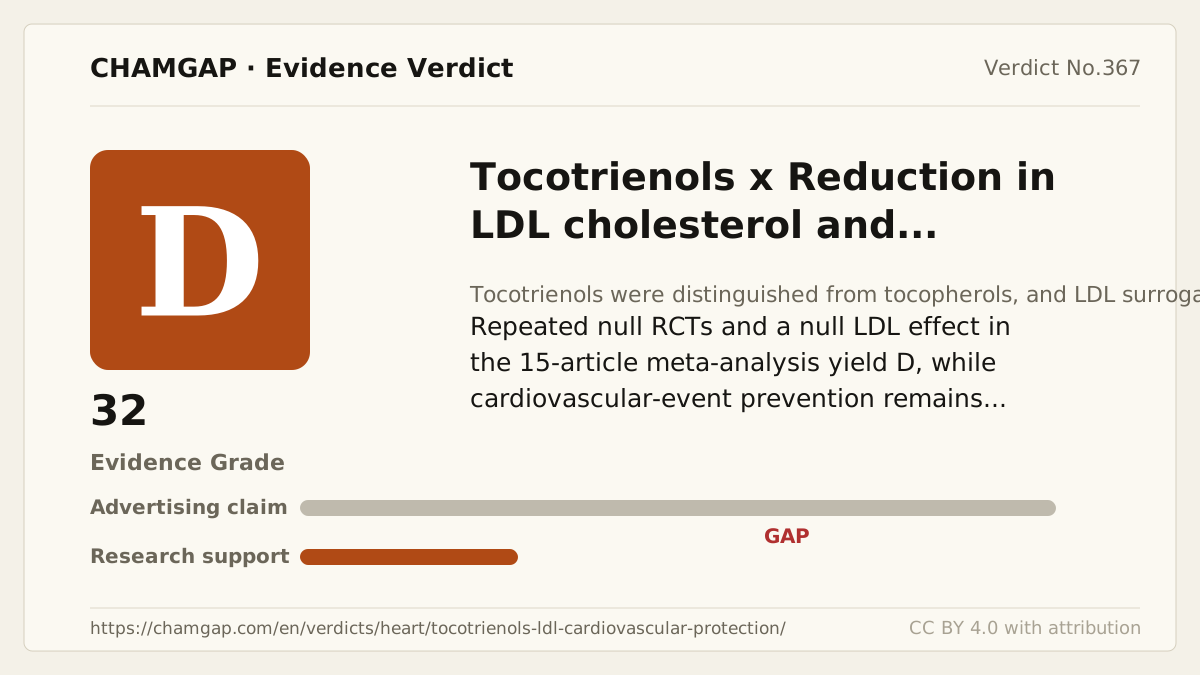
[Chamgap] Do tocotrienols lower LDL cholesterol and provide cardiovascular protection? — Evidence Grade D·32. 3 cited sources checked. Source: https://chamgap.com/en/verdicts/heart/tocotrienols-ldl-cardiovascular-protection/ · CC BY 4.0CC BY 4.0 — free to use with attribution; do not distort grades, numbers, or verdict meaning.
What this document does and does not do
Chamgap is an information source. It reports what research has and has not confirmed; it does not tell readers what to take or buy. That decision belongs to readers and, when needed, medical or legal professionals. This verdict reflects literature available up to the search date and may change as new research appears. Nothing here is medical advice.