
Red yeast rice,
does it really help with Cholesterol improvement?
research showsRed yeast rice standardized for monacolin K lowers LDL-C by about 1.02 mmol/L (about 35.8 mg/dL) versus placebo. Within the same lipid-surrogate category as oats and psyllium, this is clearly stronger efficacy evidence than grade C and supports grade B. It is not grade A because daily monacolin K across 28 marketed products ranged from 0.09 to 10.94 mg, a greater than 120-fold difference that makes the intervention called 'red yeast rice supplement' poorly reproducible. Liver injury and myopathy are lovastatin-like risks, but they are safety warnings rather than counterevidence that should lower efficacy to C; safety is recorded separately as 'Caution.' LDL reduction is a surrogate outcome, distinct from direct proof of cardiovascular-event prevention.
ads claimKorean market advertising and informational phrases generally emphasize that “red yeast rice/monacolin K may help improve blood cholesterol,” “inhibits cholesterol synthesis,” and “acts similarly to statins.” Food Safety Korea functional ingredient information lists red yeast rice functionality as “may help improve blood cholesterol” and presents the daily intake as total monacolin K 4-8 mg. Actual product pages present 1 tablet/day, total monacolin K 4 mg or 8 mg, and combination formulations with folic acid, milk thistle, vitamins, coenzyme Q10, and others, while displaying “not a drug” and cautions related to pregnancy, lactation, liver disease, and hyperlipidemia medications. Informational articles and shopping content sometimes extend to “vascular health,” “cardiovascular risk,” “blood pressure,” and “blood flow,” so cholesterol improvement and other effects need separate judgment.
Useful facts when choosing a product
- In domestic notified functional ingredient information, red yeast rice is confirmed with a total monacolin K range of 4-8 mg/day and the phrase “may help improve blood cholesterol.”
- Domestic product examples label total monacolin K 4 mg or 8 mg and are often sold as combination products with folic acid, milk thistle, vitamins, zinc, and others.
- Because monacolin K is chemically identical to lovastatin, products that show effects also have statin-like pharmacological characteristics.
- An analysis of 28 marketed products found that daily monacolin K at manufacturer-recommended servings ranged from 0.09 to 10.94 mg, a greater than 120-fold difference.
- Citrinin can form during red yeast rice fermentation, and domestic product specification examples include citrinin <=0.05 mg/kg and confirmation of active monacolin K.
- Under U.S. FDA standards, red yeast rice products containing enhanced or added lovastatin are treated as unapproved drugs that cannot be sold as dietary supplements.
Chamgap Semantic Classification Code
Candidate index · review held
F.red-yeast-rice.food.cholesterol-improvement.improve.placeboFoods and beverages > Red yeast rice > Food consumption > Cholesterol improvement > Improvement claim > Placebo
An automated migration candidate, not an issued permanent code; exact claim scope remains under review. This machine-generated migration candidate helps retrieval but is not a permanent assignment. The original verdict ID and URL remain authoritative.
What the research actually shows
RCTs of red yeast rice/monacolin K preparations alone or standardized preparations have repeatedly reported decreases in LDL-C and total cholesterol in hypercholesterolemia, statin intolerance, and general adults. A 2015 meta-analysis reported that in 20 RCTs of preparations with known monacolin K content, LDL-C was 1.02 mmol/L lower than placebo, and a 2024 meta-analysis summarized 14 clinical trials as LDL-C -35.82 mg/dL and total cholesterol -37.43 mg/dL. Becker 2009 found that in 62 statin-intolerant patients, LDL-C decreased by -43 mg/dL at 12 weeks and -35 mg/dL at 24 weeks. Heber 1999 was an 83-person RCT but had Pharmanex support and author conflicts of interest. Heinz 2016 used a combination of 3 mg monacolin K and folic acid, so it is limited as pure single-ingredient evidence. The large Chinese Xuezhikang RCT (CCSPS) reported reductions even in major coronary events in about 4,870 patients with previous myocardial infarction, but this was a secondary-prevention trial of a specific standardized extract and is difficult to equate directly with the “cholesterol improvement” claim of general domestic health functional foods. Cochrane 2011 judged in a review of Chinese herbal medicines for hypercholesterolemia that Xuezhikang was the most common preparation, but cardiovascular event and death data were absent and risk of bias was high or unclear.
Why this is classified as B (62)
B. Red yeast rice standardized for monacolin K has a consistent human effect, lowering LDL-C by about 1.02 mmol/L (about 35.8 mg/dL) versus placebo, so its efficacy evidence is stronger than grade C. It is not grade A because daily monacolin K across 28 marketed products ranged from 0.09 to 10.94 mg, a greater than 120-fold difference that reduces intervention reproducibility. Liver injury and myopathy are safety cautions, not efficacy counterevidence. LDL is a surrogate marker and is judged separately from direct proof of cardiovascular-event prevention.
Counterpoint. The LDL-C reduction from preparations standardized for monacolin K is strong enough to support grade B. However, content variation makes the effect difficult to reproduce across red yeast rice supplements in general, cardiovascular-event prevention requires separate evidence, and liver injury and myopathy are managed as safety cautions.
Rejudgment record. Reassessment (calibration realignment) — Consistent LDL-C lowering with standardized monacolin K supports grade B efficacy. Greater than 120-fold product-content variation prevents grade A, while liver injury and myopathy are separated from efficacy and recorded as a safety caution.
Cross-check — AI research and Codex final gate
Evidence Table
| Study | Design | Sample | Funding | Endpoint | Result | Weight |
|---|---|---|---|---|---|---|
| Trogkanis E et al. 2024 | meta-analysis | 14 | not reported | LDL/cholesterol | Fourteen clinical trials, 4-24 weeks; LDL-C -35.82 mg/dL, total cholesterol -37.43 mg/dL; no external funding or COI. | core |
| Gerards MC et al. 2015 | meta-analysis/RCT | 20 | not reported | LDL | Meta-analysis of 20 RCTs; in preparations with known monacolin K content, LDL-C was 1.02 mmol/L lower than placebo. | core |
| Becker DJ et al. 2009 | RCT | 62 | not reported | LDL | 62-person RCT; red yeast rice 1,800 mg twice daily lowered LDL-C by -43 mg/dL at 12 weeks and -35 mg/dL at 24 weeks; public-interest funding, no COI. | core |
| Heber D et al. 1999 | double-blind meta-analysis/RCT | 83 | possible manufacturer/industry involvement | LDL/cholesterol | 83-person 12-week double-blind RCT; total cholesterol decreased from 254 to 208 mg/dL, and LDL-C and TG also decreased. | core |
| Heinz T et al. 2016 | RCT | 142 | possible manufacturer/industry involvement | LDL/cholesterol | 142-person 12-week RCT; with a combination of 3 mg monacolin K plus folic acid, LDL-C -14.8% and total cholesterol -11.2%. | supporting |
| Bogsrud MP et al. 2010 | RCT | 42 | possible manufacturer/industry involvement | LDL/cholesterol | Placebo-controlled RCT of about 42 people for 16 weeks; reported LDL-C -23.0% and total cholesterol -15.5%. | supporting |
| Lu Z et al. 2008 | not specified | 4,870 | not reported | gut | About 4,870 patients with previous MI, mean 4.5 years; major coronary events 10.4% versus 5.7%, and lipids also improved. | supporting |
| Liu ZL et al. 2011 | not specified | not reported | cholesterol/gut | Cochrane review; Xuezhikang was the most common preparation, but interpretation required caution because cardiovascular event/death data were absent and risk of bias was present. | supporting | |
| Cohen PA et al. 2017 | Marketed-product content analysis | 28 | not reported | Daily monacolin K content | At manufacturer-recommended servings, daily monacolin K ranged from 0.09 to 10.94 mg, a greater than 120-fold difference. | core reason against A |
| LiverTox | Safety review | NIH/NIDDK | Liver injury and myopathy | Monacolin K is chemically identical to lovastatin, and red yeast rice has rarely been linked to lovastatin-like liver injury and myopathy. | separate safety assessment | |
| NCCIH | not specified | not reported | gut | Summarized more than 60-fold differences in product monacolin K content, lack of content labeling, statin-like adverse effects/interactions, and citrinin issues. | supporting | |
| EFSA Panel on Nutrition, Novel Foods and Food Allergens 2018 | not specified | not reported | liver | Monacolin K exposure may lead to serious musculoskeletal and hepatic adverse reactions, including rhabdomyolysis, and no safe intake level could be specified. | supporting | |
| Study 13 | not specified | not reported | cholesterol | Red yeast rice functionality: may help improve blood cholesterol; daily intake total monacolin K 4-8 mg. | supporting | |
| Study 14 | not specified | not reported | liver/cholesterol/gut | Labels total monacolin K 8 mg, the phrase “helps improve blood cholesterol,” not a drug, and cautions for pregnancy, liver disease, and hyperlipidemia medications. | supporting | |
| Study 15 | not specified | not reported | cholesterol/gut | Explained the market popularity of red yeast rice health functional foods, the cholesterol-lowering function of monacolin K, and citrinin safety concerns. | supporting | |
| Study 16 | not specified | not reported | cholesterol/gut | Domestic informational article explaining monacolin K in red yeast rice as an inhibitor of cholesterol synthesis and a statin-like substance. | supporting |
Receipt — 16 References
Of 16 cited sources, 1 had limited original-page access (blocked or summary-only) and were verified via index/summary, marked partial; the rest were verified at the original page. As of 2026-07-07.
Final verification and publication gate: Codex · Evidence date: 2026-07-07 · Corrections: 1
Correction log — 1
Corrections applied to this verdict, in chronological order. Changes are logged, not erased.
- 2026-07-11 · Calibration realignment (grade changed) — Red yeast rice's monacolin K (lovastatin) lowers LDL-C by about 1.02 mmol/L vs placebo, strong efficacy evidence that was inconsistent with same-endpoint precedents (oat beta-glucan A88, psyllium A84) when graded C. Efficacy was raised to B; the 120-fold variation in marketed monacolin content (short of A) and hepatotoxicity/myopathy are separated as reproducibility/safety caveats, not grade downgrades. 2026-07-11 calibration realignment. (grade C→B)
Cite this verdict
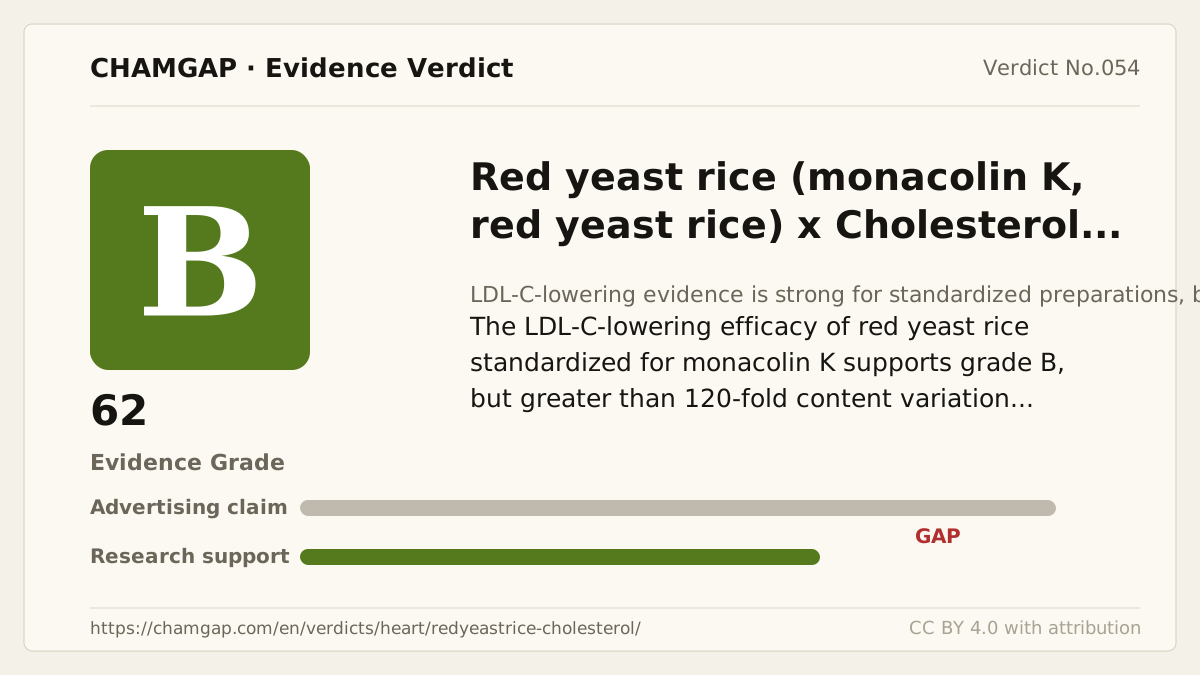
[Chamgap] Red yeast rice x cholesterol improvement — Evidence Grade B·62. 16 cited sources checked. Source: https://chamgap.com/en/verdicts/heart/redyeastrice-cholesterol/ · CC BY 4.0CC BY 4.0 — free to use with attribution; do not distort grades, numbers, or verdict meaning.
What this document does and does not do
Chamgap is an information source. It reports what research has and has not confirmed; it does not tell readers what to take or buy. That decision belongs to readers and, when needed, medical or legal professionals. This verdict reflects literature available up to the search date and may change as new research appears. Nothing here is medical advice.