
Guggul extract, or guggulipid,,
does it really help with Reduction of LDL cholesterol?
research showsGuggul is marketed as a natural statin because of Ayurvedic tradition and early Indian studies, but a well-designed placebo-controlled trial of a standardized extract did not lower LDL and instead produced a net increase of 9% to 10% versus placebo. Earlier positive studies were small, methodologically weak, and inconsistent. A credible independent human trial directly refuted the main claim, supporting D.
ads claimMarketing uses natural statin, blocked cholesterol synthesis, and three thousand years of Ayurvedic validation. Traditional use and receptor mechanisms cannot override failure of LDL lowering in a well-designed human trial.
Useful facts when choosing a product
- No formally marketed Korean health-functional-food ingredient was verified. Cross-border sites display products such as guggul or guggulsterones 37.5 mg.
- A Korean Food Safety document on ingredients prohibited for purchasing-agent import includes guggul extract resin and guggulsterones, so import eligibility must be checked for each product.
- The pivotal trial used standardized guggulipid 1,000 or 2,000 mg three times daily, delivering approximately 75 or 150 mg/day of E- and Z-guggulsterones.
- Rash, itching, and gastrointestinal symptoms can occur. Possible PXR and CYP3A interactions argue against unsupervised use with statins, anticoagulants, or other prescription medicines.
Chamgap Semantic Classification Code
Candidate index · review held
S.guggul-extract.UNK.ldl-cholesterol.reduce.placeboSupplements and nutraceuticals > Guggul extract > Unknown > LDL cholesterol > Reduction claim > Placebo
An automated migration candidate, not an issued permanent code; exact claim scope remains under review. This machine-generated migration candidate helps retrieval but is not a permanent assignment. The original verdict ID and URL remain authoritative.
What the research actually shows
The 2003 Szapary trial assigned 103 adults with LDL of 130 to 200 mg/dL to guggulipid 1,000 mg or 2,000 mg three times daily, or placebo, for eight weeks. Directly measured LDL increased in the guggul groups, and rash occurred in six guggul recipients and no placebo recipients. A 2005 evidence review by Ulbricht concluded that most early studies were small and methodologically flawed and that efficacy was unclear. Possible modulation of FXR, PXR, and CYP3A provides mechanistic hypotheses but does not substitute for human LDL lowering.
Why this is classified as D (28)
As in the D precedent for policosanol, greater weight is given to the null and adverse-direction LDL result from an independent, well-designed trial than to early regionally concentrated positive studies. Repeated independent refutation is absent, so the rating is D with 28 points rather than F.
Counterpoint. A particular Indian formulation or hypertriglyceridemic subgroup has not been conclusively excluded. There is still no basis for recommending guggul as a general LDL-lowering product.
Rejudgment record. New verdict — The null and adverse-direction LDL result from an independent double-blind trial of a standardized product outweighs early small and methodologically weak positive studies; D rather than F because independent refutation has not been repeated
Cross-check — AI research and Codex final gate
Evidence Table
| Study | Design | Sample | Funding | Endpoint | Result | Weight |
|---|---|---|---|---|---|---|
| Szapary PO et al. 2003 | Randomized double-blind placebo-controlled trial | n=103 | University of Pennsylvania-led; funding not stated in the abstract | Directly measured LDL cholesterol, other lipids, and adverse events at eight weeks | LDL changed by minus 5% with placebo versus plus 4% and plus 5% with standard and high doses, a net increase of 9% to 10%; rash occurred in six versus zero participants. | Key refuting evidence |
| Ulbricht C et al. 2005 | Natural Standard evidence-based systematic review | Natural Standard Research Collaboration | Total cholesterol, LDL, safety, and interactions | Concluded that effects were unclear and evidence was insufficient to support use for any medical condition at that time. | Supportive synthesis | |
| Brobst DE et al. 2004 | Preclinical receptor and enzyme mechanistic study | Academic mechanistic research | PXR activation and CYP3A expression | Guggulsterone induced CYP3A expression through PXR, suggesting interaction potential. | Safety mechanism |
Receipt — 3 References
All 3 cited sources were verified for existence at the original page (as of 2026-07-18).
Final verification and publication gate: Codex · Evidence date: 2026-07-18 · Corrections: none
Cite this verdict
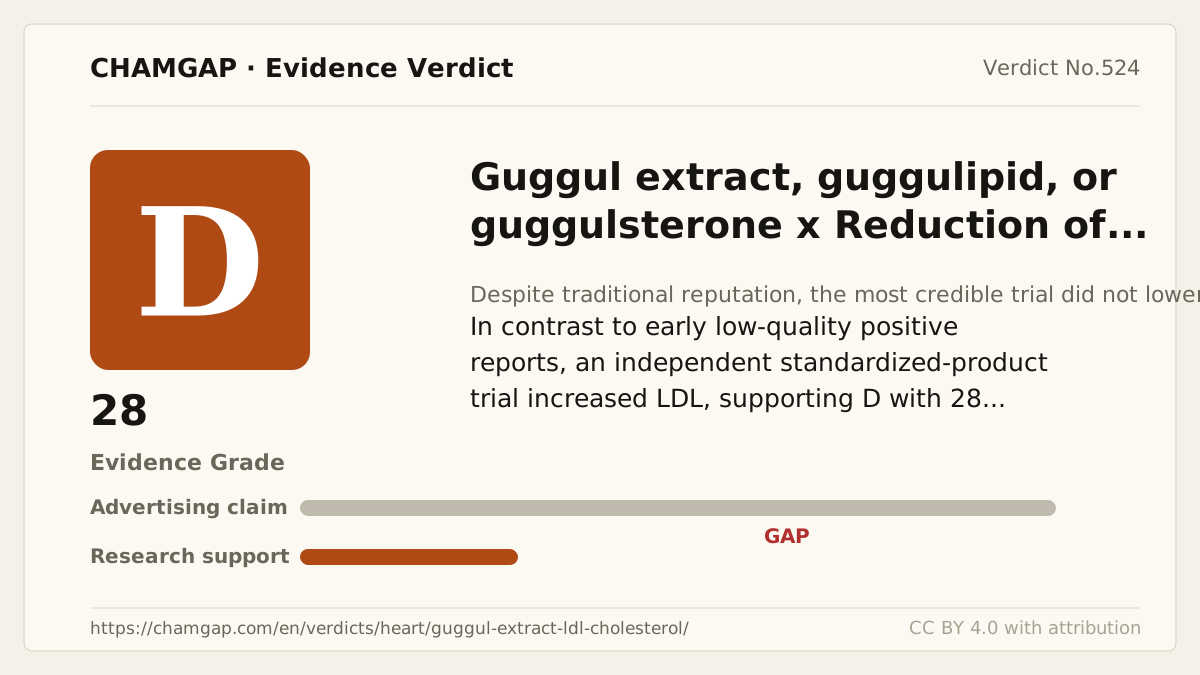
[Chamgap] Guggul extract, or guggulipid, x LDL-cholesterol reduction — Evidence Grade D·28. 3 cited sources checked. Source: https://chamgap.com/en/verdicts/heart/guggul-extract-ldl-cholesterol/ · CC BY 4.0CC BY 4.0 — free to use with attribution; do not distort grades, numbers, or verdict meaning.
What this document does and does not do
Chamgap is an information source. It reports what research has and has not confirmed; it does not tell readers what to take or buy. That decision belongs to readers and, when needed, medical or legal professionals. This verdict reflects literature available up to the search date and may change as new research appears. Nothing here is medical advice.