
Geranylgeraniol,
does it really help with Prevention of statin-related CoQ10 depletion and muscle pain?
research showsNo completed, published human efficacy trial was identified that randomized statin users to GG or placebo and evaluated CoQ10 depletion or muscle-pain incidence, so the grade is ?. GG reversed toxicity in statin-treated mouse muscle cells, and a mechanistic opinion article exists, but neither is a human pain-prevention outcome. A 2026 study in 34 healthy middle-aged adults found a serum CoQ10 maintenance signal, but participants were not statin users and the study used a fixed-order single-group design.
ads claimMarketing presents a mechanistic chain as a clinical conclusion: statins deplete GG, GG is needed for CoQ10, and therefore oral GG prevents statin muscle pain. Biochemical plausibility at each arrow is different from preventing pain in patients.
Useful facts when choosing a product
- No GG product was identified as a standard approved treatment for statin adverse effects in Korea; products are mainly annatto-derived trans-GG supplements sold through overseas or direct-import channels.
- Branded products commonly claim 150 to 300 mg per capsule, and healthy-adult studies used 150 to 300 mg/day.
- The 10-micromolar cell-culture concentration cannot be translated directly into an oral capsule dose, and GG, GGPP, and CoQ10 are different substances.
- An eight-week healthy-adult blood panel does not establish safety in statin users, people with liver or kidney disease, pregnancy or lactation, or long-term combination use. Muscle pain, weakness, or dark urine warrants medical evaluation rather than self-treatment with a supplement.
Chamgap Semantic Classification Code
Candidate index · review held
UNK.geranylgeraniol.UNK.statin-related-coq10-depletion-and-muscle-pain.prevent.placeboUnknown > Geranylgeraniol > Unknown > statin-related CoQ10 depletion and muscle pain > Occurrence-prevention claim > Placebo
An automated migration candidate, not an issued permanent code; exact claim scope remains under review. This machine-generated migration candidate helps retrieval but is not a permanent assignment. The original verdict ID and URL remain authoritative.
What the research actually shows
Jaśkiewicz 2018 found that 10 micromolar GGOH restored cell viability and RAP1 prenylation in mouse C2C12 muscle cells exposed to atorvastatin or simvastatin. Tan 2023 used this and related preclinical literature to propose prevention of statin-associated muscle symptoms in a hypothesis and opinion article whose first author was affiliated with an ingredient company. Gheith 2023 evaluated blood and hormone safety in 66 healthy adults using 150 mg/day for four weeks followed by 300 mg/day for four weeks; it did not study statin users, CoQ10 depletion, or muscle pain. Jurgelewicz 2026 reported a serum CoQ10 maintenance signal in 34 healthy middle-aged adults who received eight weeks of placebo followed by eight weeks of GG at 300 mg/day, but statin users were excluded and the authors called for targeted follow-up research.
Why this is classified as ?
Because no target human efficacy literature exists, preclinical-only evidence was not forced into D; the grade is ? with a null score. The 2026 serum CoQ10 signal in healthy adults concerns a different population, design, and endpoint from statin-related depletion and muscle pain. Short-term healthy-adult safety is separated from efficacy, while safety in the target population remains unknown.
Counterpoint. The mechanism justifies clinical testing, but it does not currently justify changing a statin regimen or self-adding GG. Evidence on CoQ10 supplementation itself cannot be attributed to GG.
Rejudgment record. New verdict — Only cell mechanisms and a CoQ10 surrogate in healthy nonusers of statins were found, with no human efficacy trial of CoQ10 depletion or muscle-pain prevention in statin users
Sub-claim grades by effect
This ingredient is marketed for several effects. A single overall grade blends strong and weak claims together, so each effect is graded separately here. The overall grade reflects the strongest disconfirming or core claim.
| Effect (sub-claim) | Grade | Basis |
|---|---|---|
| Prevention or reversal of statin-related CoQ10 depletion | ? | No human GG trial has evaluated serum or muscle CoQ10 in statin users. |
| Prevention of statin-associated muscle pain | ? | No human GG efficacy trial has evaluated muscle-pain incidence, severity, or statin discontinuation. |
Cross-check — AI research and Codex final gate
Evidence Table
| Study | Design | Sample | Funding | Endpoint | Result | Weight |
|---|---|---|---|---|---|---|
| Jaśkiewicz A et al. 2018 | Preclinical experiment in mouse C2C12 muscle cells | 3 | Polish academic research funding | Statin cytotoxicity, RAP1 prenylation, and autophagy | Ten-micromolar GGOH restored viability and prenylation in some statin-exposed muscle cells. | Preclinical mechanism |
| Gheith R et al. 2023 | Randomized double-blind placebo-controlled dose-escalation trial in healthy adults | 8 | Used branded GG-Gold with industry-linked authors and institution | Hematology, comprehensive metabolic panels, and sex hormones | Major blood tests did not change at 150 to 300 mg/day, but statin users, CoQ10, and muscle pain were not evaluated. | Safety context |
| Jurgelewicz M et al. 2026 | Single-group fixed-order placebo-intervention crossover trial in healthy adults | 8 | The first author was employed by the sponsor and the study was linked to a branded ingredient | Testosterone, serum CoQ10, and health questionnaires | Serum CoQ10 was maintained during 300 mg/day, but participants were not statin users and muscle pain was not assessed. | Nontarget surrogate |
| Tan B, Chin KY. 2023 | Hypothesis and opinion review | The first author was affiliated with American River Nutrition | Hypothesized connection between GG and statin-associated muscle symptoms | Proposed clinical use of GG but supplied no human efficacy trial for statin-associated muscle symptoms. | Confirms literature gap |
Receipt — 4 References
All 4 cited sources were verified for existence at the original page (as of 2026-07-18).
Final verification and publication gate: Codex · Evidence date: 2026-07-18 · Corrections: none
Cite this verdict
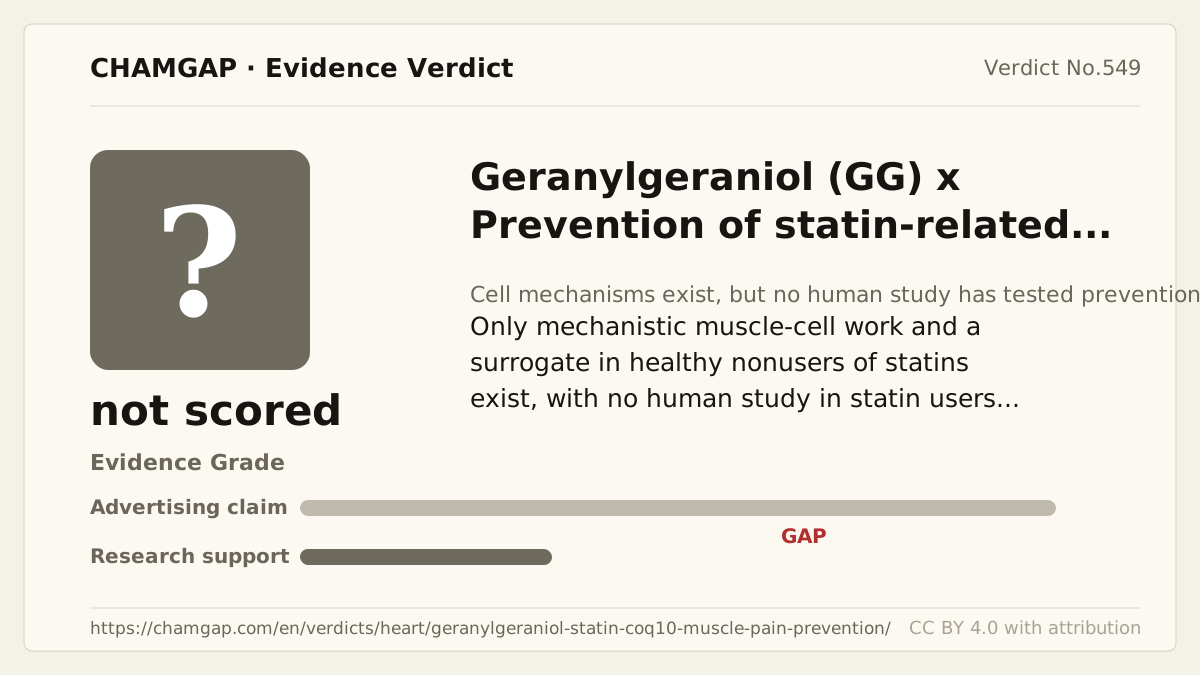
[Chamgap] Geranylgeraniol (GG) x prevention of statin-related CoQ10 depletion and muscle pain — Evidence Grade ?. 4 cited sources checked. Source: https://chamgap.com/en/verdicts/heart/geranylgeraniol-statin-coq10-muscle-pain-prevention/ · CC BY 4.0CC BY 4.0 — free to use with attribution; do not distort grades, numbers, or verdict meaning.
What this document does and does not do
Chamgap is an information source. It reports what research has and has not confirmed; it does not tell readers what to take or buy. That decision belongs to readers and, when needed, medical or legal professionals. This verdict reflects literature available up to the search date and may change as new research appears. Nothing here is medical advice.