
Almonds,
does it really help with Lower LDL cholesterol and reduced heart-disease risk?
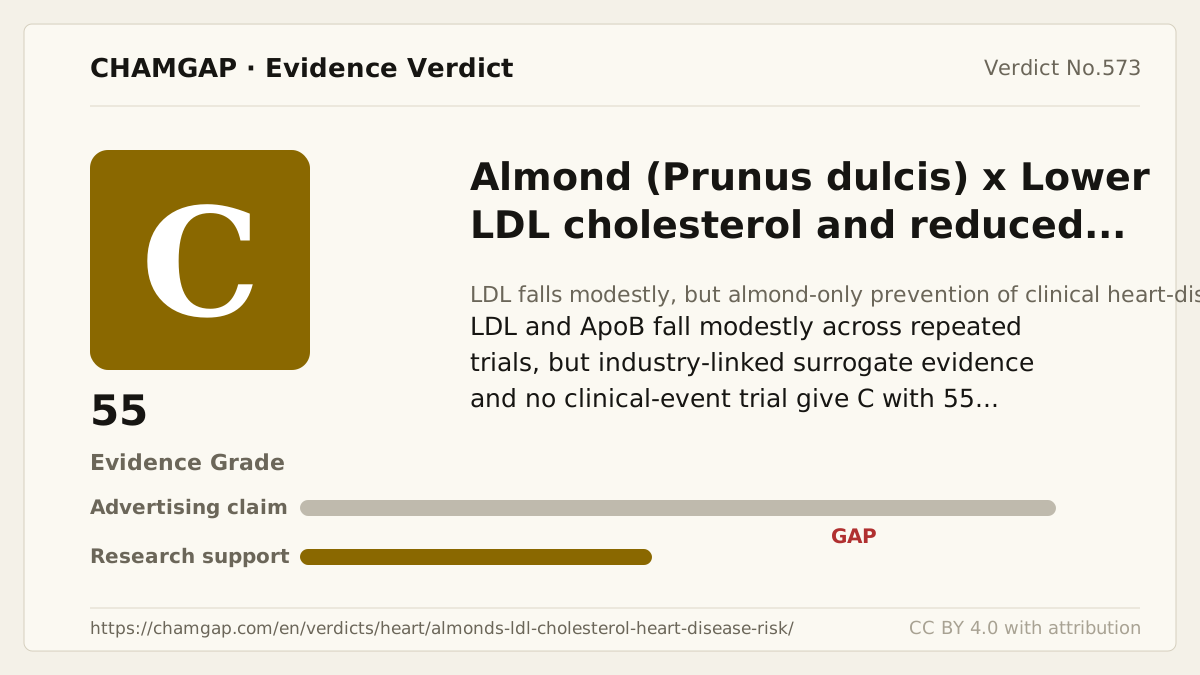
research showsAlmonds modestly and consistently lower LDL cholesterol and ApoB across randomized trials, but all outcomes are cardiovascular-risk surrogates and the latest meta-analysis has Almond Board ties, giving C. A 2025 meta-analysis of 48 comparisons and 2,485 participants found mean reductions of 0.132 mmol/L in LDL and 4.55 mg/dL in ApoB. No almond-only randomized trial has tested myocardial infarction, stroke, or cardiovascular death, so prevention of clinical heart-disease events remains a separate ? subclaim.
ads claimMarketing translates a reduction of a few milligrams per deciliter in LDL directly into heart-disease prevention or replacement of medication. Almonds are a dietary component, not a stand-alone treatment proven to prevent cardiovascular events.
Useful facts when choosing a product
- Lipid trials commonly used 20 to 100 g of almonds per day, while a one-ounce serving of about 28 g supplies roughly 160 kcal.
- Using unsalted, unsweetened almonds to replace refined snacks or saturated-fat foods better matches the evidence than simply adding calories.
- Tree-nut allergy can cause reactions ranging from hives to anaphylaxis, and whole nuts pose a choking risk to young children and people with swallowing difficulty.
- Almonds are energy dense, but randomized evidence does not show weight gain and suggests a small reduction; this does not justify unlimited intake.
Chamgap Semantic Classification Code
Candidate index · review held
F.almond.food.ldl-cholesterol-and-reduced-heart-disease-risk.reduce.UNKFoods and beverages > Almond > Food consumption > LDL cholesterol and reduced heart-disease risk > Reduction claim > Unknown
An automated migration candidate, not an issued permanent code; exact claim scope remains under review. This machine-generated migration candidate helps retrieval but is not a permanent assignment. The original verdict ID and URL remain authoritative.
What the research actually shows
Musa-Veloso et al. 2025 pooled 36 publications of almond trials lasting at least four weeks and found small reductions in LDL-C, total cholesterol, non-HDL-C, and ApoB; the Almond Board of California funded the review. The same group's 2016 meta-analysis of 27 datasets reported LDL-C lower by 0.124 mmol/L. Lee-Bravatti et al. 2019 reviewed 18 randomized trials of cardiovascular risk factors including lipids and weight, not clinical events. A meta-analysis of 37 randomized trials found no weight gain and a small mean weight reduction of 0.45 kg, arguing against inevitable weight gain with usual almond consumption.
Why this is classified as C (55)
A meta-analysis of 48 comparisons and 2,485 participants found small but consistent reductions of 0.132 mmol/L in LDL and 4.55 mg/dL in ApoB. All outcomes are risk-factor surrogates, however, and the latest synthesis has Almond Board funding and author conflicts, so rules ① and ②-b preclude B. This gives the upper end of C with 55 points, while the absence of event trials makes heart-disease prevention a separate ? subclaim.
Counterpoint. Someone who needs LDL lowering should use almonds as a replacement for saturated-fat foods within the whole diet, not as a substitute for medication. Statins or other proven treatment may still be needed according to LDL and total risk.
Rejudgment record. Reassessment (cross-check reflected) — Accepted the small consistent LDL and ApoB reductions but applied rules ① and ②-b to cap industry-linked risk-factor surrogate evidence at C, while separating the absence of cardiovascular clinical events into a ? subclaim
Sub-claim grades by effect
This ingredient is marketed for several effects. A single overall grade blends strong and weak claims together, so each effect is graded separately here. The overall grade reflects the strongest disconfirming or core claim.
| Effect (sub-claim) | Grade | Basis |
|---|---|---|
| Reduction in lipid surrogates including LDL and ApoB | C | A 48-comparison meta-analysis found a small consistent effect, but the evidence is industry-linked and surrogate-based. |
| Prevention of cardiovascular events or heart disease | ? | No almond-only randomized trial has assessed myocardial infarction, stroke, or cardiovascular death. |
| Weight neutrality | B | Many trials show no weight gain and a small reduction signal. |
Cross-check — AI research and Codex final gate
Evidence Table
| Study | Design | Sample | Funding | Endpoint | Result | Weight |
|---|---|---|---|---|---|---|
| Musa-Veloso K et al. 2025 | Systematic review and meta-analysis of randomized trials | 36 publications, 48 comparisons, and 2,485 participants | Funded by the Almond Board of California; authors employed by a consultancy | LDL-C, total cholesterol, non-HDL-C, ApoB, and other lipids | LDL-C fell 0.132 mmol/L, total cholesterol 0.160 mmol/L, and ApoB 4.552 mg/dL. | Latest large synthesis with industry funding |
| Musa-Veloso K et al. 2016 | Systematic review and meta-analysis of randomized trials | 18 publications and 27 datasets | Supported by the Almond Board of California | Fasting blood lipids | LDL-C fell 0.124 mmol/L and total cholesterol 0.153 mmol/L. | Replicated lipid evidence |
| Chahibakhsh N et al. 2024 | Dose-response meta-analysis of 37 randomized trials | 37 randomized trials and 43 intervention arms | No industry support reported | Body weight, BMI, waist circumference, and fat mass | Body weight decreased by a mean 0.45 kg and BMI did not increase. | Weight-neutrality subclaim |
Receipt — 4 References
All 4 cited sources were verified for existence at the original page (as of 2026-07-19).
Final verification and publication gate: Codex · Evidence date: 2026-07-19 · Corrections: none
Cite this verdict
[Chamgap] Almonds x lower LDL cholesterol and reduced heart-disease risk — Evidence Grade C·55. 4 cited sources checked. Source: https://chamgap.com/en/verdicts/heart/almonds-ldl-cholesterol-heart-disease-risk/ · CC BY 4.0CC BY 4.0 — free to use with attribution; do not distort grades, numbers, or verdict meaning.
What this document does and does not do
Chamgap is an information source. It reports what research has and has not confirmed; it does not tell readers what to take or buy. That decision belongs to readers and, when needed, medical or legal professionals. This verdict reflects literature available up to the search date and may change as new research appears. Nothing here is medical advice.