
MCT oil,
does it really help with Improved memory and cognitive function in mild cognitive impairment and Alzheimer's disease?
research showsMCT oil is rated C because it may improve some short-term cognitive tests in MCI and mild Alzheimer's disease. A 2023 meta-analysis reported an SMD of 0.64 for global cognition, but memory, language, and attention domains were not significant, and the studies were small, short, and heterogeneous. Increased ketones and brain ketone use are clear mechanistic or surrogate findings, but they do not establish prevention or slower dementia progression. This is a cognition-axis verdict distinct from the exercise-endurance and energy claim in verdict 288.
ads claimMarketing expands brain fuel and ketone elevation into restored memory, Alzheimer's prevention, and stopped dementia progression. The evidence fits selected short-term cognitive tests in MCI or mild AD, not a disease-modifying effect.
Useful facts when choosing a product
- Trials commonly used about 17 to 42 g per day, which can be far more than one or two capsules of a retail product.
- MCT raises beta-hydroxybutyrate and brain ketone use, but ketone elevation itself does not establish memory restoration or slower dementia progression.
- Higher doses commonly cause diarrhea, abdominal discomfort, nausea, and dropout, so studies often titrate the dose gradually and give it with food.
- MCT is a calorie-dense fat and must not replace standard Alzheimer's care; people with liver disease, diabetes, or nutrition problems should consult a clinician.
Chamgap Semantic Classification Code
Candidate index · review held
UNK.mct-oil.UNK.memory-and-cognitive-function-in-mild-cognitive-impairment-and-alzheimers-disease.improve.placeboUnknown > MCT oil > Unknown > memory and cognitive function in mild cognitive impairment and Alzheimer's disease > Improvement claim > Placebo
An automated migration candidate, not an issued permanent code; exact claim scope remains under review. This machine-generated migration candidate helps retrieval but is not a permanent assignment. The original verdict ID and URL remain authoritative.
What the research actually shows
Sun et al. 2023 synthesized 10 human interventions in MCI or AD and found improved global cognition, but not the individual memory, language, or attention domains, concluding that the evidence remained inconclusive. The BENEFIC trial by Fortier et al. assigned 83 people with MCI to 30 g/day kMCT or placebo for six months and observed benefits on selected recall, language, and executive tests. Henderson et al. studied 152 people with AD for 90 days and found higher beta-hydroxybutyrate and selected ADAS-Cog signals, especially among APOE4 noncarriers, while gastrointestinal adverse events were more frequent. Avgerinos et al. pooled 422 participants and reported ketosis and a small combined cognitive effect, but called for further trials because of risk of bias.
Why this is classified as C (52)
Meta-analyses and several randomized trials show some short-term cognitive-score benefit, so D is inappropriate. Samples remain small, follow-up is short, domain results conflict, and ketones are the most consistent surrogate. No dementia-progression or prevention outcome has been established, giving C with 52 points.
Counterpoint. A tolerable adjunctive trial may be reasonable for someone with MCI or mild AD who continues standard care and a balanced diet. APOE testing or an apparent MCT response should not be used to predict prognosis.
Rejudgment record. New verdict — Accepted positive short-term cognitive signals in randomized trials and meta-analyses, but applied the rule ① ceiling of C for small heterogeneous studies, reliance on the ketone surrogate, and no disease-progression outcome
Sub-claim grades by effect
This ingredient is marketed for several effects. A single overall grade blends strong and weak claims together, so each effect is graded separately here. The overall grade reflects the strongest disconfirming or core claim.
| Effect (sub-claim) | Grade | Basis |
|---|---|---|
| Short-term cognition and memory in MCI or mild AD | C | Some trials and meta-analyses are positive, but domain results conflict and studies are small and short. |
| Prevention or slower dementia progression | ? | No adequate human trial has assessed long-term conversion, progression, or functional loss. |
| Effect in APOE4 subgroups | C | A larger signal in noncarriers comes from small subgroups and is not a validated predictor. |
Cross-check — AI research and Codex final gate
Evidence Table
| Study | Design | Sample | Funding | Endpoint | Result | Weight |
|---|---|---|---|---|---|---|
| Sun L et al. 2023 | Systematic review and meta-analysis | Nine publications and 10 studies | Academic review; mixed funding among included trials | Global, memory, language, and attention scores and APOE4 subgroups | Global cognition improved with SMD 0.64, but memory, language, and attention were not significant; the effect was larger in APOE4 noncarriers. | Key synthesis with heterogeneity |
| Fortier M et al. 2021 BENEFIC | Six-month randomized placebo-controlled trial | 83 participants with MCI | Nestlé-related investigator and product conflicts reported | Cognitive tests and plasma ketones | Selected recall, fluency, naming, and executive tests improved and correlated with ketones. | Direct short-term MCI efficacy |
| Henderson ST et al. 2009 | Multicenter randomized double-blind placebo-controlled trial | 152 participants with mild-to-moderate AD | Led by AC-1202 developer Accera | ADAS-Cog, ADCS-CGIC, ketones, and APOE4 | Selected cognitive benefit at day 45 and a signal in APOE4 noncarriers occurred, but follow-up was short and gastrointestinal events were more frequent. | Direct AD evidence with industry concentration |
Receipt — 4 References
All 4 cited sources were verified for existence at the original page (as of 2026-07-19).
Final verification and publication gate: Codex · Evidence date: 2026-07-19 · Corrections: none
Cite this verdict
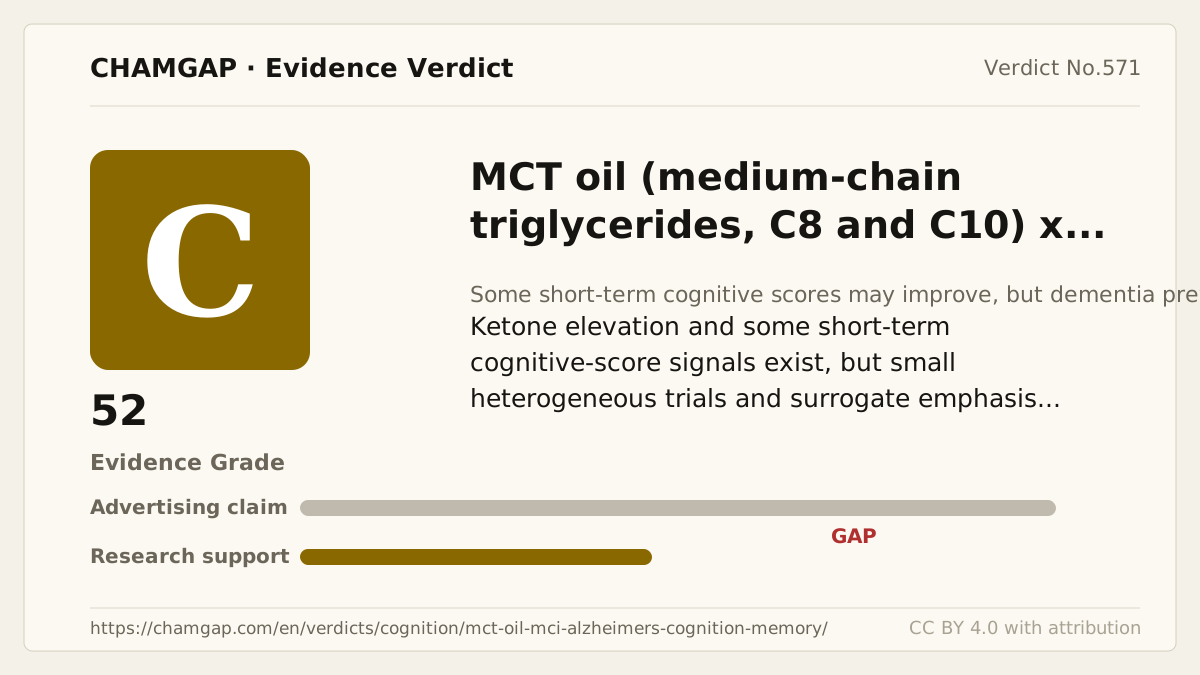
[Chamgap] MCT oil x improved memory and cognition in mild cognitive impairment and Alzheimer's disease — Evidence Grade C·52. 4 cited sources checked. Source: https://chamgap.com/en/verdicts/cognition/mct-oil-mci-alzheimers-cognition-memory/ · CC BY 4.0CC BY 4.0 — free to use with attribution; do not distort grades, numbers, or verdict meaning.
What this document does and does not do
Chamgap is an information source. It reports what research has and has not confirmed; it does not tell readers what to take or buy. That decision belongs to readers and, when needed, medical or legal professionals. This verdict reflects literature available up to the search date and may change as new research appears. Nothing here is medical advice.