
Magnesium,
does it really help with Prevention of migraine attacks and reduction in frequency?
research showsOral magnesium receives a C for migraine prevention. An 81-participant trial of trimagnesium dicitrate 600 mg/day reduced attack frequency, but a similar 69-participant multicenter trial of magnesium aspartate 486 mg/day was indistinguishable from placebo and stopped early. Small trials, inconsistent salt forms, and reliance on subjective headache diaries prevent generalization to all magnesium products.
ads claimClaims that magnesium deficiency causes every migraine, that one pill blocks attacks, or that sleep-oriented magnesium products carry the same preventive evidence exceed the data. This verdict concerns prevention in diagnosed migraine, not the sleep and eye-twitch claim in verdict 013 or the L-threonate cognition claim in verdict 375.
Useful facts when choosing a product
- Magnesium health functional foods are widely sold in South Korea as nutrients needed for energy use and maintenance of nerve and muscle function; this is not recognition of a migraine-prevention indication.
- A common migraine-study and clinical range is 400-600 mg/day of elemental magnesium, but a label stating 500 mg of magnesium oxide does not mean 500 mg of elemental magnesium.
- The key positive trial used trimagnesium dicitrate 600 mg/day. Oxide, citrate, glycinate, and other salts differ in elemental content and absorption and cannot be assumed interchangeable.
- Diarrhea is common at preventive study doses, impaired kidney function raises hypermagnesemia risk, and spacing may be needed from some antibiotics and bisphosphonates.
Chamgap Semantic Classification Code
Candidate index · review held
S.magnesium.UNK.migraine-attacks-and-reduction-in-frequency.prevent.placeboSupplements and nutraceuticals > Magnesium > Unknown > migraine attacks and reduction in frequency > Occurrence-prevention claim > Placebo
An automated migration candidate, not an issued permanent code; exact claim scope remains under review. This machine-generated migration candidate helps retrieval but is not a permanent assignment. The original verdict ID and URL remain authoritative.
What the research actually shows
The 1996 Peikert multicenter trial randomized 81 participants to trimagnesium dicitrate 600 mg/day or placebo for 12 weeks and reported reductions in attack frequency and migraine days. The 1996 Pfaffenrath multicenter trial gave magnesium aspartate 486 mg/day to 69 participants for 12 weeks but found response rates of 28.6% versus 29.4% and stopped early. The 2018 von Luckner review found only one positive study among two Class I trials and classified the five-trial evidence as Grade C, possibly effective. The 2019 Okoli review and meta-analysis also judged adult preventive efficacy uncertain. The 2012 AAN/AHS Level B guideline was retired in full in 2015 and is not a current recommendation.
Why this is classified as C (55)
An 81-participant positive trial conflicts with a completely null 69-participant trial, and the five-trial review found only one positive Class I study and assigned Grade C. The 2012 guideline was retired in 2015, while small samples, inconsistent salt forms, and subjective headache diaries support C with 55 points.
Counterpoint. It may be a low-cost adjunctive preventive option for some patients, but assessing benefit requires an appropriate elemental dose and at least 8-12 weeks, and certainty is lower than for established prescription preventives.
Rejudgment record. Reassessment (cross-check reflected) — An 81-participant positive trimagnesium dicitrate trial conflicts with a completely null 69-participant magnesium aspartate trial, the five-trial review concluded Grade C, and the 2012 AAN/AHS Level B guideline was retired in 2015; small samples, salt-form inconsistency, and subjective outcomes were also considered.
Sub-claim grades by effect
This ingredient is marketed for several effects. A single overall grade blends strong and weak claims together, so each effect is graded separately here. The overall grade reflects the strongest disconfirming or core claim.
| Effect (sub-claim) | Grade | Basis |
|---|---|---|
| Prevention of migraine attacks and reduction in frequency with oral magnesium | C | An 81-participant positive trial conflicts with a completely null 69-participant trial, and the five-trial systematic review concluded Grade C. |
Cross-check — AI research and Codex final gate
Evidence Table
| Study | Design | Sample | Funding | Endpoint | Result | Weight |
|---|---|---|---|---|---|---|
| Peikert et al. 1996 RCT | Multicenter double-blind randomized placebo-controlled trial | 81 | Not stated in the abstract | Attack frequency, migraine days, and acute medication use | After 12 weeks of trimagnesium dicitrate 600 mg/day, attack frequency fell 41.6% from baseline versus 15.8% with placebo; diarrhea occurred in 18.6%. | Key positive |
| Pfaffenrath et al. 1996 RCT | Multicenter prospective double-blind randomized placebo-controlled trial | 69 | Not stated in the abstract | Response rate for at least a 50% reduction in attack intensity or duration, migraine days, and number of attacks | After 12 weeks of magnesium aspartate 486 mg/day, response rates were 28.6% with magnesium and 29.4% with placebo; the completely null trial stopped after its planned interim analysis. | Key null evidence |
| Study 3 | Systematic review of double-blind placebo-controlled trials | 5 | Unknown; academic author affiliations | Migraine days and number of attacks | One of two Class I and two of three Class III trials were positive on primary efficacy outcomes; overall Grade C, possibly effective. | Key limitation |
| Study 4 | Systematic review and meta-analysis of randomized trials of vitamins and minerals for migraine prevention | 226 | Academic research; funding varied across original trials | Attack frequency, duration, severity, and migraine days | The adult severity effect was nonsignificant, and adult preventive efficacy of magnesium was judged uncertain because of insufficient evidence. | Key counterevidence |
Receipt — 5 References
All 5 cited sources were verified for existence at the original page (as of 2026-07-18).
Final verification and publication gate: Codex · Evidence date: 2026-07-18 · Corrections: none
Cite this verdict
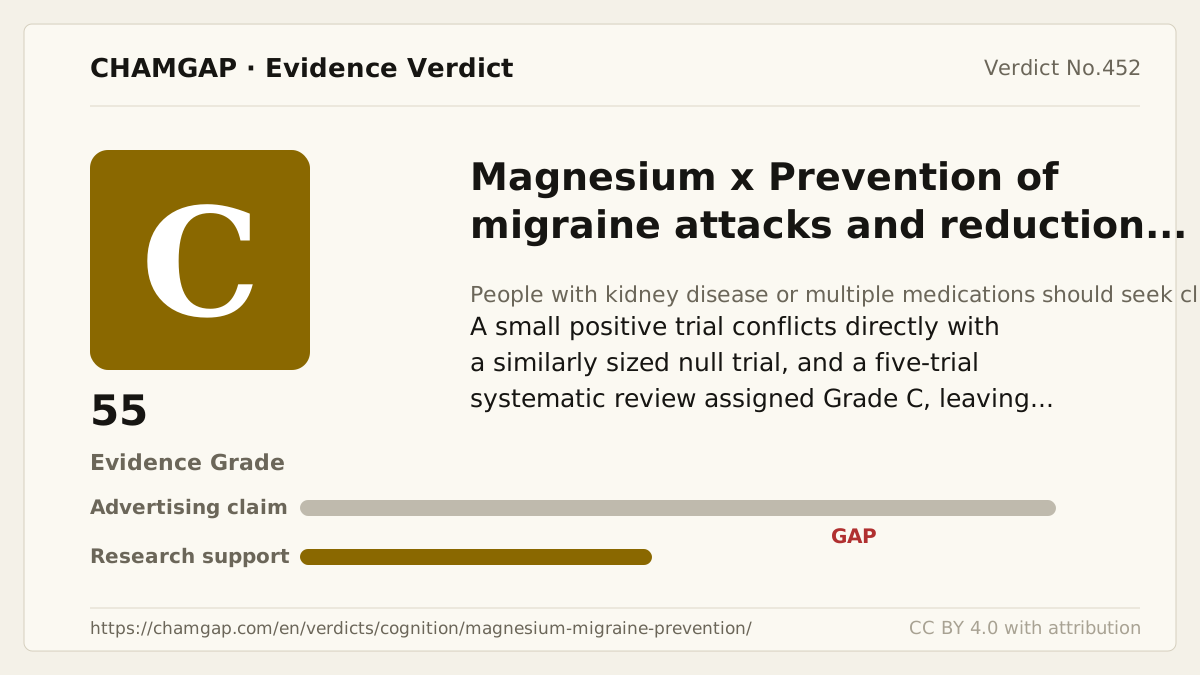
[Chamgap] Magnesium x migraine attack prevention and frequency reduction — Evidence Grade C·55. 5 cited sources checked. Source: https://chamgap.com/en/verdicts/cognition/magnesium-migraine-prevention/ · CC BY 4.0CC BY 4.0 — free to use with attribution; do not distort grades, numbers, or verdict meaning.
What this document does and does not do
Chamgap is an information source. It reports what research has and has not confirmed; it does not tell readers what to take or buy. That decision belongs to readers and, when needed, medical or legal professionals. This verdict reflects literature available up to the search date and may change as new research appears. Nothing here is medical advice.