
Lecanemab,
does it really help with Slowing cognitive and functional decline in amyloid-confirmed early Alzheimer's disease?
research showsLecanemab is rated C because it modestly slowed 18-month cognitive and functional decline in amyloid-confirmed mild cognitive impairment or mild dementia due to Alzheimer's disease. In the 1,795-participant Clarity AD randomized trial, the primary CDR-SB endpoint, a cognitive and functional clinical scale rather than a surrogate, favored lecanemab by 0.45 points. The clinical perceptibility of this absolute difference is uncertain, and positive confirmatory evidence is concentrated in one Eisai- and Biogen-led single-product trial. Strict application of boundary ②-b therefore caps the grade at C with 58 points. Dementia arrest and memory restoration remain unproven, while ARIA-E at 12.6%, ARIA-H, infusion reactions, and APOE4-related risk remain major safety concerns.
ads claimPromotion can expand slowing progression into stopping Alzheimer's disease or restoring memory. The demonstrated scope is a modestly slower average decline over 18 months in amyloid-confirmed patients at an early stage.
Useful facts when choosing a product
- Lecanemab is a monoclonal antibody that binds soluble aggregated amyloid-beta and belongs to a prescription disease-modifying treatment pathway distinct from MCT oils or cognitive supplements.
- The evidence applies to mild cognitive impairment or mild dementia due to Alzheimer's disease with confirmed amyloid pathology. Benefit in moderate or severe dementia has not been established.
- Brain MRI is required before and during treatment, and APOE epsilon 4 genotype provides important information for counseling about ARIA risk.
- Intravenous or approved subcutaneous dosing schedules and monitoring must follow the current national label and specialist instructions. Lecanemab is not a symptomatic drug that immediately restores memory.
Chamgap Semantic Classification Code
Candidate index · review held
M.lecanemab.UNK.slowing-cognitive-and-functional-decline-in-amyloid-confirmed-early-alzheimers-disease.assess.placeboMedicinal interventions > Lecanemab > Unknown > Slowing cognitive and functional decline in amyloid-confirmed early Alzheimer's disease > Association or change assessment > Placebo
An automated migration candidate, not an issued permanent code; exact claim scope remains under review. This machine-generated migration candidate helps retrieval but is not a permanent assignment. The original verdict ID and URL remain authoritative.
What the research actually shows
Clarity AD randomized patients with mild cognitive impairment or mild dementia and amyloid pathology confirmed by PET or cerebrospinal fluid to lecanemab 10 mg/kg intravenously every two weeks or placebo. At 18 months, the CDR-SB difference was -0.45 points (95% CI -0.67 to -0.23), with differences of -1.44 on ADAS-cog14 and +2.0 on ADCS-MCI-ADL among concordant secondary outcomes. Eisai and Biogen funded the trial, and no longer independent placebo-controlled replication of comparable size is available. Unlike MCT products or cognitive supplements, lecanemab is an anti-amyloid disease-modifying therapy targeting soluble amyloid-beta protofibrils and plaques.
Why this is classified as C (58)
C. The 1,795-participant double-blind trial was consistently positive on CDR-SB and key cognitive and functional secondary outcomes, so statistical clinical efficacy is accepted. However, the clinical perceptibility of the -0.45-point absolute CDR-SB difference is uncertain, and positive evidence is concentrated in one Eisai- and Biogen-led single-product confirmatory trial. Strict application of the boundary ②-b ceiling and the effect-size dispute yields C with 58 points. ARIA-E at 12.6%, ARIA-H, infusion reactions, and APOE4-related risk remain separate safety concerns.
Counterpoint. For eligible patients at an early stage, slower progression may be valuable, but the small expected average benefit must be weighed against MRI monitoring and ARIA risk with the patient and care partner.
Rejudgment record. Reassessment (cross-check reflected) — Applied the boundary ②-b ceiling of C because the Clarity AD primary CDR-SB endpoint was statistically positive but the clinical perceptibility of the -0.45-point absolute difference is uncertain and positive evidence is concentrated in one Eisai- and Biogen-led single-product confirmatory trial
Sub-claim grades by effect
This ingredient is marketed for several effects. A single overall grade blends strong and weak claims together, so each effect is graded separately here. The overall grade reflects the strongest disconfirming or core claim.
| Effect (sub-claim) | Grade | Basis |
|---|---|---|
| Slowing cognitive and functional decline in amyloid-confirmed early Alzheimer's disease | C | The 1,795-participant randomized trial showed a statistically positive −0.45-point CDR-SB difference, but the absolute effect was small and evidence was concentrated in one sponsor-led confirmatory trial. |
| Stopping dementia progression or restoring memory | ? | Only slower average progression was shown; disease arrest, reversal, and memory restoration remain unproven. |
| ARIA-E or ARIA-H and APOE4-related risk | ? | This is a safety rather than efficacy claim; MRI monitoring and genotype-informed counseling are required. |
Cross-check — AI research and Codex final gate
Evidence Table
| Study | Design | Sample | Funding | Endpoint | Result | Weight |
|---|---|---|---|---|---|---|
| van Dyck CH et al. 2023, Clarity AD | Multicenter randomized double-blind placebo-controlled phase 3 trial | 1,795 participants with amyloid-confirmed early Alzheimer's disease | Eisai and Biogen | Change in CDR-SB at 18 months and secondary cognitive and functional outcomes | CDR-SB worsened by 1.21 versus 1.66 points, a difference of -0.45 (95% CI -0.67 to -0.23); key secondary outcomes also significantly favored lecanemab. | Pivotal direct clinical efficacy evidence |
| Cummings J et al. 2023 appropriate-use recommendations | Evidence review and expert appropriate-use recommendations | Clarity AD and the lecanemab clinical-development evidence base | Multiple authors reported industry relationships | Patient eligibility, ARIA and hemorrhage risk, and MRI and APOE4 monitoring | The recommendations identify greater ARIA risk in APOE4 carriers, especially homozygotes, and call for special caution with anticoagulation and hemorrhage risk. | Supporting safety and scope evidence |
Receipt — 3 References
All 3 cited sources were verified for existence at the original page (as of 2026-07-19).
Final verification and publication gate: Codex · Evidence date: 2026-07-19 · Corrections: none
Cite this verdict
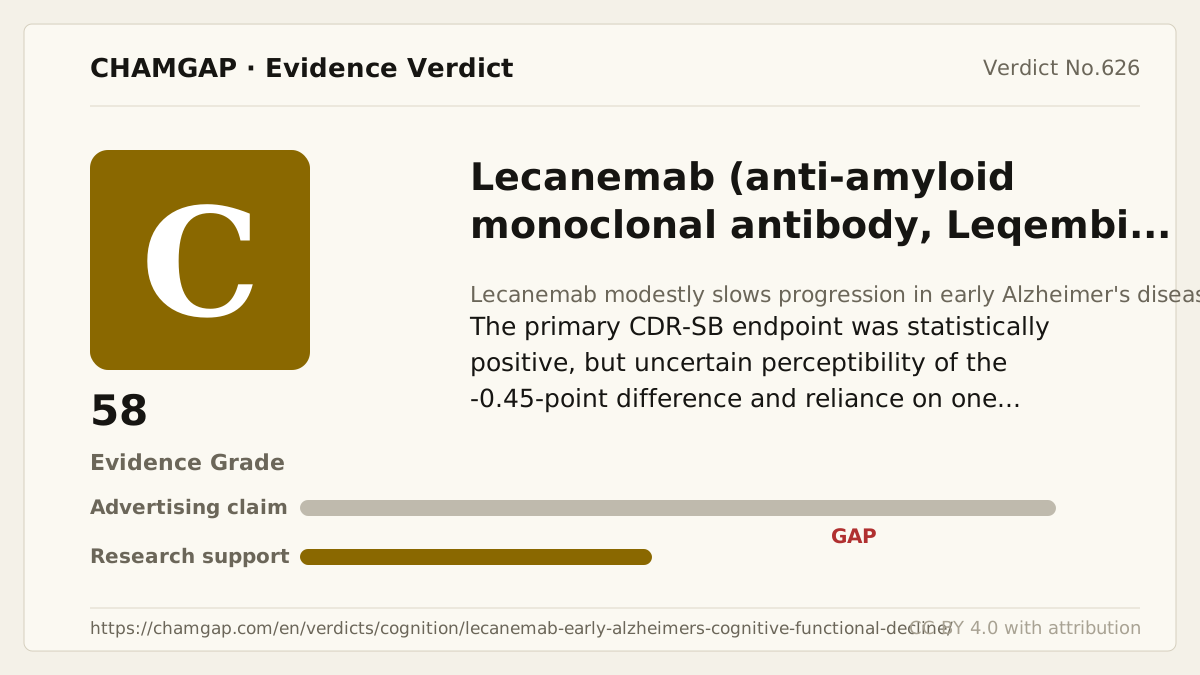
[Chamgap] Lecanemab x slowing cognitive and functional decline in early Alzheimer's disease — Evidence Grade C·58. 3 cited sources checked. Source: https://chamgap.com/en/verdicts/cognition/lecanemab-early-alzheimers-cognitive-functional-decline/ · CC BY 4.0CC BY 4.0 — free to use with attribution; do not distort grades, numbers, or verdict meaning.
What this document does and does not do
Chamgap is an information source. It reports what research has and has not confirmed; it does not tell readers what to take or buy. That decision belongs to readers and, when needed, medical or legal professionals. This verdict reflects literature available up to the search date and may change as new research appears. Nothing here is medical advice.