
High-dose vitamin E,
does it really help with Prevention of dementia and Alzheimer disease in the general older population?
research showsThe claim that high-dose vitamin E prevents dementia or Alzheimer disease in cognitively normal older adults is not supported. In the PREADViSE randomized trial of 7,540 asymptomatic men, neither vitamin E alone nor vitamin E with selenium reduced dementia incidence, and a long-term cognitive substudy of 6,377 healthy older women also found no benefit. The large independent null trial rule supports a D grade.
ads claimMarketing moves directly from phrases such as 'brain-cell antioxidant,' 'memory protection,' and 'Alzheimer prevention' to a prevention claim. Higher blood tocopherol or an antioxidant mechanism is not the clinical outcome of incident dementia, and correction of deficiency must be separated from long-term high-dose use.
Useful facts when choosing a product
- Single-ingredient 400 IU alpha-tocopherol softgels are distributed in Korea as over-the-counter medicines or imported supplement products.
- PREADViSE used synthetic vitamin E 400 IU/day, whereas mild-cognitive-impairment and Alzheimer treatment trials used 2,000 IU/day. The doses and populations differ.
- Treatment of vitamin E deficiency is a different indication from dementia prevention in older adults without deficiency.
- High-dose alpha-tocopherol raises concerns about bleeding, hemorrhagic stroke, and interactions with anticoagulant or antiplatelet drugs. A mortality signal at 400 IU/day or more has been reported in meta-analysis, although generalizability to healthy adults remains debated.
Chamgap Semantic Classification Code
Candidate index · review held
S.vitamin-e.UNK.dementia-and-alzheimer-disease-in-the-general-older-population.prevent.placeboSupplements and nutraceuticals > Vitamin E > Unknown > dementia and Alzheimer disease in the general older population > Occurrence-prevention claim > Placebo
An automated migration candidate, not an issued permanent code; exact claim scope remains under review. This machine-generated migration candidate helps retrieval but is not a permanent assignment. The original verdict ID and URL remain authoritative.
What the research actually shows
The 2017 PREADViSE study by Kryscio and colleagues began as an ancillary double-blind randomized trial within SELECT and followed 7,540 men. Dementia occurred in 325 of 7,338 participants, with no reduction in the vitamin E, selenium, or combination groups. The 2006 Women's Health Study cognitive substudy administered 600 IU on alternate days to 6,377 healthy older women and found no benefit for global cognition, cognitive change, or substantial decline after an average of 9.6 years. In the 2005 Petersen trial, vitamin E 2,000 IU/day did not reduce progression to Alzheimer disease over three years in amnestic mild cognitive impairment. The TEAM-AD functional signal belongs to the treatment axis in established disease.
Why this is classified as D (25)
A 7,540-participant independent trial directly assessing incident dementia was null, and separate large long-term cognition and mild-cognitive-impairment progression trials also showed no preventive benefit. F could be considered for repeated refutation, but PREADViSE remains the main large trial directly addressing incident dementia in the general older population, so the conservative grade is D with 25 points.
Counterpoint. A trial signal for slower functional decline in established Alzheimer disease belongs to a separate treatment axis and cannot be used to infer prevention in asymptomatic adults.
Rejudgment record. New verdict — Prioritized the null 7,540-participant independent trial directly testing incident dementia in asymptomatic older adults and separated deficiency treatment and established Alzheimer progression
Sub-claim grades by effect
This ingredient is marketed for several effects. A single overall grade blends strong and weak claims together, so each effect is graded separately here. The overall grade reflects the strongest disconfirming or core claim.
| Effect (sub-claim) | Grade | Basis |
|---|---|---|
| Prevention of incident dementia in cognitively normal older adults | D | Neither vitamin E alone nor its combination with selenium was effective in the 7,540-participant PREADViSE trial. |
| Prevention of progression from mild cognitive impairment to Alzheimer disease | D | A three-year trial of 2,000 IU/day did not reduce progression to Alzheimer disease. |
| Slowing functional decline in established mild to moderate Alzheimer disease | C | One large TEAM-AD trial found a signal for slower decline in activities of daily living, but this is not a prevention claim. |
Cross-check — AI research and Codex final gate
Evidence Table
| Study | Design | Sample | Funding | Endpoint | Result | Weight |
|---|---|---|---|---|---|---|
| Kryscio RJ et al. 2017 (PREADViSE) | Multicenter double-blind randomized trial followed by cohort follow-up | 7,338 | Public funding from the U.S. National Institutes of Health | Incident all-cause dementia | There were 325 dementia cases; the hazard ratio was 0.88 for vitamin E alone and 1.00 for the selenium combination, neither significant versus placebo. | Key |
| Kang JH et al. 2006 | Cognitive substudy of a large double-blind randomized trial | 6,377 | Public funding from the U.S. National Institutes of Health | Global cognition, verbal memory, and cognitive decline | Long-term alternate-day 600 IU provided no benefit for global cognition or cognitive change after an average of 9.6 years. | Key |
| Petersen RC et al. 2005 | Double-blind randomized placebo-controlled trial | 769 | U.S. NIH with support from Pfizer and Eisai | Progression to Alzheimer disease | Vitamin E 2,000 IU/day did not reduce progression from mild cognitive impairment to Alzheimer disease over three years. | Supportive |
| Dysken MW et al. 2014 (TEAM-AD) | Multicenter double-blind randomized placebo-controlled trial | 613 | Public funding from the U.S. Department of Veterans Affairs with study products supplied | Activities of daily living on the ADCS-ADL | Functional decline was slower with 2,000 IU/day monotherapy, but this was treatment of diagnosed Alzheimer disease, not prevention. | Contextual |
Receipt — 5 References
All 5 cited sources were verified for existence at the original page (as of 2026-07-18).
Final verification and publication gate: Codex · Evidence date: 2026-07-18 · Corrections: none
Cite this verdict
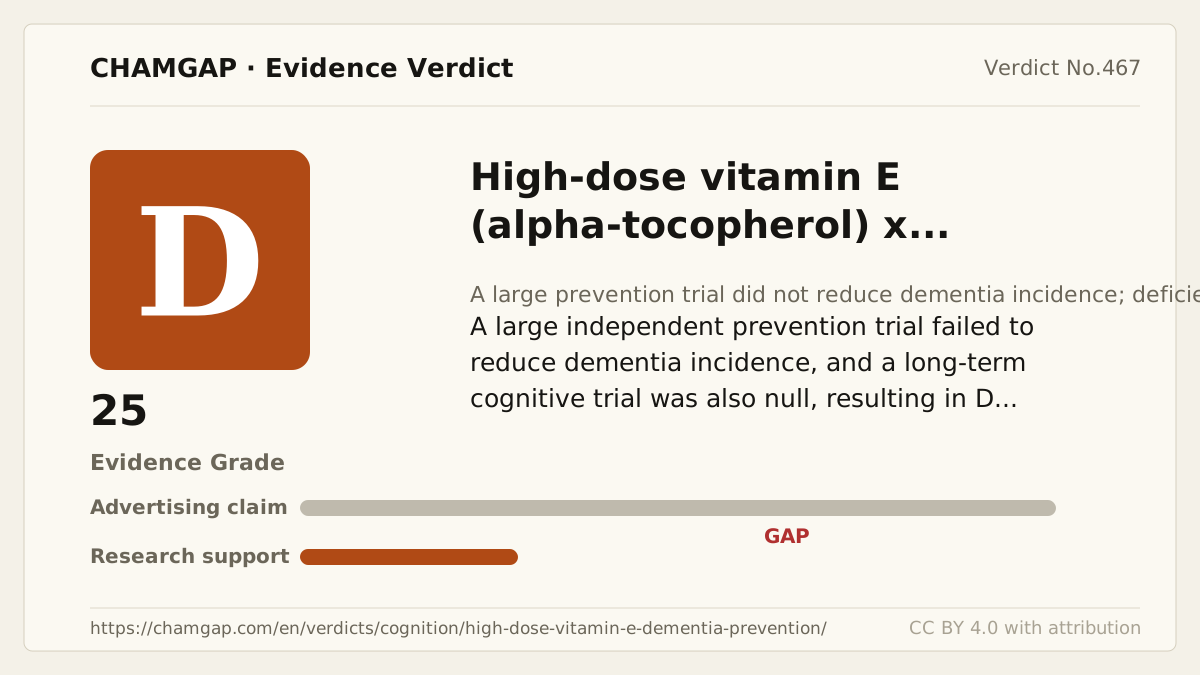
[Chamgap] High-dose vitamin E x prevention of dementia and Alzheimer disease — Evidence Grade D·25. 5 cited sources checked. Source: https://chamgap.com/en/verdicts/cognition/high-dose-vitamin-e-dementia-prevention/ · CC BY 4.0CC BY 4.0 — free to use with attribution; do not distort grades, numbers, or verdict meaning.
What this document does and does not do
Chamgap is an information source. It reports what research has and has not confirmed; it does not tell readers what to take or buy. That decision belongs to readers and, when needed, medical or legal professionals. This verdict reflects literature available up to the search date and may change as new research appears. Nothing here is medical advice.