
Heat-treated green tea extract,
does it really help with Improvement of memory and concentration?
research showsHeat-treated green tea extract at 900 mg/day improved a memory composite and brain functional connectivity in a 12-week double-blind RCT of 80 people with subjective memory impairment, but the evidence consists of one manufacturing process, one product, and one trial, supporting C.
ads claimJeju green tea, individually recognized memory improvement, concentration, and brain connectivity may be presented together. This is a specific ingredient in which heat converts part of EGCG to non-epicatechins such as GCG, so it must not be mixed with evidence for ordinary tea drinking or body-fat catechin products.
Useful facts when choosing a product
- Korean individually recognized heat-treated green tea extract No. 2022-34 has a daily intake of 900 mg/day.
- A specified heat process changes its catechin composition, so it is not equivalent to ordinary green tea extract or green-tea beverages.
- Korean finished products may add B vitamins, caffeine-containing ingredients, or other vitality ingredients, which differs from a single-ingredient trial.
- Caffeine can cause restlessness or insomnia, and people with liver disease or taking medicines are advised to consult a professional; these are safety issues separate from efficacy grading.
Chamgap Semantic Classification Code
Candidate index · review held
S.heat-treated-green-tea-extract.UNK.memory-and-concentration.improve.placeboSupplements and nutraceuticals > Heat-treated green tea extract > Unknown > memory and concentration > Improvement claim > Placebo
An automated migration candidate, not an issued permanent code; exact claim scope remains under review. This machine-generated migration candidate helps retrieval but is not a permanent assignment. The original verdict ID and URL remain authoritative.
What the research actually shows
Joo 2025 randomized 80 middle-aged adults with subjective memory impairment to HT-GTE or placebo for 12 weeks. The standardized memory composite increased more with HT-GTE (z=2.535, interaction p=0.011), and functional connectivity in the right precuneus of the default mode network also increased (z=2.554, p=0.011). The sample was small and this is the only trial. Registration, the prespecified analysis plan, multiplicity handling, and detailed manufacturer funding could not be fully established from the public abstract. Individual recognition demonstrates that a study exists but does not establish independent replication or a clinical outcome.
Why this is classified as C (51)
The positive memory-composite RCT is recognized, but 80 participants, 12 weeks, one manufacturing process, an imaging surrogate, absent independent replication, and rule ②-b support C with 51 points.
Counterpoint. A short-term memory-test signal remains in middle-aged adults with subjective memory impairment, but it cannot be expanded to concentration generally or dementia prevention.
Rejudgment record. New verdict — Positive single-product RCT in 80 participants, capped by rule ②-b because of 12-week duration, imaging surrogate, and no independent replication
Sub-claim grades by effect
This ingredient is marketed for several effects. A single overall grade blends strong and weak claims together, so each effect is graded separately here. The overall grade reflects the strongest disconfirming or core claim.
| Effect (sub-claim) | Grade | Basis |
|---|---|---|
| Memory composite in people with subjective memory impairment | C | A single-product 12-week RCT in 80 participants was positive, but independent replication is absent. |
| Improved concentration | ? | The public key trial centered on a memory composite and did not establish a separate clinical concentration endpoint. |
| Dementia prevention and preservation of daily function | ? | These long-term clinical outcomes were not tested. |
Cross-check — AI research and Codex final gate
Evidence Table
| Study | Design | Sample | Funding | Endpoint | Result | Weight |
|---|---|---|---|---|---|---|
| Joo et al. 2025 | Randomized double-blind placebo-controlled trial | 80 | Details unavailable in the public abstract; specified individually recognized ingredient | Memory composite and default-mode-network connectivity | At 12 weeks, interactions for the memory composite and right-precuneus connectivity were each positive at p=0.011. | Key |
| Ahn et al. 2022 | Preclinical study in aged mice | Public research support with manufacturer ingredient linkage | Memory behavior and hippocampal synaptic plasticity | It supported mechanistic plausibility for a GCG-enriched heat-treated extract but did not replicate human efficacy. | Mechanistic |
Receipt — 3 References
All 3 cited sources were verified for existence at the original page (as of 2026-07-17).
Final verification and publication gate: Codex · Evidence date: 2026-07-17 · Corrections: none
Cite this verdict
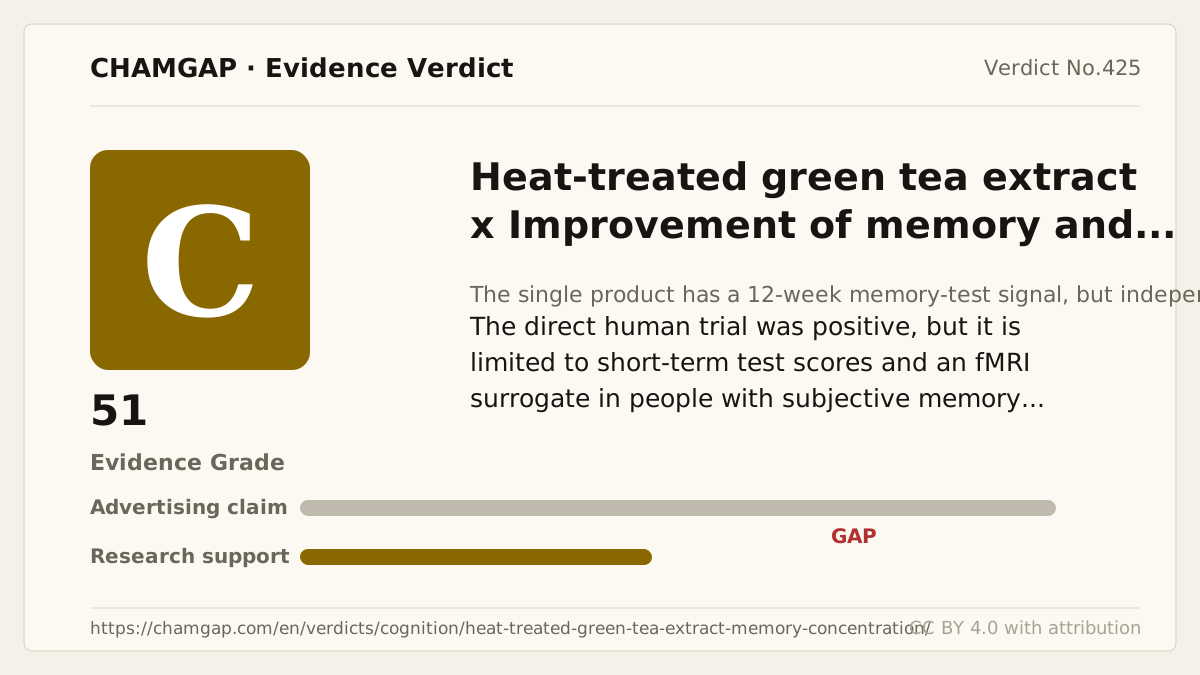
[Chamgap] Heat-treated green tea extract x memory and concentration — Evidence Grade C·51. 3 cited sources checked. Source: https://chamgap.com/en/verdicts/cognition/heat-treated-green-tea-extract-memory-concentration/ · CC BY 4.0CC BY 4.0 — free to use with attribution; do not distort grades, numbers, or verdict meaning.
What this document does and does not do
Chamgap is an information source. It reports what research has and has not confirmed; it does not tell readers what to take or buy. That decision belongs to readers and, when needed, medical or legal professionals. This verdict reflects literature available up to the search date and may change as new research appears. Nothing here is medical advice.