
DW2009,
does it really help with Improvement of memory and attention in mild cognitive impairment?
research showsDW2009 improved a combined cognitive score and attention in a 12-week double-blind RCT of 100 people with mild cognitive impairment, but the evidence depends on one product and one trial, included company researchers, and has no long-term clinical outcomes, supporting a C grade.
ads claimMarketing can combine Korea's first individually recognized cognitive probiotic, the gut-brain axis, and increased BDNF. Individual recognition indicates that a study and a specified ingredient exist; it does not establish independent replication or guarantee a B grade.
Useful facts when choosing a product
- DW2009 is known as Korean individually recognized ingredient No. 2022-29, with a daily intake of 800 mg of the complex.
- The test material is a complex produced by fermenting defatted soybean flour with L. plantarum C29; it is not the same as a C29-only probiotic.
- Korean finished products may combine it with vitamins or other cognition-related ingredients, which differs from the DW2009-only trial condition.
- The 800 mg/day trial cannot be extrapolated to other C29-strain products or ordinary fermented-soy foods.
Chamgap Semantic Classification Code
Candidate index · review held
UNK.lactiplantibacillus-plantarum-c29-fermented-soybean-complex.UNK.memory-and-attention-in-mild-cognitive-impairment.improve.placeboUnknown > Lactiplantibacillus plantarum C29-fermented soybean complex > Unknown > memory and attention in mild cognitive impairment > Improvement claim > Placebo
An automated migration candidate, not an issued permanent code; exact claim scope remains under review. This machine-generated migration candidate helps retrieval but is not a permanent assignment. The original verdict ID and URL remain authoritative.
What the research actually shows
The Hwang 2019 RCT randomized 100 people with MCI to DW2009 800 mg/day or placebo for 12 weeks. The combined score of attention, working memory, and verbal memory showed a positive group-by-time interaction at p=0.02, and attention was also positive at p=0.02. The discussion described the memory result as a meaningful trend, while the correlation between serum BDNF change and cognitive change was exploratory mechanistic evidence. Funding came from Korean government programs, but researchers from the developer, Dongwha Pharm, included the first author, and no second independent product RCT was identified. Later C29 and DW2009 publications are mainly mouse and cell studies and did not raise the human grade.
Why this is classified as C (55)
The positive primary combined cognitive result in a 100-participant RCT is recognized, but rule ②-b caps the evidence at C with 55 points because it is a single proprietary mixture, has company involvement, lasted 12 weeks, and lacks independent replication.
Counterpoint. The placebo-controlled trial used direct cognitive testing in MCI, but it did not test dementia prevention or preservation of daily function.
Rejudgment record. New verdict — Positive RCT in 100 participants, capped by rule ②-b because of a single proprietary mixture, company involvement, and no independent replication
Sub-claim grades by effect
This ingredient is marketed for several effects. A single overall grade blends strong and weak claims together, so each effect is graded separately here. The overall grade reflects the strongest disconfirming or core claim.
| Effect (sub-claim) | Grade | Basis |
|---|---|---|
| Combined cognition and attention in MCI with the DW2009 mixture | C | A single 12-week RCT in 100 participants was positive, but product- and team-independent replication is absent. |
| Cognitive efficacy of C29 bacteria alone or fermented soy alone | ? | The mixture trial cannot separate the human contribution of each component. |
| Prevention of dementia or preservation of daily function | ? | These long-term clinical endpoints were not tested. |
Cross-check — AI research and Codex final gate
Evidence Table
| Study | Design | Sample | Funding | Endpoint | Result | Weight |
|---|---|---|---|---|---|---|
| Hwang et al. 2019 | Multicenter randomized double-blind placebo-controlled trial | 100 | Korean government grants; developer-affiliated authors included | Combined cognition, attention, working and verbal memory, and serum BDNF | Combined cognition and attention interactions were positive at p=0.02; memory was a trend and the BDNF correlation was exploratory. | Key |
| Lee et al. 2018 | 5XFAD mouse preclinical study | Korean research support with DW2009 development linkage | Memory behavior, microglia, and gut microbiota | It provided mechanistic plausibility for DW2009 but did not independently replicate human efficacy. | Mechanistic |
Receipt — 2 References
All 2 cited sources were verified for existence at the original page (as of 2026-07-17).
Final verification and publication gate: Codex · Evidence date: 2026-07-17 · Corrections: none
Cite this verdict
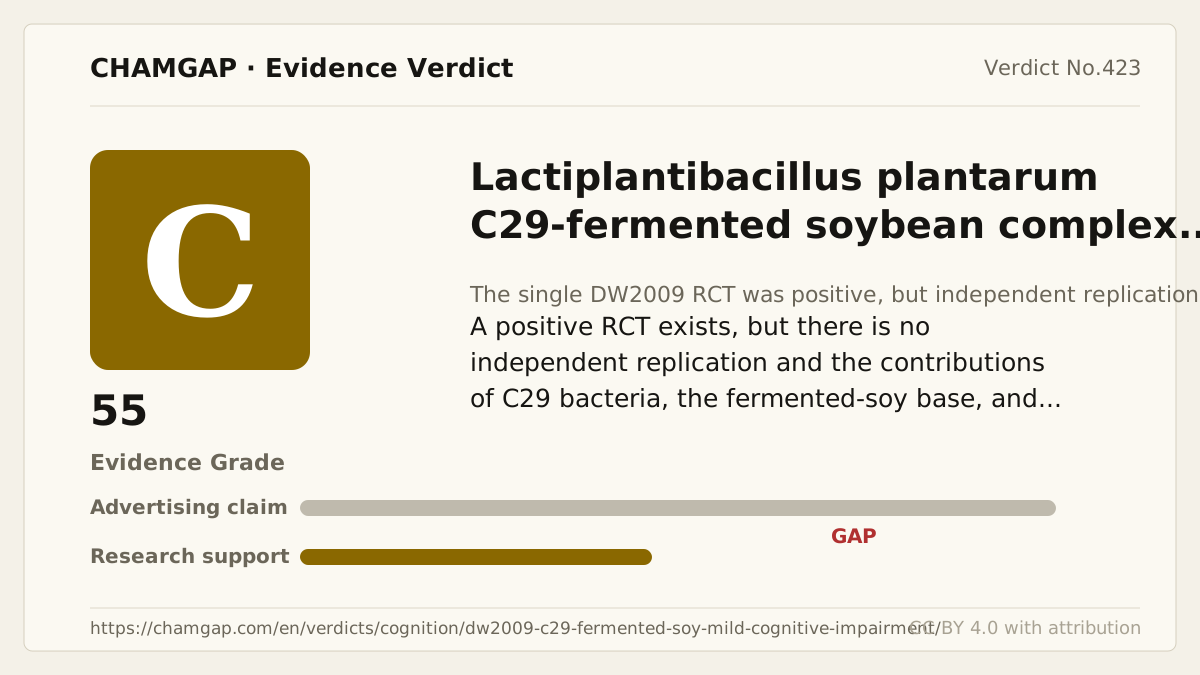
[Chamgap] DW2009 x memory and attention in mild cognitive impairment — Evidence Grade C·55. 2 cited sources checked. Source: https://chamgap.com/en/verdicts/cognition/dw2009-c29-fermented-soy-mild-cognitive-impairment/ · CC BY 4.0CC BY 4.0 — free to use with attribution; do not distort grades, numbers, or verdict meaning.
What this document does and does not do
Chamgap is an information source. It reports what research has and has not confirmed; it does not tell readers what to take or buy. That decision belongs to readers and, when needed, medical or legal professionals. This verdict reflects literature available up to the search date and may change as new research appears. Nothing here is medical advice.