
Combined vitamins B6, B12, and folate,
does it really help with Prevention of dementia and cognitive decline by lowering homocysteine?
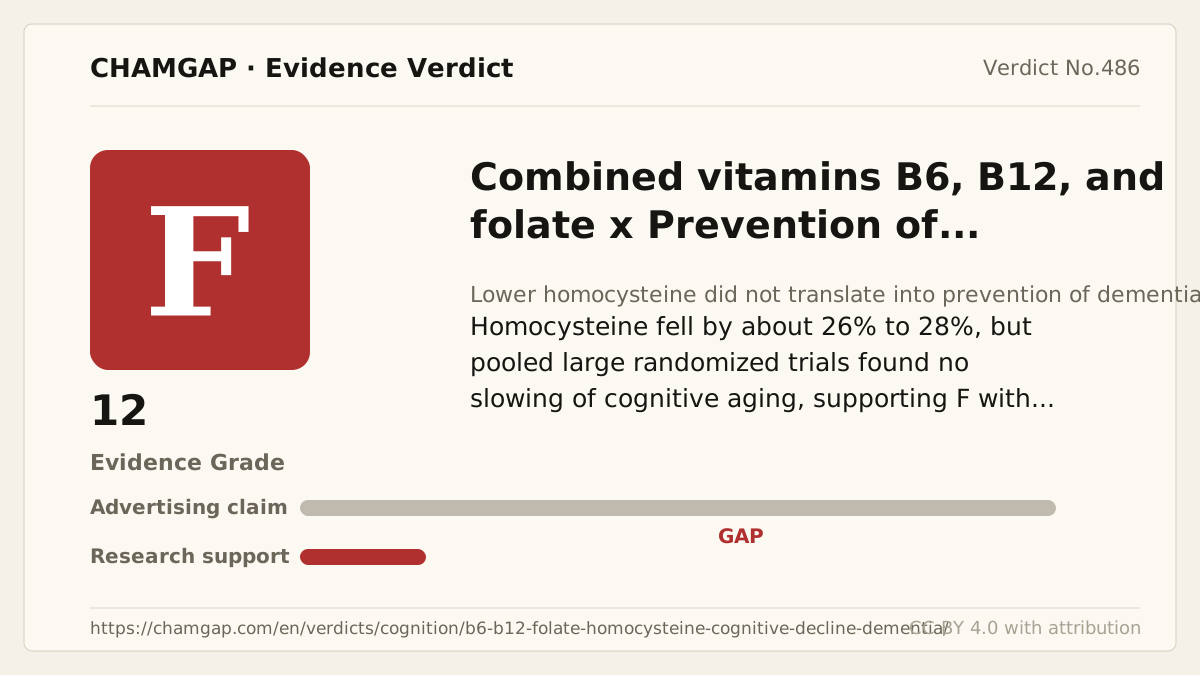
research showsVitamins B6, B12, and folate reliably lower blood homocysteine, but this change has not translated into prevention of dementia or overall cognitive decline. An individual-participant meta-analysis of 11 large trials involving about 22,000 people, together with meta-analyses of 19 and 31 randomized trials, repeatedly found no overall cognitive benefit, supporting F. Correction of deficiency and the brain-atrophy signal in a high-homocysteine mild-cognitive-impairment subgroup are separate questions.
ads claimMarketing links the claims that lowering homocysteine lowers dementia risk and that methylated vitamins preserve memory. A change in a risk factor or laboratory value does not automatically establish lower dementia incidence, better cognition, or preserved independent living.
Useful facts when choosing a product
- Products combining vitamins B6, B12, and folate are widely distributed in Korea, but this verdict concerns efficacy for preventing dementia and cognitive decline.
- VITACOG used folic acid 0.8 mg/day, vitamin B12 0.5 mg/day, and vitamin B6 20 mg/day for 24 months.
- The high doses and chemical forms used in trials may differ from marketed multivitamins, and doses used to correct deficiency are not the same as preventive supplementation.
- Long-term high-dose vitamin B6 can cause sensory neuropathy, and folic acid can mask hematologic signs of untreated vitamin B12 deficiency.
Chamgap Semantic Classification Code
Candidate index · review held
S.combined-vitamins-b6.UNK.dementia-and-cognitive-decline-by-lowering-homocysteine.prevent.placeboSupplements and nutraceuticals > Combined vitamins B6 > Unknown > dementia and cognitive decline by lowering homocysteine > Occurrence-prevention claim > Placebo
An automated migration candidate, not an issued permanent code; exact claim scope remains under review. This machine-generated migration candidate helps retrieval but is not a permanent assignment. The original verdict ID and URL remain authoritative.
What the research actually shows
The 2014 Clarke individual-participant meta-analysis pooled 11 large trials with about 22,000 participants followed for an average of 2.3 to 5 years. B vitamins lowered homocysteine by 26% to 28%, yet the cognitive-domain composite difference was 0.00, the global-cognition difference was -0.01, and cognitive aging was not slowed. The 2012 meta-analysis of 19 randomized trials and the 2019 meta-analysis of 31 randomized trials by Ford and Almeida also found no clear cognitive benefit. In the Kwok trial, 279 patients with mild cognitive impairment and high homocysteine had lower homocysteine after 24 months but no difference in the Clinical Dementia Rating Sum of Boxes, memory, or executive function. VITACOG, in contrast, reported less magnetic-resonance-imaging brain atrophy in 168 people with mild cognitive impairment, leaving a limited subgroup and surrogate hypothesis.
Why this is classified as F (12)
Homocysteine lowering is established, but the target claim is prevention of dementia and cognitive decline. An individual-participant meta-analysis of about 22,000 people, multiple randomized-trial meta-analyses, and a high-risk mild-cognitive-impairment trial repeatedly found no clinical cognitive benefit, supporting F with 12 points. The subgroup brain-atrophy signal and deficiency correction remain separate claims.
Counterpoint. The possibility of slower magnetic-resonance-imaging brain atrophy in mild cognitive impairment with high baseline homocysteine remains a target for confirmation. It does not establish dementia prevention in the general population or benefit from additional supplementation in people with adequate vitamin status.
Rejudgment record. New verdict — Separated homocysteine lowering from clinical cognitive outcomes and prioritized repeated null randomized evidence, including individual data from about 22,000 participants
Sub-claim grades by effect
This ingredient is marketed for several effects. A single overall grade blends strong and weak claims together, so each effect is graded separately here. The overall grade reflects the strongest disconfirming or core claim.
| Effect (sub-claim) | Grade | Basis |
|---|---|---|
| Lowering blood homocysteine | C | Multiple large randomized trials consistently confirmed a biochemical reduction of about 26% to 28%, but the rating is capped at C because this is a surrogate rather than a clinical outcome. |
| Prevention of overall cognitive decline and cognitive aging | F | In an IPD meta-analysis of 11 trials (~22,000 people) homocysteine fell 26-28%, but overall cognition differed by z=-0.01 and cognitive aging by 0.02 years/year (null); a 31-trial synthesis and high-homocysteine elderly trials were also repeatedly null. |
| Prevention of dementia incidence itself | ? | Most trials measured cognitive scores or MCI and did not directly measure dementia incidence as a primary endpoint. |
| Slowing brain atrophy in mild cognitive impairment with high homocysteine | C | This is a magnetic-resonance-imaging surrogate signal from the 168-person VITACOG trial, not confirmation of dementia prevention or preserved function. |
Cross-check — AI research and Codex final gate
Evidence Table
| Study | Design | Sample | Funding | Endpoint | Result | Weight |
|---|---|---|---|---|---|---|
| Clarke R et al. 2014 | Individual-participant-data meta-analysis of randomized trials | 22,000 | Predominantly public and nonprofit support | Homocysteine, memory, processing speed, executive function, global cognition, and cognitive aging | Homocysteine fell by 26% to 28%, but there was no significant effect on domain-specific or global cognition or cognitive aging. | Decisive |
| Ford AH, Almeida OP. 2012 and 2019 | Systematic reviews and meta-analyses of randomized placebo-controlled trials | 31 | Unknown or mixed | Cognitive function and cognitive decline | No clear cognitive benefit from homocysteine-lowering B vitamins was found in people with or without cognitive impairment. | Key, repeated |
| Kwok T et al. 2020 | Randomized double-blind placebo-controlled trial | 279 | Hong Kong public research support | Clinical Dementia Rating Sum of Boxes, memory, executive function, and homocysteine | Homocysteine fell over 24 months, but the primary Clinical Dementia Rating Sum of Boxes and cognitive secondary outcomes did not differ. | Direct contradiction in a high-risk group |
| Smith AD et al. 2010 | Randomized double-blind placebo-controlled trial | 168 | Public and nonprofit support with vitamins supplied | Two-year whole-brain atrophy rate on magnetic resonance imaging | Brain atrophy was slower with B vitamins, but this was an imaging surrogate rather than a dementia-incidence trial. | Limited counterevidence |
Receipt — 5 References
All 5 cited sources were verified for existence at the original page (as of 2026-07-18).
Final verification and publication gate: Codex · Evidence date: 2026-07-18 · Corrections: none
Cite this verdict
[Chamgap] Combined vitamins B6, B12, and folate x prevention of dementia and cognitive decline through homocysteine lowering — Evidence Grade F·12. 5 cited sources checked. Source: https://chamgap.com/en/verdicts/cognition/b6-b12-folate-homocysteine-cognitive-decline-dementia/ · CC BY 4.0CC BY 4.0 — free to use with attribution; do not distort grades, numbers, or verdict meaning.
What this document does and does not do
Chamgap is an information source. It reports what research has and has not confirmed; it does not tell readers what to take or buy. That decision belongs to readers and, when needed, medical or legal professionals. This verdict reflects literature available up to the search date and may change as new research appears. Nothing here is medical advice.