
Apoaequorin, Prevagen,
does it really help with Improvement in age-related memory decline and cognitive function?
research showsThe pivotal Madison Memory Study was a 218-person, ninety-day randomized trial, but the full study population showed no significant advantage over placebo on any of nine computerized cognitive tasks. Advertising and a later paper emphasized selected positives from more than thirty post hoc subgroup comparisons. In 2024, a United States federal court confirmed that the jury found no competent and reliable scientific evidence for all eight challenged memory and cognition claims and ordered their nationwide cessation, supporting F.
ads claimAdvertising claimed clinically proven memory improvement, benefit within ninety days, and relief of age-related memory problems. These messages highlighted selected post hoc subgroups after a null overall result, and the court found that the same eight claims lacked competent and reliable scientific support.
Useful facts when choosing a product
- Prevagen is not a Korean over-the-counter medicine; Korean consumers can encounter imported Regular Strength 10-mg and Extra Strength 20-mg products through cross-border retailers.
- The Madison Memory Study used apoaequorin 10 mg/day for ninety days. Regular finished products also contain vitamin D3, so product-level and ingredient-level attribution should be distinguished.
- Apoaequorin is a recombinant form of a jellyfish calcium-binding protein, and no human pharmacokinetic evidence shows that intact oral protein reaches the brain.
- The ninety-day trial reported good short-term tolerability, but independent long-term safety, drug interactions, pregnancy and lactation, and evidence in older adults taking multiple medicines are insufficient, leaving safety unknown.
Chamgap Semantic Classification Code
Candidate index · review held
UNK.apoaequorin.UNK.age-related-memory-decline-and-cognitive-function.improve.placeboUnknown > Apoaequorin > Unknown > age-related memory decline and cognitive function > Improvement claim > Placebo
An automated migration candidate, not an issued permanent code; exact claim scope remains under review. This machine-generated migration candidate helps retrieval but is not a permanent assignment. The original verdict ID and URL remain authoritative.
What the research actually shows
The Madison Memory Study randomized 218 community-dwelling adults with self-reported memory concerns to apoaequorin 10 mg or placebo and assessed nine computerized cognitive tasks over ninety days. According to the Federal Trade Commission complaint and federal court record, none was significant in the full population. Investigators performed more than thirty post hoc analyses, with only selected tasks in small subgroups positive. The 2016 Moran paper claimed improvements in verbal learning and recall from these data, but included manufacturer founders or affiliates and was not independent. No human evidence shows that intact oral apoaequorin crosses the blood-brain barrier, while the manufacturer's safety studies showed rapid digestion in the stomach like other dietary proteins. In 2024, the United States District Court for the Southern District of New York ordered cessation of advertising that claimed better memory, improvement within ninety days, reduced age-related memory problems, or other cognitive benefits.
Why this is classified as F (5)
All nine cognitive tasks were null in the full population of the only pivotal trial, and positive claims rely on manufacturer post hoc subgroups. The 2024 jury and court also found no scientific support for eight memory and cognition advertising claims, resulting in F with 5 points under repeated-refutation and regulatory-rejection criteria.
Counterpoint. Reassessment would be possible if an independent team reproduced a clinically meaningful effect using preregistered standard cognitive tests. No such confirmation currently exists beyond post hoc signals from the manufacturer trial.
Rejudgment record. New verdict — Prioritized null results across all nine tasks in the full population and the 2024 court finding of absent scientific support over manufacturer post hoc subgroups
Sub-claim grades by effect
This ingredient is marketed for several effects. A single overall grade blends strong and weak claims together, so each effect is graded separately here. The overall grade reflects the strongest disconfirming or core claim.
| Effect (sub-claim) | Grade | Basis |
|---|---|---|
| Improvement in age-related memory decline | F | Memory and learning tasks were null in the full population, and the court found no scientific support for the related advertising claims. |
| Improvement in overall cognitive function | F | All nine computerized cognitive tasks were null, with no independent replication. |
Cross-check — AI research and Codex final gate
Evidence Table
| Study | Design | Sample | Funding | Endpoint | Result | Weight |
|---|---|---|---|---|---|---|
| Madison Memory Study; Moran DL et al. 2016 | Manufacturer randomized double-blind placebo-controlled trial | 90 | Quincy Bioscience manufacturer study with author conflicts | Nine computerized cognitive tasks, verbal learning, and delayed recall | All nine tasks were null in the full population; published positives came from selected findings among more than thirty post hoc subgroup comparisons. | Decisive direct null evidence |
| FTC and State of New York v. Quincy Bioscience, 2017-2024 | Regulatory litigation, jury verdict, and federal judgment | 8 | Public enforcement by the United States Federal Trade Commission and New York State | Scientific support for eight claims about memory, ninety-day effects, age-related memory problems, and other cognitive benefits | The jury found that none of the eight claims had competent and reliable scientific support, and the court ordered nationwide cessation. | Decisive regulatory and judicial evidence |
| Spence J et al. 2017 | Clinical pharmacy review | Unknown | Cognitive efficacy and safety | Concluded that meaningful evidence for apoaequorin efficacy was lacking. | Independent supportive evidence |
Receipt — 4 References
All 4 cited sources were verified for existence at the original page (as of 2026-07-18).
Final verification and publication gate: Codex · Evidence date: 2026-07-18 · Corrections: none
Cite this verdict
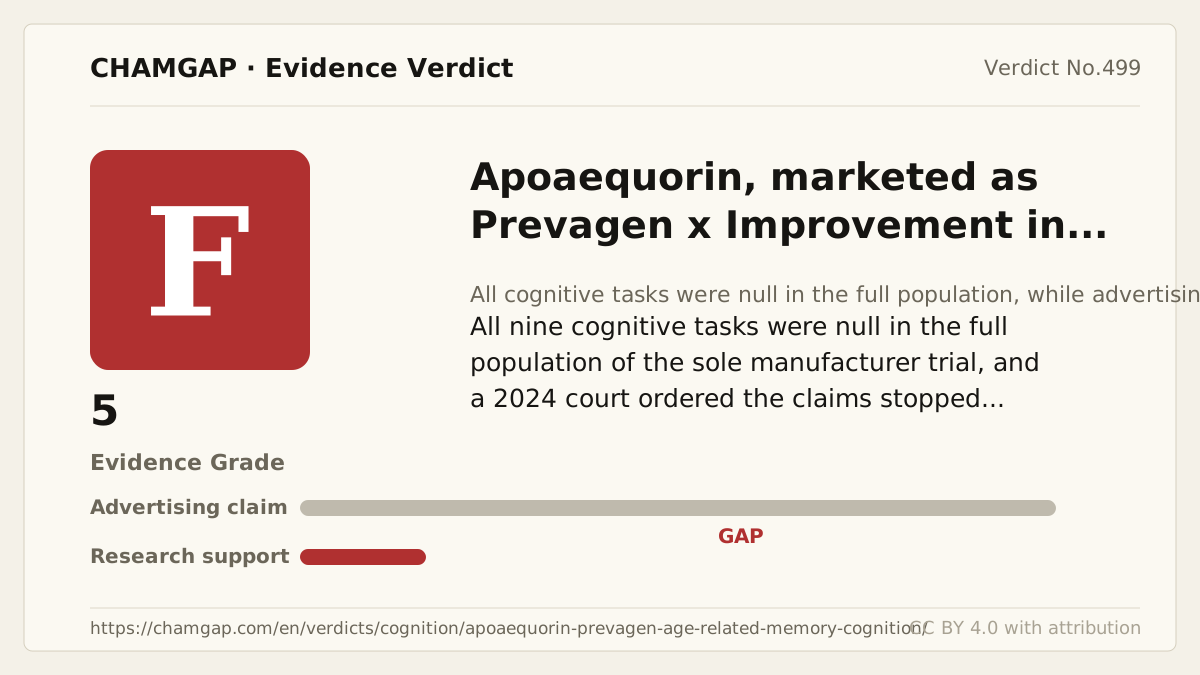
[Chamgap] Apoaequorin, Prevagen x age-related memory decline and cognitive function — Evidence Grade F·5. 4 cited sources checked. Source: https://chamgap.com/en/verdicts/cognition/apoaequorin-prevagen-age-related-memory-cognition/ · CC BY 4.0CC BY 4.0 — free to use with attribution; do not distort grades, numbers, or verdict meaning.
What this document does and does not do
Chamgap is an information source. It reports what research has and has not confirmed; it does not tell readers what to take or buy. That decision belongs to readers and, when needed, medical or legal professionals. This verdict reflects literature available up to the search date and may change as new research appears. Nothing here is medical advice.