
Evening primrose seed extract,
does it really help with Attenuation of postprandial blood-glucose rise?
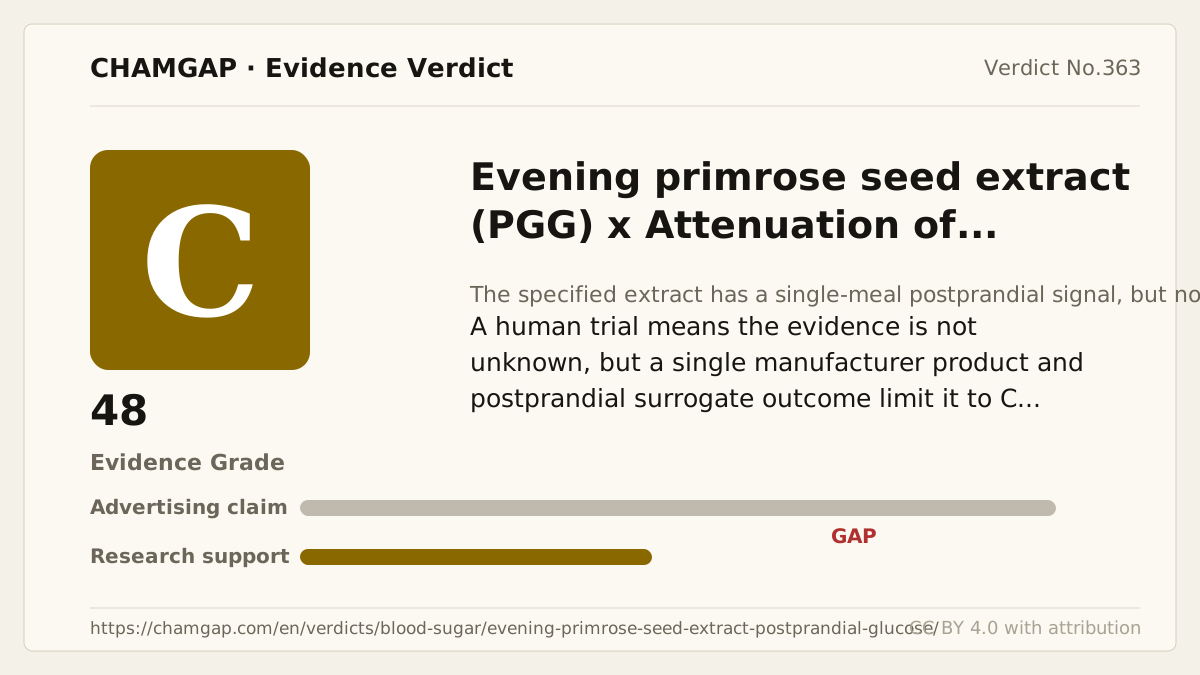
research showsA small single-dose crossover study of an ethanolic extract from defatted evening primrose seeds reported lower post-rice blood glucose and insulin excursions in 16 healthy participants and 18 participants with borderline or mild diabetes. The rating is C because published support is concentrated in one manufacturer-linked extract, a single-dose surrogate outcome, and lacks independent replication or long-term HbA1c and complication outcomes.
ads claimMarketing can claim that PGG blocks sugar, solves glucose spikes, or prevents diabetes. Published human evidence concerns a single-meal curve for a specific seed extract. PGG is a specification marker and is not the gamma-linolenic acid found in evening primrose seed oil.
Useful facts when choosing a product
- Korean health-functional-food products are formulated to provide 4 to 8.4 mg PGG daily under the regulatory specification, while tablet mass and additional ingredients vary.
- Evening primrose seed extract is a polyphenol-rich ethanolic extract of defatted seeds and is different from evening primrose oil or GLA products.
- The published human trial used 200 mg of extract once, so matching only the marketed PGG amount does not prove full equivalence to the study product.
- People using glucose-lowering medication should discuss possible additive glucose reduction with a clinician, and long-term and pregnancy or lactation safety data are limited.
Chamgap Semantic Classification Code
Candidate index · review held
S.evening-primrose-seed-extract.UNK.attenuation-of-postprandial-blood-glucose-rise.reduce.placeboSupplements and nutraceuticals > Evening primrose seed extract > Unknown > Attenuation of postprandial blood-glucose rise > Reduction claim > Placebo
An automated migration candidate, not an issued permanent code; exact claim scope remains under review. This machine-generated migration candidate helps retrieval but is not a permanent assignment. The original verdict ID and URL remain authoritative.
What the research actually shows
The Aitani 2003 human study used a crossover design in 16 healthy participants and 18 participants with borderline or mild diabetes, administering 200 mg extract or placebo with 200 g cooked rice and reporting lower postprandial glucose and insulin. A mechanistic paper from the same research network reported in-vitro alpha-glucosidase inhibition and rat starch-load results, which are not human clinical outcomes. The current Korean notified specification describes ethanol extraction after defatting, at least 20 mg/g PGG, a daily PGG intake of 4 to 8.4 mg, and a postprandial-glucose function.
Why this is classified as C (48)
A small single-dose human crossover trial means the evidence is not unknown, but positive support is limited to one manufacturer-linked extract and postprandial glucose and insulin surrogates. Lack of independent repetition and long-term clinical outcomes yields C with 48 points.
Counterpoint. A short-term signal for attenuating postprandial glucose with the specified extract exists, so the claim is not entirely unsupported.
Rejudgment record. Reassessment (cross-check reflected) — A positive small single-dose postprandial surrogate trial of one manufacturer-linked extract; regulatory status was not treated as independent replication
Cross-check — AI research and Codex final gate
Evidence Table
| Study | Design | Sample | Funding | Endpoint | Result | Weight |
|---|---|---|---|---|---|---|
| Aitani M et al. 2003 human study | Randomized single-dose crossover trial | 18 | Manufacturer investigators including Oryza Oil and Fat Chemical | Post-rice blood glucose and insulin curves | Selected reductions in postprandial glucose and insulin excursions with 200 mg extract. | Key; single manufacturer |
| Aitani M et al. 2003 mechanism study | In-vitro and rat starch-load preclinical study | Investigators from Oryza Oil and Fat Chemical and Otsuka | Alpha-glucosidase inhibition and rat blood glucose | Enzyme inhibition and rat postprandial-glucose signals from polyphenol fractions; not a human outcome. | Mechanistic support | |
| MFDS notified standard 2-15 | Regulatory ingredient specification | Ministry of Food and Drug Safety, Republic of Korea | PGG specification, daily intake, and functional wording | Specifies at least 20 mg/g PGG, 4 to 8.4 mg daily, and a postprandial-glucose function. | Specification; not proof of efficacy |
Receipt — 3 References
All 3 cited sources were verified for existence at the original page (as of 2026-07-16).
Final verification and publication gate: Codex · Evidence date: 2026-07-16 · Corrections: none
Cite this verdict
[Chamgap] Evening primrose seed extract (PGG) x postprandial blood glucose — Evidence Grade C·48. 3 cited sources checked. Source: https://chamgap.com/en/verdicts/blood-sugar/evening-primrose-seed-extract-postprandial-glucose/ · CC BY 4.0CC BY 4.0 — free to use with attribution; do not distort grades, numbers, or verdict meaning.
What this document does and does not do
Chamgap is an information source. It reports what research has and has not confirmed; it does not tell readers what to take or buy. That decision belongs to readers and, when needed, medical or legal professionals. This verdict reflects literature available up to the search date and may change as new research appears. Nothing here is medical advice.