
D-pinitol,
does it really help with Insulin sensitivity and fasting and postprandial blood glucose?
research showsAn overall D was too low because human RCTs exist and conflict. A 13-week trial of 1.2 g/day in 30 people with type 2 diabetes reported improvements in fasting glucose, HbA1c, and HOMA-IR, whereas a 22-person clamp trial and a 15-person trial were null for insulin sensitivity, and acute postprandial signals were limited. Small samples, metabolic surrogate endpoints, and no large confirmatory trial support C.
ads claimMarketing turns structural similarity to D-chiro-inositol, insulin signaling, GLUT4, plant origin, and patents into claims of improved insulin resistance or diabetes management. Absorption and mechanism do not override null human clamp findings.
Useful facts when choosing a product
- The former Korean individually recognized pinitol powder No. 2014-65 used 1.2 g/day, but its recognition was withdrawn in 2019 after low-tier ingredients with insufficient human testing lost effect.
- The positive longer diabetes trial used 1.2 g/day, while repeated null trials used about 20 mg/kg/day or 2 g/day.
- The acute postprandial signal occurred at up to a 6 g single dose, which is not equivalent to the former Korean recognized intake.
- Long-term safety and evidence in pregnancy, lactation, liver or kidney disease, and combination with glucose-lowering drugs are insufficient; it should not replace medication.
Chamgap Semantic Classification Code
Candidate index · review held
UNK.d-pinitol.UNK.insulin-sensitivity-and-fasting-and-postprandial-blood-glucose.assess.placeboUnknown > D-pinitol > Unknown > Insulin sensitivity and fasting and postprandial blood glucose > Association or change assessment > Placebo
An automated migration candidate, not an issued permanent code; exact claim scope remains under review. This machine-generated migration candidate helps retrieval but is not a permanent assignment. The original verdict ID and URL remain authoritative.
What the research actually shows
Kim 2005 gave 30 people with type 2 diabetes 600 mg of D-pinitol twice daily for 13 weeks and reported improvements in fasting glucose, HbA1c, and HOMA-IR. In contrast, the 22-person insulin-resistance clamp RCT by Davis in 2000 found no difference in glucose production or disposal, and the six-week trial in 15 older nondiabetic adults by Campbell in 2004 was null for sensitivity and receptor endpoints. Acute postprandial studies with 15 and 30 participants found limited signals, but these were single-dose metabolic surrogates.
Why this is classified as C (44)
A positive 30-person, 13-week glycemic-control trial conflicts with null 22-person clamp and 15-person sensitivity studies. Existing human RCTs make D too low, but small surrogate studies and no large confirmation support C with 44 points.
Counterpoint. Replacement of standard diabetes care and reduction of clinical events are unproven, and the insulin-sensitivity subclaim remains D.
Rejudgment record. Reassessment (cross-check reflected) — A positive 30-person, 13-week trial at 1.2 g/day conflicts with null 22-person clamp and 15-person sensitivity studies; evidence is limited to small metabolic-surrogate trials without large confirmation
Sub-claim grades by effect
This ingredient is marketed for several effects. A single overall grade blends strong and weak claims together, so each effect is graded separately here. The overall grade reflects the strongest disconfirming or core claim.
| Effect (sub-claim) | Grade | Basis |
|---|---|---|
| Improved insulin sensitivity | D | Null clamp study in 22 participants and null study in 15 participants |
| Long-term glycemic control and postprandial glucose | C | Conflicting positive 30-person trial with small samples |
Cross-check — AI research and Codex final gate
Evidence Table
| Study | Design | Sample | Funding | Endpoint | Result | Weight |
|---|---|---|---|---|---|---|
| Davis A et al. 2000 | Randomized double-blind placebo-controlled clamp trial | 22 | One author reported pharmaceutical research support | Hyperinsulinemic-euglycemic clamp, basal glucose production, and glucose disposal | Plasma pinitol and D-chiro-inositol increased, but insulin sensitivity did not improve. | Key opposing |
| Campbell WW et al. 2004 | Randomized placebo-controlled six-week trial | 15 | Academic research | Fasting and oral or intravenous glucose challenge, hepatic and whole-body sensitivity, and muscle receptor activation | Two grams/day did not affect glucose, insulin sensitivity, or muscle insulin-receptor activation. | Key opposing |
| Kim JI et al. 2005 | Randomized double-blind placebo-controlled trial | 30 | Korean Ministry of Health and Welfare grant | Fasting glucose, HbA1c, insulin, and HOMA-IR | Reported improvement in several glycemic markers after 1.2 g/day for 13 weeks, but this was one small trial. | Supportive positive |
| Hernandez-Mijares A et al. 2013 | Acute crossover controlled trial | 30 | Fruit Up product used; possible industry linkage | 240-minute postprandial glucose, insulin, and plasma pinitol | A single 6 g dose lowered early glucose and insulin; lower doses and durable effects were not established. | Supportive |
Receipt — 4 References
All 4 cited sources were verified for existence at the original page (as of 2026-07-17).
Final verification and publication gate: Codex · Evidence date: 2026-07-17 · Corrections: none
Cite this verdict
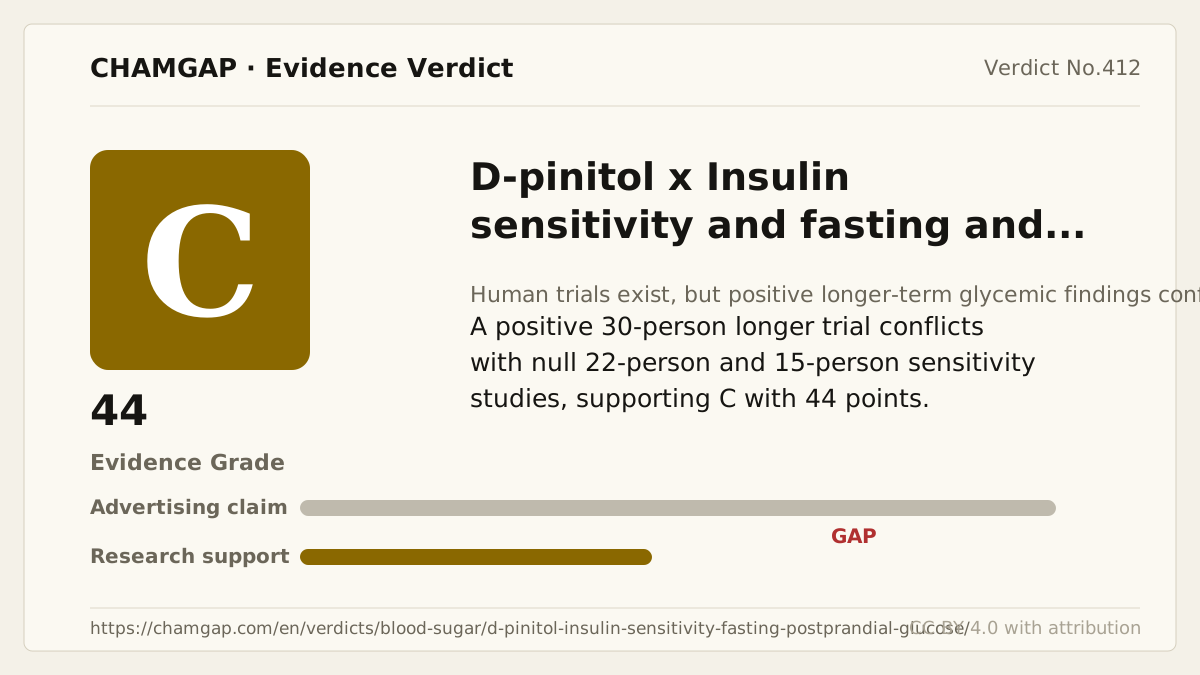
[Chamgap] D-pinitol x insulin sensitivity and fasting and postprandial blood glucose — Evidence Grade C·44. 4 cited sources checked. Source: https://chamgap.com/en/verdicts/blood-sugar/d-pinitol-insulin-sensitivity-fasting-postprandial-glucose/ · CC BY 4.0CC BY 4.0 — free to use with attribution; do not distort grades, numbers, or verdict meaning.
What this document does and does not do
Chamgap is an information source. It reports what research has and has not confirmed; it does not tell readers what to take or buy. That decision belongs to readers and, when needed, medical or legal professionals. This verdict reflects literature available up to the search date and may change as new research appears. Nothing here is medical advice.