
Spermidine,
does it really help with Aging, autophagy, and cognition?
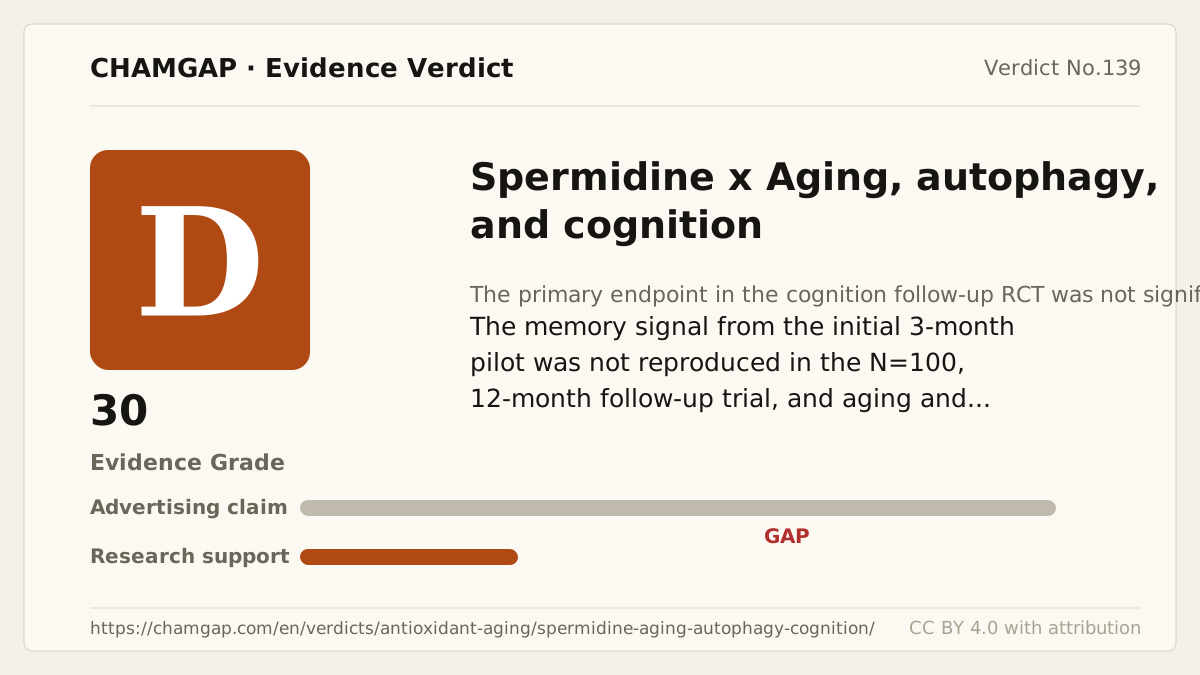
research showsThe cognition claim is graded D because the primary memory endpoint in the 12-month SmartAge phase 2b trial was not significant versus placebo. The aging and autophagy claims rest mainly on mouse preclinical studies and dietary observational research, and oral supplementation has not been shown to raise circulating spermidine; clinical efficacy has not been established. Safety is classified as Caution because long-term high-dose data are limited.
ads claimProducts emphasize 'autophagy,' 'longevity,' 'anti-aging,' 'cellular cleanup,' and 'memory.' Among these, autophagy is a mechanistic or surrogate-marker expression, while anti-aging requires long-term clinical endpoints.
Useful facts when choosing a product
- Supplement ingredients are often food-extract forms such as wheat-germ extract.
- Spermidine content in foods and standardized capsule content can differ.
- Autophagy markers are not direct evidence of clinical aging delay.
- Long-term safety data for high-content supplementation are limited.
Chamgap Semantic Classification Code
Candidate index · review held
S.spermidine.UNK.aging-autophagy-and-cognition.assess.placeboSupplements and nutraceuticals > Spermidine > Unknown > Aging, autophagy, and cognition > Association or change assessment > Placebo
An automated migration candidate, not an issued permanent code; exact claim scope remains under review. This machine-generated migration candidate helps retrieval but is not a permanent assignment. The original verdict ID and URL remain authoritative.
What the research actually shows
Schwarz 2022 SmartAge phase 2b (PMID 35616942) randomized 100 older adults with subjective cognitive decline to wheat-germ-extract spermidine 0.9 mg/day (a mixture also containing spermine and putrescine) or placebo for 12 months. The between-group difference in primary mnemonic discrimination was −0.03 (95% CI −0.11 to 0.05, P=.47), and most secondary endpoints were also not significant. The Wirth 2018 phase 2a pilot (PMID 30388439) reported a memory signal in N=30 over 3 months, but it was not reproduced in the subsequent phase 2b trial. Both SmartAge studies included ingredient or manufacturer-related ties. Senekowitsch 2023 (PMID 37111071), a triple-blind crossover trial in 12 healthy adults, administered 15 mg/day for 5 days and did not detect an increase in plasma or salivary spermidine; Keohane 2024 (PMID 39405978) reported that high-purity spermidine 40 mg/day produced only minimal changes in circulating polyamines in older men. The Alsaleh 2026 vaccine pilot (PMID 42169618), N=40 at 6 mg/day for 13 weeks, reported signals in a nonresponder subgroup and immune surrogate markers, but the nonresponder counts were imbalanced at 8 versus 2. Félix 2024 (PMID 39594533) randomized 41 people and analyzed 35 using a combination of AM3, spermidine, and hesperidin, reporting a change in Immunity Clock-based 'biological age'; it therefore cannot isolate spermidine's effect or clinical aging delay. Eisenberg 2016 (PMID 27841876) is preclinical mouse lifespan and cardiovascular evidence, while Kiechl 2018 (PMID 29955838) is an N=829 dietary observational study that reported a mortality HR of 0.76 (95% CI 0.67 to 0.86). POLYCAD (PMID 41168834) is a trial protocol with no results.
Why this is classified as D (30)
Methodology ②-b does not support upgrading when a small, initially positive, manufacturer-linked result is not independently reproduced, and methodology ② directly incorporates a null primary endpoint in a larger follow-up trial. Cognition is therefore D. Aging and autophagy are also D because the evidence consists of mouse preclinical data, dietary observation, and mechanistic, immune, or biological-age surrogate markers without established clinical efficacy. Autophagy mechanism surrogate markers alone could allow at most C, but these data do not establish clinical efficacy. Because real human RCTs exist, ? does not apply.
Counterpoint. Signals from the initial pilot, animal studies, and dietary observation support a hypothesis, but they do not replace the null 12-month cognition RCT and supplement pharmacokinetic data.
Rejudgment record. Reassessment (?→D) — Applied methodology ②-b for failure to independently reproduce an initially positive small manufacturer-linked study and ② for a null primary endpoint in the larger follow-up; cognition D, aging and autophagy D
Sub-claim grades by effect
This ingredient is marketed for several effects. A single overall grade blends strong and weak claims together, so each effect is graded separately here. The overall grade reflects the strongest disconfirming or core claim.
| Effect (sub-claim) | Grade | Basis |
|---|---|---|
| Cognition | D | SmartAge (N=100, 12 months, phase 2b) primary cognitive endpoint null (P=.47) |
| Aging/autophagy | D | Only mouse preclinical and dietary observation; oral intake does not even raise blood levels |
Cross-check — AI research and Codex final gate
Evidence Table
| Study | Design | Sample | Funding | Endpoint | Result | Weight |
|---|---|---|---|---|---|---|
| Schwarz C et al. 2022 SmartAge phase 2b (PMID 35616942) | 12-month randomized double-masked placebo-controlled phase 2b trial | 100 | German Federal Ministry of Education and Research support; wheat-germ-extract study product and ingredient-related ties | Primary mnemonic discrimination; cognitive, behavioral, and physiological secondary endpoints | For spermidine 0.9 mg/day versus placebo, the primary between-group difference was −0.03 (95% CI −0.11 to 0.05, P=.47); most secondary endpoints were null. | Core; null follow-up |
| Wirth M et al. 2018 SmartAge phase 2a (PMID 30388439) | 3-month randomized double-blind placebo-controlled pilot | 30 | Public support and study-ingredient-related ties | Memory performance and mnemonic discrimination | Reported a moderate memory signal that was not reproduced on the primary endpoint of the N=100, 12-month follow-up trial. | Initial signal |
| Senekowitsch S et al. 2023 (PMID 37111071) | Randomized placebo-controlled triple-blind crossover pharmacokinetic trial | 12 | University and public research support | Plasma and salivary spermidine, spermine, and putrescine | Fifteen mg/day for 5 days did not significantly increase plasma or salivary spermidine; plasma spermine increased. | Pharmacokinetic |
| Keohane P et al. 2024 (PMID 39405978) | Exploratory double-blind randomized placebo-controlled trial | Sponsored by Chrysea Labs | Circulating polyamines in serum and urine | High-purity spermidine 40 mg/day produced only minimal changes in circulating polyamines. | Pharmacokinetic; manufacturer-sponsored | |
| Alsaleh G et al. 2026 (PMID 42169618) | 13-week double-blind randomized placebo-controlled vaccine pilot | 40 | Academic research support; wheat-germ-extract study product used | Vaccine immune response and immune-cell senescence surrogate markers | At 6 mg/day, signals appeared in a nonresponder subgroup and immune surrogates; nonresponders were imbalanced at 8 versus 2. | Exploratory subgroup and surrogate markers |
| Félix J et al. 2024 (PMID 39594533) | 2-month randomized double-blind placebo-controlled combination trial | 35 | Universidad Complutense de Madrid research support; AM3, spermidine, and hesperidin combination | Immunity Clock-based biological age and immune and oxidative-inflammatory surrogate markers | Reported surrogate-marker changes with the combination, but the effect of spermidine alone cannot be isolated. | Combination and surrogate markers |
| Eisenberg T et al. 2016 (PMID 27841876) | Primarily mouse preclinical study | Public and academic research support | Autophagy, cardiovascular function, and lifespan | Reported lifespan and cardiovascular signals in mice, not clinical efficacy of a human supplement. | Preclinical | |
| Kiechl S et al. 2018 (PMID 29955838) | Prospective community-based dietary observational study | 829 | Public and academic research support | Dietary spermidine intake and all-cause mortality | Multivariable-adjusted HR 0.76 (95% CI 0.67 to 0.86); as an observational study, it cannot isolate a causal supplement effect. | Observational |
Receipt — 8 References
All 8 cited sources were verified for existence at the original page (as of 2026-07-11).
Final verification and publication gate: Codex · Evidence date: 2026-07-11 · Corrections: 1
Correction log — 1
Corrections applied to this verdict, in chronological order. Changes are logged, not erased.
- 2026-07-11 · Re-adjudication (grade changed) — The previous 'judgment deferred (?)' treated the SmartAge cognition RCT as exploratory/small, but it was an N=100, 12-month phase 2b trial (Schwarz 2022, PMID 35616942) whose primary cognitive endpoint was null. Because a human RCT exists and was null, this is D, not '?'. The citation's ClinicalTrials search link and author misattribution were replaced with the actual papers. Found in the 2026-07-11 internal audit. (grade ?→D)
Cite this verdict
[Chamgap] Spermidine × Aging, Autophagy, and Cognition — Evidence Grade D·30. 8 cited sources checked. Source: https://chamgap.com/en/verdicts/antioxidant-aging/spermidine-aging-autophagy-cognition/ · CC BY 4.0CC BY 4.0 — free to use with attribution; do not distort grades, numbers, or verdict meaning.
What this document does and does not do
Chamgap is an information source. It reports what research has and has not confirmed; it does not tell readers what to take or buy. That decision belongs to readers and, when needed, medical or legal professionals. This verdict reflects literature available up to the search date and may change as new research appears. Nothing here is medical advice.