
Pentadecanoic acid C15:0,
does it really help with Reversal of cellular aging and extension of healthspan?
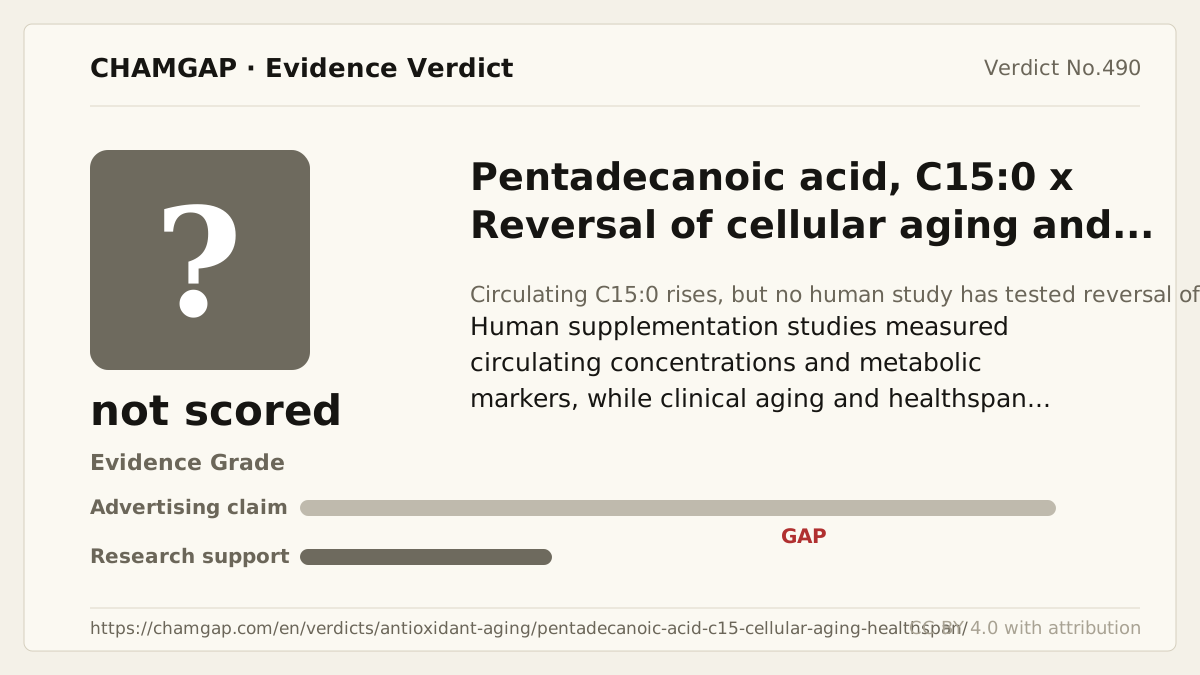
research showsHuman supplementation studies of pentadecanoic acid exist, but none tested reversal of aging, biological age, healthspan, or lifespan. A 30-person, 12-week randomized trial used circulating C15:0 as its primary endpoint, and selected liver-enzyme findings came from a post hoc analysis according to achieved concentrations. Longevity claims depend on cell-comparison studies with commercial conflicts and observational research, so the target efficacy is rated unknown.
ads claimFatty15 marketing links stronger cell membranes, slower aging at the cellular level, and healthier aging to reversal of aging in people. Overlapping anti-inflammatory or antifibrotic responses in cultured cells do not establish lower biological age, better function, disease-free survival, or longer lifespan in humans.
Useful facts when choosing a product
- The verifiable Fatty15 label lists 100 mg of purified C15:0 per capsule and one capsule daily. No formally authorized Korean functional claim was identified, and consumers may encounter it as an imported product.
- The direct human randomized trial used purified free-fatty-acid C15:0 at 200 mg/day for 12 weeks, twice the marketed label dose.
- C15:0 occurs in trace amounts in dairy fat, ruminant meat, and selected fish and plants, but observational food-intake research is not equivalent to efficacy of a purified supplement.
- No serious adverse event occurred in the 30-person, 12-week trial, but long-term high-dose safety and evidence in pregnancy, lactation, children, and people with liver or lipid disorders are insufficient.
Chamgap Semantic Classification Code
Candidate index · review held
UNK.pentadecanoic-acid.UNK.reversal-of-cellular-aging-and-extension-of-healthspan.assess.placeboUnknown > Pentadecanoic acid > Unknown > Reversal of cellular aging and extension of healthspan > Association or change assessment > Placebo
An automated migration candidate, not an issued permanent code; exact claim scope remains under review. This machine-generated migration candidate helps retrieval but is not a permanent assignment. The original verdict ID and URL remain authoritative.
What the research actually shows
The 2024 Robinson trial assigned 30 young adults with overweight or obesity in a two-to-one ratio to C15:0 at 200 mg/day or placebo for 12 weeks. Circulating C15:0 increased by 1.88 micrograms per milliliter more than placebo, but aging markers and healthspan were not measured. Differences in alanine aminotransferase, aspartate aminotransferase, and hemoglobin among participants who exceeded 5 micrograms per milliliter after treatment came from stratification by achieved concentration rather than the primary randomized comparison. The 88-person TANGO trial evaluated diet, C15:0, fatty liver, and metabolic markers, not aging. The 2023 Venn-Watson study compared overlapping cultured-cell responses to C15:0, rapamycin, metformin, and acarbose, and its authors were founders, employees, or consultants of companies commercializing C15:0. Observational associations between circulating C15:0 and cardiovascular disease remain vulnerable to dietary and metabolic confounding.
Why this is classified as ?
Human evidence for higher circulating C15:0 and selected metabolic markers can be separated as a C-level subclaim. The target claims of aging reversal and longer healthspan have no human efficacy literature measuring those outcomes and rely on cell and observational data, resulting in an unknown grade and null score.
Counterpoint. Short-term bioavailability and tolerability at 200 mg/day provide a starting point for a long-term aging trial. Independent trials need prespecified validated aging biomarkers, physical function, disease incidence, and survival.
Rejudgment record. New verdict — Separated supplementation studies of circulating and metabolic markers from clinical aging and healthspan outcomes and applied an unknown grade because target human efficacy literature is absent
Sub-claim grades by effect
This ingredient is marketed for several effects. A single overall grade blends strong and weak claims together, so each effect is graded separately here. The overall grade reflects the strongest disconfirming or core claim.
| Effect (sub-claim) | Grade | Basis |
|---|---|---|
| Reversal of cellular aging or reduction of biological age | ? | No human supplementation efficacy literature measuring a validated aging endpoint was identified. |
| Extension of healthspan or lifespan | ? | No supplementation trial evaluated human function, disease-free survival, or mortality. |
| Changes in circulating C15:0 and selected short-term metabolic markers | C | A 30-person, 12-week randomized trial and an 88-person fatty-liver dietary trial exist, but they are limited by size, surrogate outcomes, and product support. |
Cross-check — AI research and Codex final gate
Evidence Table
| Study | Design | Sample | Funding | Endpoint | Result | Weight |
|---|---|---|---|---|---|---|
| Robinson MK et al. 2024 | Single-center double-blind randomized placebo-controlled trial | 12 | Partly supported by the National Institutes of Health; product and placebo supplied by Seraphina | Primary circulating C15:0, safety, liver enzymes, hematology, and metabolic markers | Circulating C15:0 increased with 200 mg/day, but there was no aging or healthspan endpoint and selected markers came from achieved-concentration analyses. | Direct human, non-aging |
| Chooi YC et al. 2024 | Double-blind parallel randomized dietary trial | 12 | Singapore research and industry collaboration | Intrahepatic fat, body weight, and metabolic markers | An Asian-adapted Mediterranean diet and C15:0 were evaluated, but aging and healthspan were not measured. | Metabolic context |
| Venn-Watson S, Schork NJ. 2023 | Molecular-phenotyping comparison in cultured human cells | 4 | Partly funded by the United States Navy with commercial conflicts involving C15:0 | Overlap in inflammatory, fibrotic, immune, and cancer-related cellular responses | Overlapping responses between C15:0 and longevity candidates such as rapamycin were reported, but this was not a human aging trial. | Preclinical, commercially concentrated |
| Trieu K et al. 2021 | Prospective cohort, systematic review, and meta-analysis | 42,736 | Predominantly public and academic support | Circulating dairy-fat biomarkers, cardiovascular disease, and mortality | Higher C15:0 was associated with lower total cardiovascular-disease risk, but all-cause mortality was nonsignificant and supplement causality was not established. | Observational context |
Receipt — 5 References
All 5 cited sources were verified for existence at the original page (as of 2026-07-18).
Final verification and publication gate: Codex · Evidence date: 2026-07-18 · Corrections: none
Cite this verdict
[Chamgap] Pentadecanoic acid C15:0 x reversal of cellular aging and extension of healthspan — Evidence Grade ?. 5 cited sources checked. Source: https://chamgap.com/en/verdicts/antioxidant-aging/pentadecanoic-acid-c15-cellular-aging-healthspan/ · CC BY 4.0CC BY 4.0 — free to use with attribution; do not distort grades, numbers, or verdict meaning.
What this document does and does not do
Chamgap is an information source. It reports what research has and has not confirmed; it does not tell readers what to take or buy. That decision belongs to readers and, when needed, medical or legal professionals. This verdict reflects literature available up to the search date and may change as new research appears. Nothing here is medical advice.