
Oral salmon-derived PDRN,
does it really help with Cell regeneration, skin rejuvenation, and delayed aging?
research showsOral salmon-derived PDRN is graded ? for cell regeneration, skin rejuvenation, and delayed aging. The identified human PDRN literature concerns intramuscular and perilesional injections for diabetic foot ulcers, intramuscular and subcutaneous injections at skin-graft donor sites, postoperative scar injections, and injectable or topical formulations in aesthetic practice. No human trial was identified that tested whether orally ingested PDRN survives digestion and absorption and improves skin regeneration or a clinical aging outcome. An oral trial of proteoglycan from salmon nasal cartilage tested a different substance and cannot be substituted for PDRN evidence.
ads claimMarketing transfers the imagery of salmon DNA, nucleotides, and injectable dermatologic PDRN or Rejuran products to capsules and jellies marketed as regeneration from within. Gastrointestinal exposure and direct injection into or near a lesion do not produce the same bioavailability or target-tissue concentration.
Useful facts when choosing a product
- PDRN generally denotes a mixture of purified DNA fragments from sources such as salmonid germ cells, but the terminology and molecular-weight boundary between PN and PDRN are inconsistent across literature and products.
- Representative human trials administered PDRN intramuscularly, subcutaneously, perilesionally, or intradermally and do not establish digestion, absorption, or skin delivery from an oral supplement.
- Salmon nasal-cartilage proteoglycan, salmon-gonad DNA or nucleotides, PN, and PDRN can have similar marketing names but cannot be treated as the same tested substance.
- Standardized human data are unavailable for an effective oral dose, molecular-weight distribution, post-digestion activity, or long-term safety, so the label and fish-allergen source require separate review.
Chamgap Semantic Classification Code
Candidate index · review held
UNK.salmon-derived-polydeoxyribonucleotide.oral.cell-regeneration-skin-rejuvenation-and-delayed-aging.reduce.placeboUnknown > salmon-derived polydeoxyribonucleotide > Oral > Cell regeneration, skin rejuvenation, and delayed aging > Reduction claim > Placebo
An automated migration candidate, not an issued permanent code; exact claim scope remains under review. This machine-generated migration candidate helps retrieval but is not a permanent assignment. The original verdict ID and URL remain authoritative.
What the research actually shows
A 2014 randomized trial in 216 people with diabetic foot ulcers found that intramuscular and perilesional PDRN improved complete healing and wound closure over eight weeks. A 2001 trial at skin-graft donor sites used intramuscular and subcutaneous administration in 26 participants, and a 2020 systematic review synthesized clinical and preclinical wound-healing literature. Recent dermatology reviews describe clinical PDRN or PN formulations as injectables, gels, creams, serums, and masks but do not provide oral PDRN efficacy trials. Human evidence for PDRN and efficacy of ingestible PDRN are therefore different propositions.
Why this is classified as ?
Human wound-healing trials exist for nonoral PDRN, but no human trial was identified that evaluated clinical cell-regeneration, skin-rejuvenation, or delayed-aging outcomes after oral PDRN. Route, disease, and endpoint extrapolation is disallowed, so the grade is ? and no score is assigned. Product quality and safety uncertainty remain separate.
Counterpoint. Direct evidence would require chemically characterized oral PDRN compared with placebo, absorption and pharmacokinetic assessment, and prespecified measures of wrinkles, elasticity, hydration, or validated clinical aging outcomes.
Rejudgment record. New verdict — Did not extrapolate nonoral wound-healing evidence to oral skin or anti-aging claims and applied the absence of route-matched human trials
Sub-claim grades by effect
This ingredient is marketed for several effects. A single overall grade blends strong and weak claims together, so each effect is graded separately here. The overall grade reflects the strongest disconfirming or core claim.
| Effect (sub-claim) | Grade | Basis |
|---|---|---|
| Cell regeneration from oral PDRN | ? | No trial was identified that assessed clinical human tissue regeneration after oral absorption. |
| Skin rejuvenation from oral PDRN | ? | No human trial was identified that evaluated wrinkles, elasticity, or hydration with oral PDRN. |
| Delayed aging from oral PDRN | ? | No oral PDRN human trial has evaluated healthspan or clinical aging outcomes. |
| Specific wound healing with injected PDRN | B | Positive randomized trials exist in diabetic ulcers and other wounds, but this is a different route and disease axis and does not support the oral claim. |
Cross-check — AI research and Codex final gate
Evidence Table
| Study | Design | Sample | Funding | Endpoint | Result | Weight |
|---|---|---|---|---|---|---|
| Colangelo MT et al. 2020 | Systematic review of wound healing and tissue regeneration | Clinical and preclinical PDRN literature | Academic research with no commercial funding stated | Wound healing, tissue regeneration, and mechanisms | The review synthesized regenerative evidence, but identified clinical applications were predominantly nonoral and no oral skin anti-aging trial was presented. | Route-specific evidence-gap assessment |
| Squadrito F et al. 2014 | Multicenter randomized double-blind placebo-controlled trial | 216 patients with diabetic foot ulcers | Pharmaceutical-development context with possible academic-industry interests | Complete ulcer healing at eight weeks, closure time, and re-epithelialization | Intramuscular and perilesional PDRN improved complete healing and wound closure versus placebo. | Positive nonoral evidence, not evidence of oral efficacy |
| Rubegni P et al. 2001 | Randomized double-blind placebo-controlled pilot trial | 26 patients with skin-graft donor sites | Inadequately reported | Re-epithelialization and wound symptoms | Intramuscular and subcutaneous PDRN accelerated early re-epithelialization. | Small nonoral study, not evidence of oral efficacy |
Receipt — 4 References
All 4 cited sources were verified for existence at the original page (as of 2026-07-19).
Final verification and publication gate: Codex · Evidence date: 2026-07-19 · Corrections: none
Cite this verdict
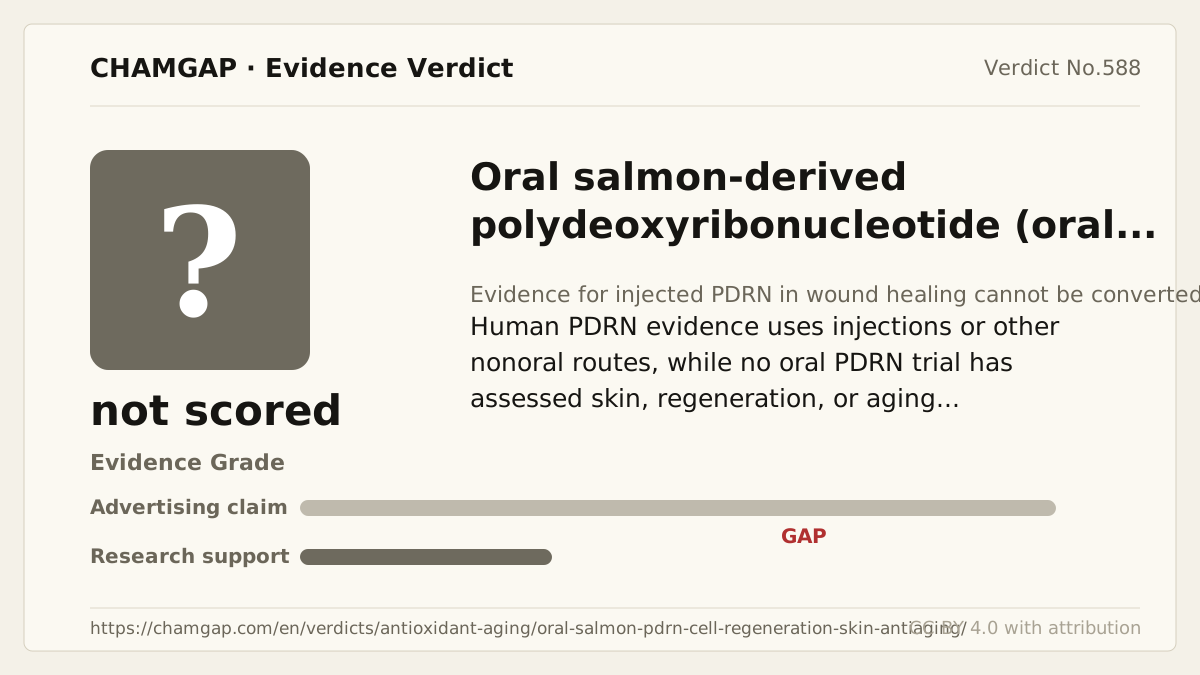
[Chamgap] Oral salmon-derived PDRN x cell regeneration, skin rejuvenation, and delayed aging — Evidence Grade ?. 4 cited sources checked. Source: https://chamgap.com/en/verdicts/antioxidant-aging/oral-salmon-pdrn-cell-regeneration-skin-antiaging/ · CC BY 4.0CC BY 4.0 — free to use with attribution; do not distort grades, numbers, or verdict meaning.
What this document does and does not do
Chamgap is an information source. It reports what research has and has not confirmed; it does not tell readers what to take or buy. That decision belongs to readers and, when needed, medical or legal professionals. This verdict reflects literature available up to the search date and may change as new research appears. Nothing here is medical advice.