
Reduced NMN,
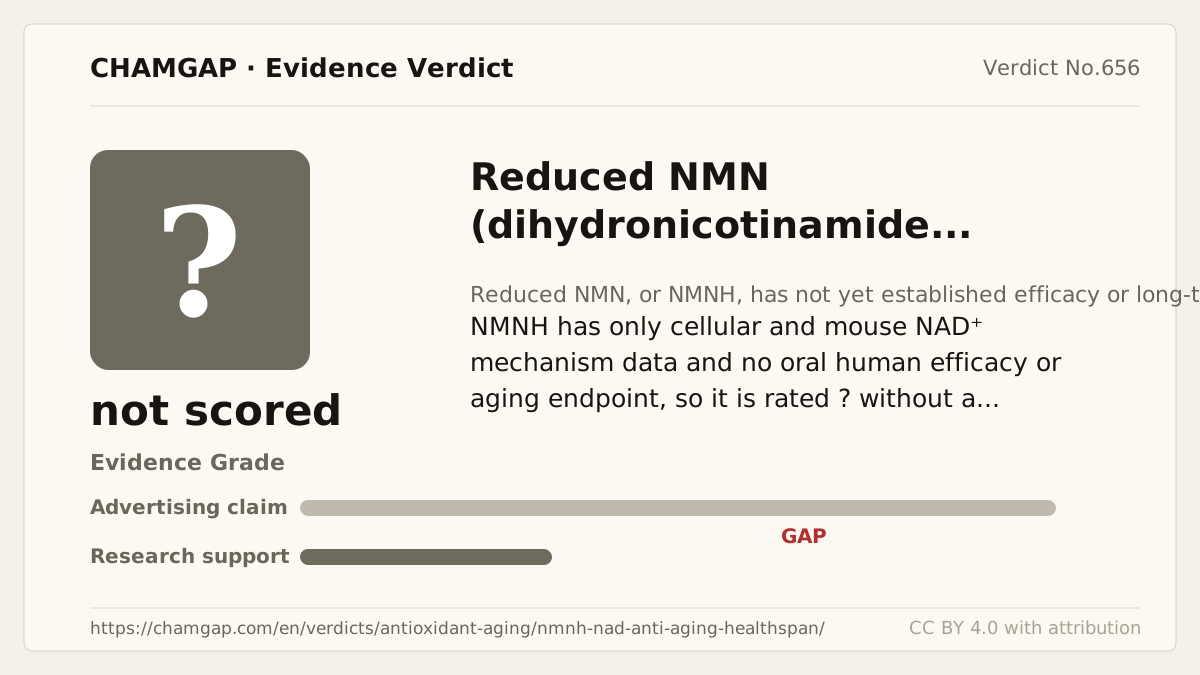
does it really help with Delayed aging, improved cellular energy, and longer healthspan through a surge in NAD⁺?
research showsReduced NMN, or NMNH, is rated ? because no human oral efficacy literature exists. The public core studies are preclinical experiments asking whether NMNH raises NAD⁺ in cells and mice, not whether it changes human NAD⁺, perceived energy, aging, or healthspan. Human trials of oxidized NMN or NR cannot substitute for evidence on the chemically different NMNH, and outcomes from products combining CoQ10, PQQ, or other ingredients cannot be attributed to NMNH alone. Human and long-term safety have not been established either.
ads claimMarketing converts a surge in NAD⁺ concentration in mouse tissues directly into human rejuvenation, energy, and longer life. Some products combine NMNH with CoQ10, PQQ, or other NAD⁺ precursors, preventing attribution while presenting the package as if it proved the effect of NMNH alone.
Useful facts when choosing a product
- NMNH differs in redox state from the oxidized NMN commonly sold as a supplement. Human trial results for NMN or NR cannot be transferred directly to NMNH dosing, efficacy, or safety.
- Published NMNH studies examined metabolite concentrations and injury models in cells and mice. Human oral absorption, an appropriate dose, clinical aging endpoints, and long-term safety have not been established.
- Some marketed products also contain CoQ10, PQQ, or other NAD⁺ precursors. A perceived effect or laboratory change from a combination cannot be attributed to NMNH alone.
- Label accuracy, purity, and stability may vary among supplements. Because human safety data are absent, NMNH should not be used to treat disease or replace prescribed therapy.
Chamgap Semantic Classification Code
Candidate index · review held
S.reduced-nmn.UNK.delayed-aging-improved-cellular-energy-and-longer-healthspan-through-a-surge-in-nad.reduce.UNKSupplements and nutraceuticals > Reduced NMN > Unknown > Delayed aging, improved cellular energy, and longer healthspan through a surge in NAD⁺ > Reduction claim > Unknown
An automated migration candidate, not an issued permanent code; exact claim scope remains under review. This machine-generated migration candidate helps retrieval but is not a permanent assignment. The original verdict ID and URL remain authoritative.
What the research actually shows
Zapata-Pérez and colleagues reported that NMNH rapidly increased NAD⁺ across cultured cells and multiple mouse tissues and produced a repair signal in a hypoxia-reoxygenation model of renal tubular epithelial injury. Liu and colleagues found that NMNH increased NAD⁺ and NADH in cells and mouse liver but suppressed glycolysis and the TCA cycle and induced cell-cycle arrest and growth suppression. Neither study was an oral human supplementation trial, and neither measured clinical aging, healthspan, fatigue, or function. No publicly available human efficacy trial of NMNH itself was identified through July 19, 2026.
Why this is classified as ?
No public oral human efficacy literature or aging or healthspan endpoint exists for NMNH itself. Cellular and mouse NAD⁺ changes precede even surrogate human evidence, while oxidized NMN, NR, and combination products belong to different evidence tracks. The result is ? with a null score. Unregulated product variation and unestablished human safety are independent safety issues.
Counterpoint. An interesting NAD⁺ mechanism is not evidence that a supplement helps humans live longer in good health. Until a registered and published oral randomized human trial appears, neither the direction nor the size of efficacy can be judged.
Rejudgment record. New verdict — Applied ? for absence of human efficacy literature because NMNH itself has no oral human efficacy study or aging or healthspan endpoint and only cellular and mouse NAD⁺ mechanism data; oxidized NMN, NR, and combination products were excluded as separate evidence tracks
Sub-claim grades by effect
This ingredient is marketed for several effects. A single overall grade blends strong and weak claims together, so each effect is graded separately here. The overall grade reflects the strongest disconfirming or core claim.
| Effect (sub-claim) | Grade | Basis |
|---|---|---|
| Delayed aging and improved healthspan | ? | NMNH itself has no oral human trial or clinical aging or healthspan endpoint. |
| Increased NAD⁺ and improved cellular energy | ? | The NAD⁺ rise is a cellular and animal surrogate with no human data, and one study found suppression of glycolysis and the TCA cycle. |
| Attribution of combination-product effects to NMNH alone | ? | CoQ10, PQQ, and other co-ingredients prevent isolation of an NMNH-only effect. |
Cross-check — AI research and Codex final gate
Evidence Table
| Study | Design | Sample | Funding | Endpoint | Result | Weight |
|---|---|---|---|---|---|---|
| Zapata-Pérez R et al. 2021 | Preclinical cellular and mouse mechanistic metabolism study | Cultured cells and mice; zero humans | Academic institutions with a Nestlé Research-affiliated coauthor | Cellular and tissue NAD⁺ and renal tubular-cell injury markers | NMNH rapidly increased NAD⁺ in cells and multiple mouse tissues and produced a repair signal in a cellular injury model. | Not human efficacy or a clinical aging endpoint |
| Liu Y et al. 2021 | Cellular metabolomics and preclinical mouse study | Cultured cells and mice; zero humans | Academic research; not a manufacturer clinical trial in the published abstract | NAD⁺, NADH, glycolysis, the TCA cycle, and cell growth | NMNH increased NAD⁺ and NADH but suppressed glycolysis, the TCA cycle, and cell growth. | Not human energy or anti-aging efficacy |
Receipt — 2 References
All 2 cited sources were verified for existence at the original page (as of 2026-07-19).
Final verification and publication gate: Codex · Evidence date: 2026-07-19 · Corrections: none
Cite this verdict
[Chamgap] Reduced NMN (NMNH) x delayed aging, improved cellular energy, and longer healthspan through a surge in NAD⁺ — Evidence Grade ?. 2 cited sources checked. Source: https://chamgap.com/en/verdicts/antioxidant-aging/nmnh-nad-anti-aging-healthspan/ · CC BY 4.0CC BY 4.0 — free to use with attribution; do not distort grades, numbers, or verdict meaning.
What this document does and does not do
Chamgap is an information source. It reports what research has and has not confirmed; it does not tell readers what to take or buy. That decision belongs to readers and, when needed, medical or legal professionals. This verdict reflects literature available up to the search date and may change as new research appears. Nothing here is medical advice.